
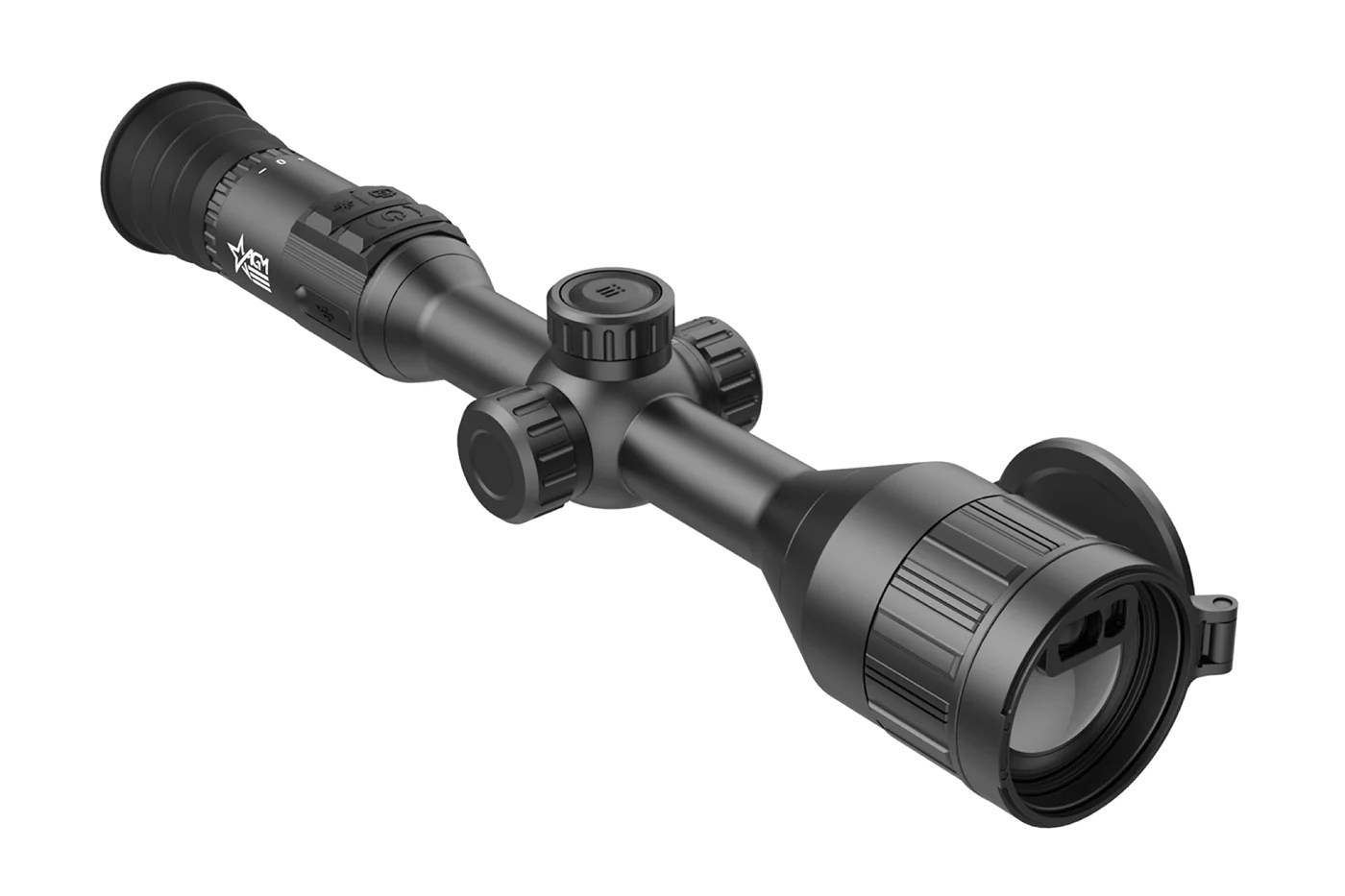
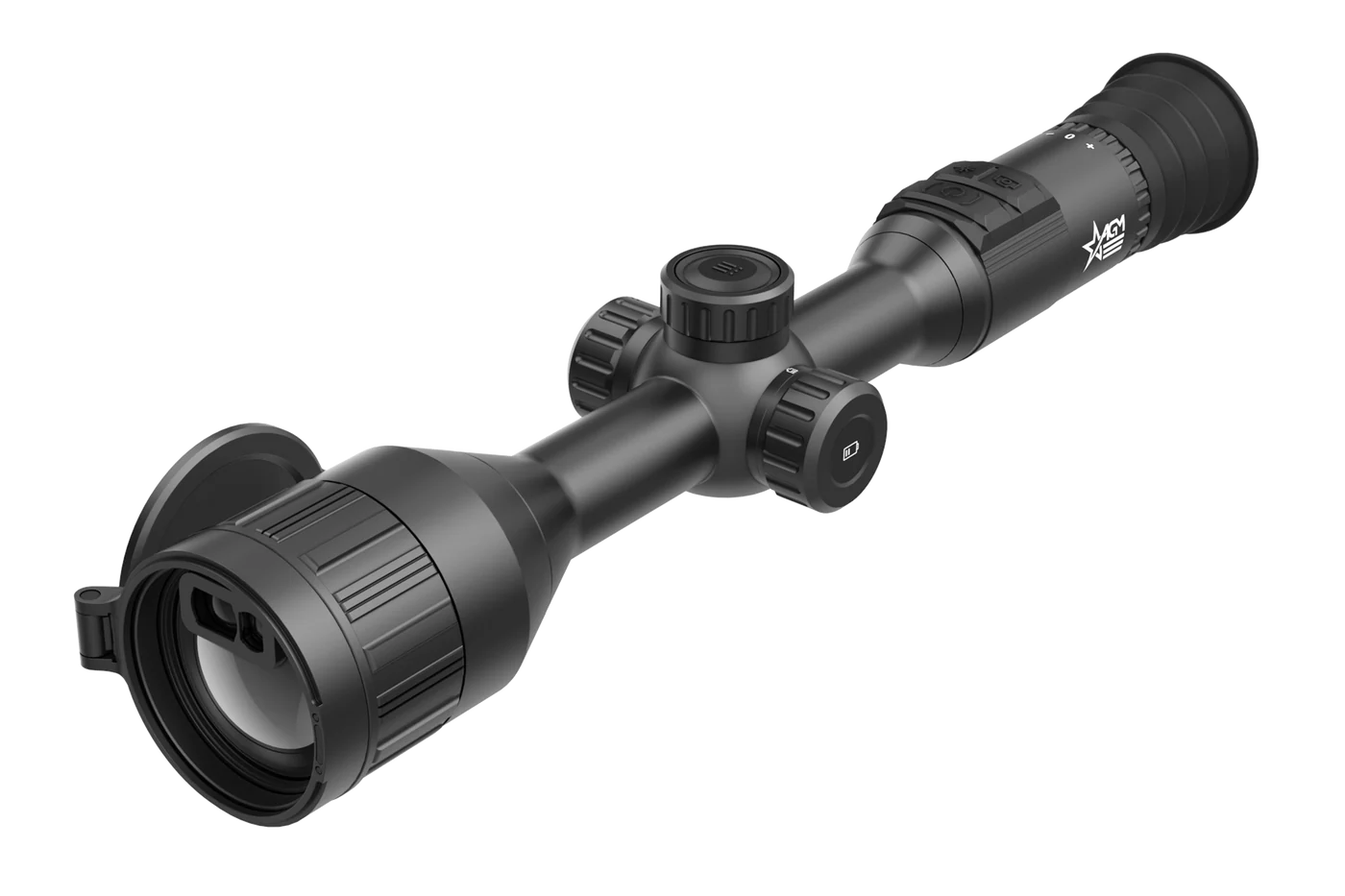
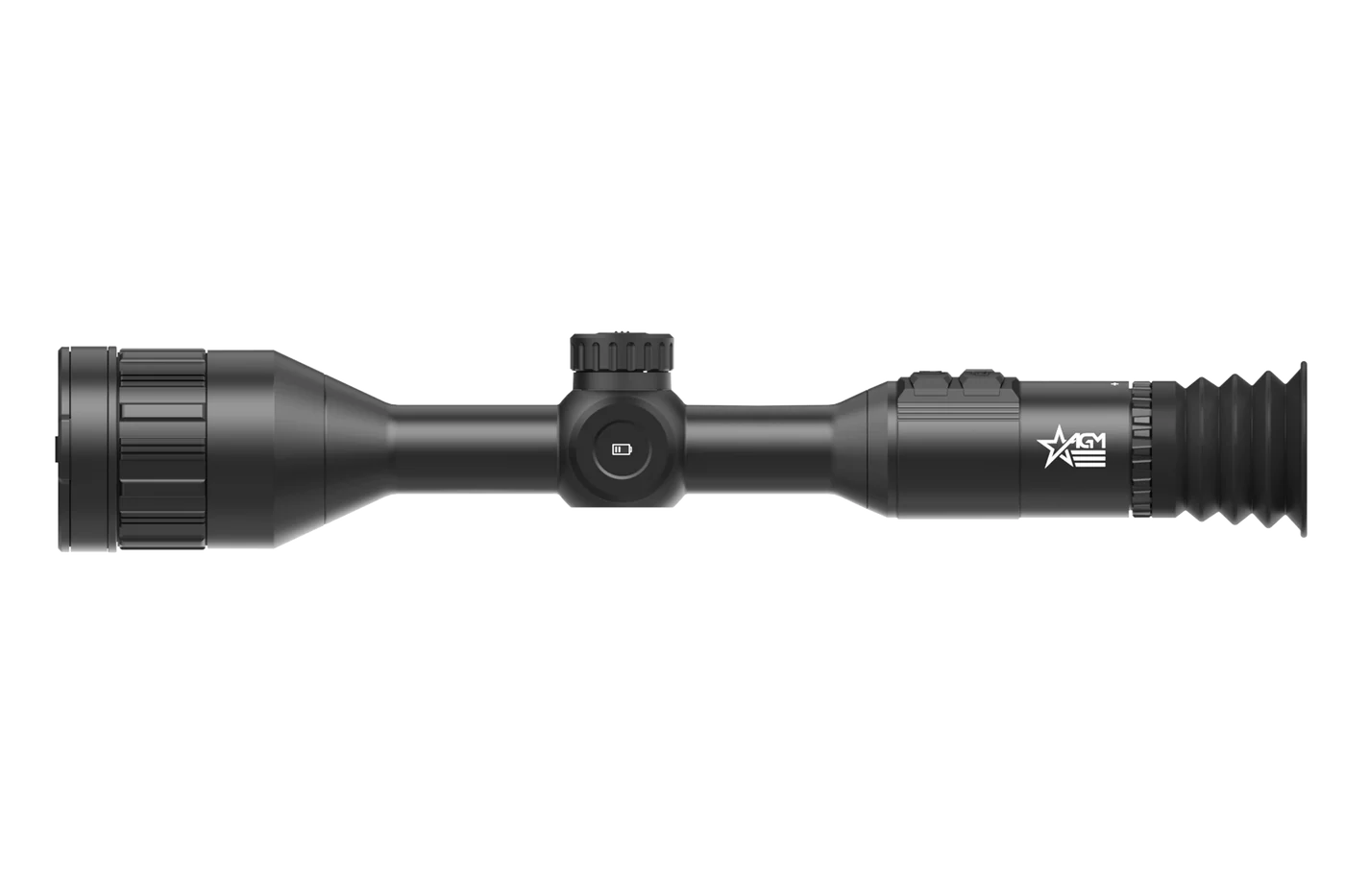
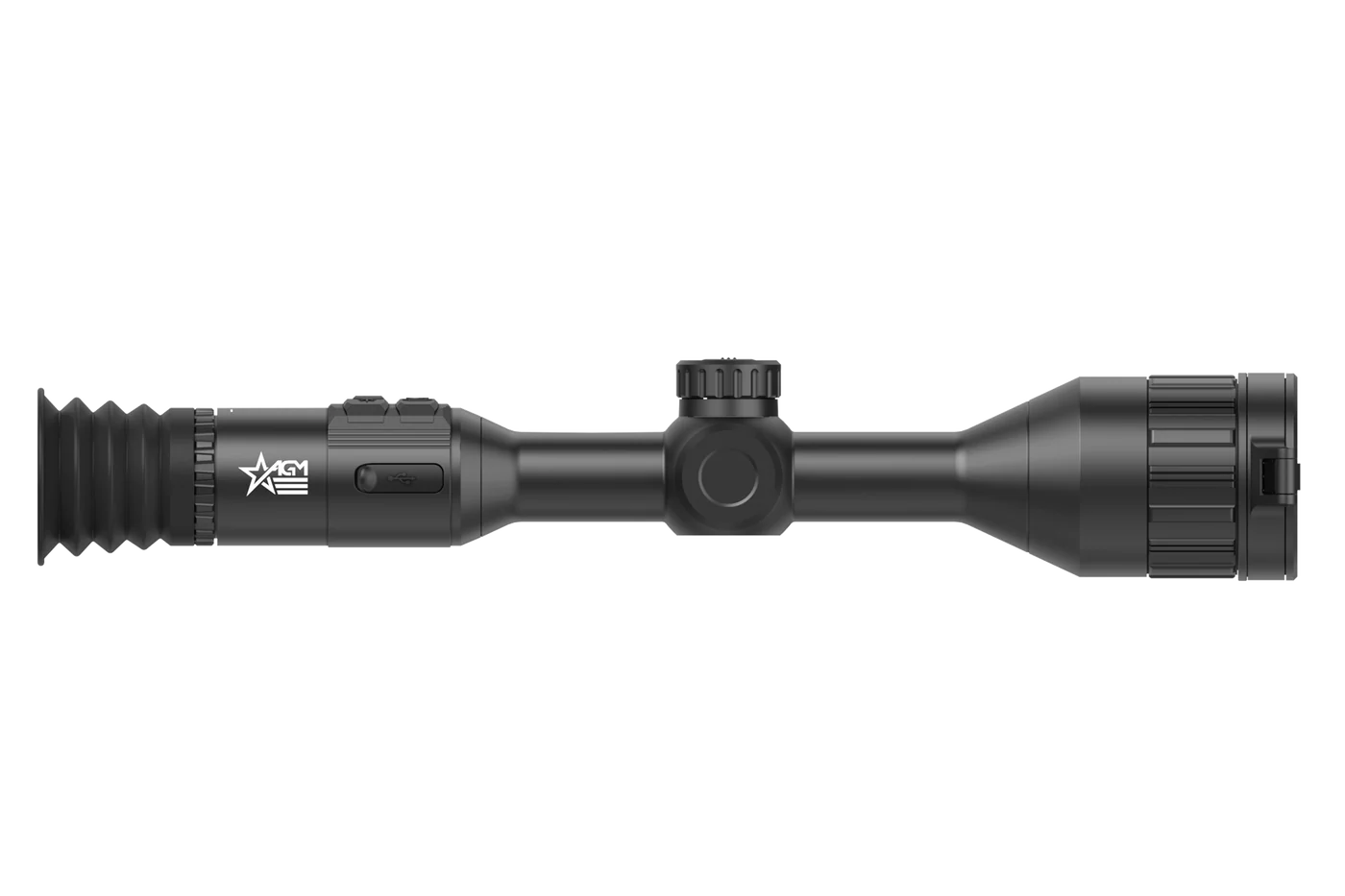
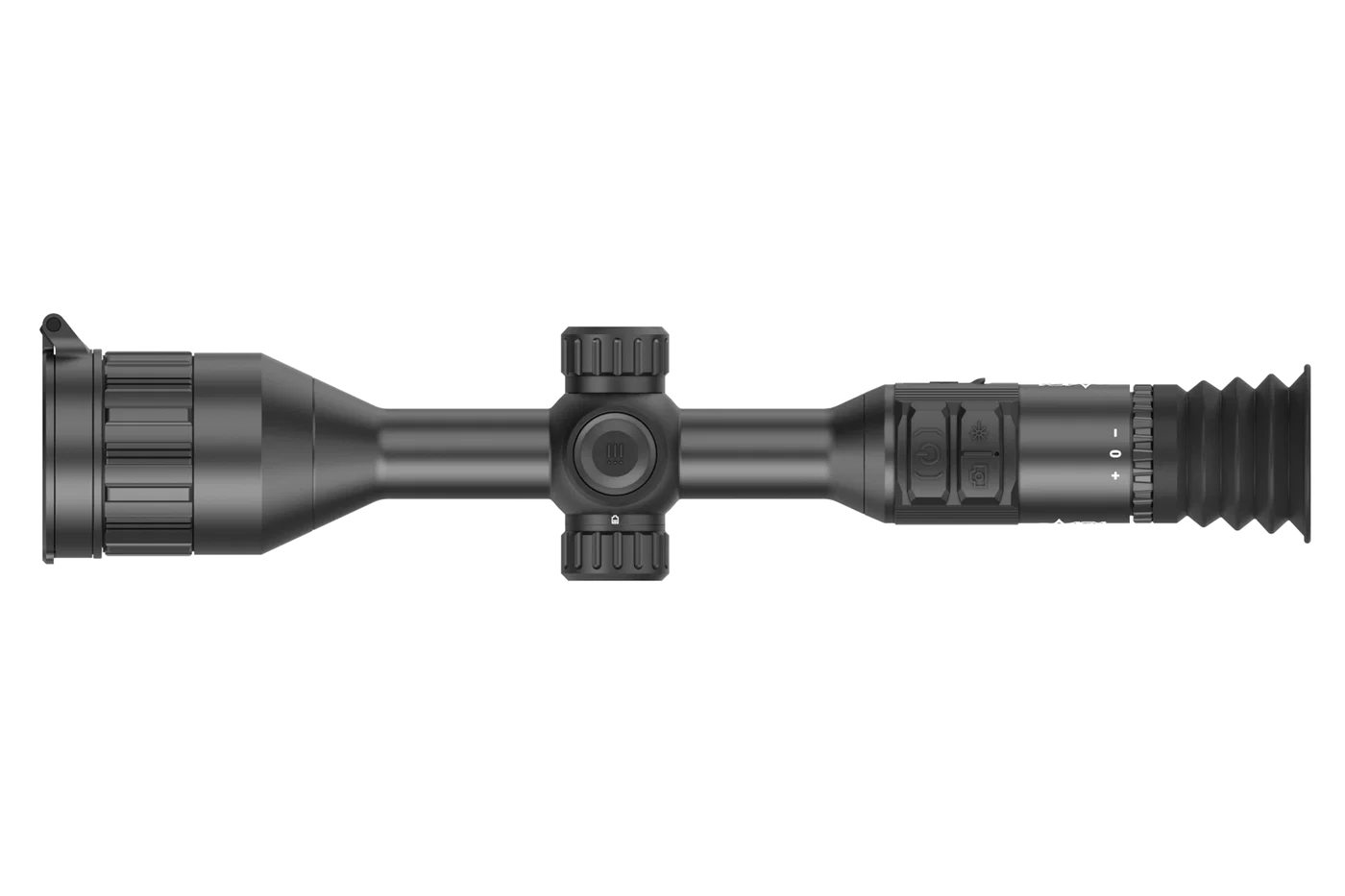
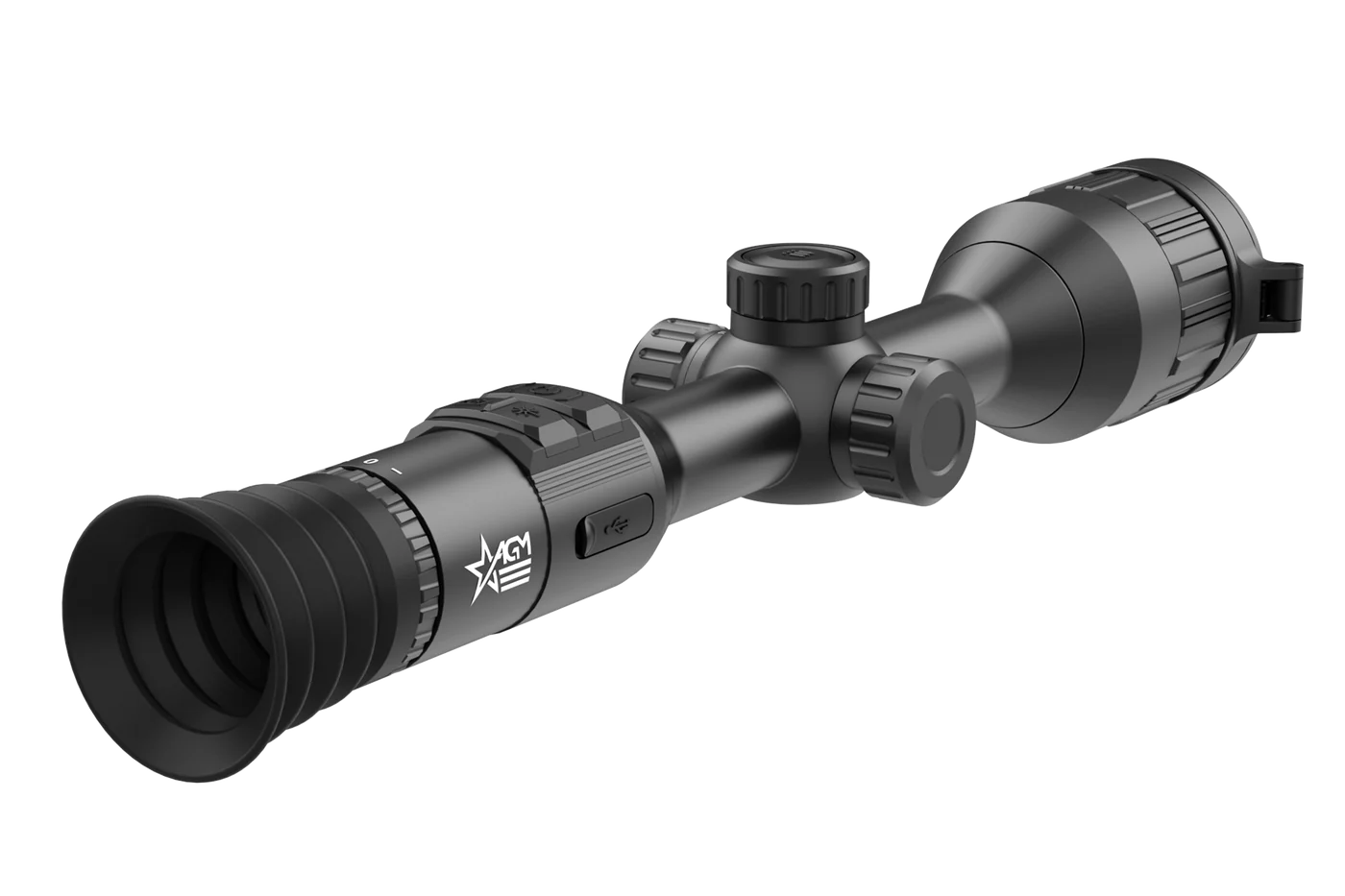
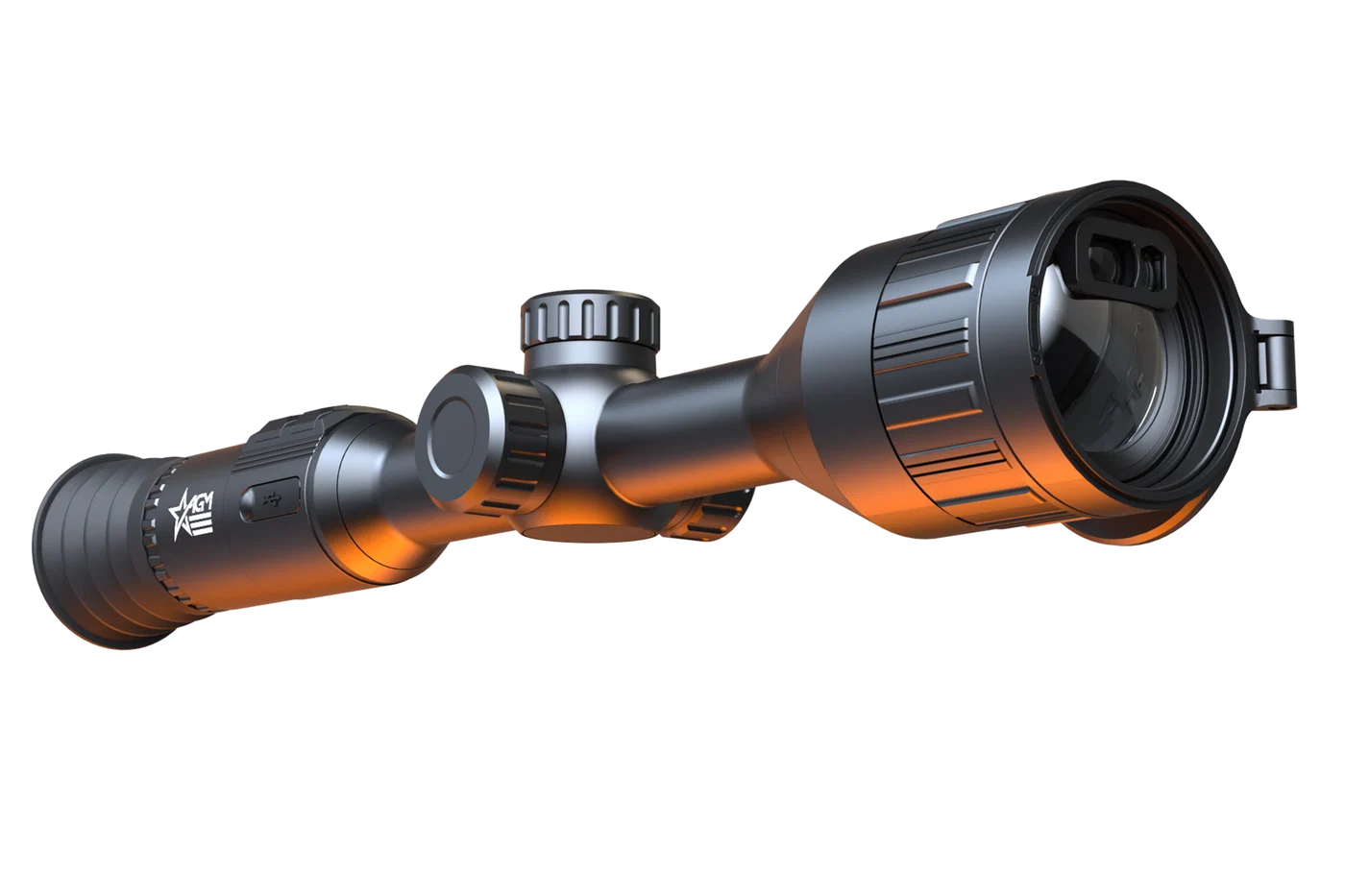
The rangefinder is inside the lens, and that is the point.
Every other way of adding rangefinding to a thermal scope involves a housing bolted to the side or top of the body. That adds weight where you do not want it, breaks the profile, and puts the emitter at an offset from the optical axis so the ranged point sits slightly away from where the reticle is pointing.
AGM built the 1,000-yard laser into the front lens assembly. From any angle except directly head-on, you cannot see it. The practical consequences are that the scope mounts in standard 30 mm rings, the balance stays where a scope’s balance should be, and the ranged point matches the reticle.
The ballistic calculator stores five profiles. That is the number that makes a difference in practice: enough for a rifle with three loads plus a second rifle, without the menu depth becoming a problem in the dark.
Sub-15 mK on a 640 sensor
NETD measures the smallest temperature difference the sensor resolves, in millikelvins. Lower is more sensitive. Sub-15 mK is at the sensitive end of the commercial market.
It matters most when thermal contrast collapses: ground fog, drizzle, high humidity, and a damp field at first light where a deer is barely warmer than the grass. In those conditions sensitivity determines whether you see an outline or a smear, and resolution barely helps.
This figure is the specification that separates the V2 generation from the Gen 1 Adder TS, which runs at sub-35 mK. If you are comparing this model against our Adder TS50-640, the sensor resolution is identical and the noise floor is less than half. Read the generation comparison on the category page before deciding.
Display and interface
The 2560×2560 micro display is AGM’s first at that density and replaces the 1024×768 panel on Gen 1. Over a long session the denser panel lowers eye strain, because fatigue on thermal optics comes from the brain interpolating a coarse image rather than from brightness.
The semi-circular interface puts battery, magnification, range, time, and pitch scale around the edge of the view rather than across it. Pitch readout matters more than most buyers expect: shooting up or down a slope changes effective bullet drop, and the calculator does not correct for angle automatically.
Shutterless NUC means calibration happens algorithmically with the live image. No freeze, no shutter click. Ten brightness and ten contrast steps, all six palettes including red and green monochrome, plus warm and cool hue modes.
The 0.5× incremental step zoom is a small feature that earns its place. Standard scopes jump 2×, 4×, and 8×. Half-step adjustment lets you sit at the highest magnification that still holds image quality for the distance you are actually at.
Power, build, and support
Dual power: an internal rechargeable cell plus a removable 18650, giving up to 9 hours with the rangefinder active. USB-C external power supports 5V/2A with QC3.0. Note that the USB-C connection charges only the internal battery, so use the supplied charger for the 18650.
IP67 waterproof and shockproof, rated to 1,000 g recoil. 64 GB storage with video, audio, and Shot Activated Recording, plus on-device playback so you review footage through the eyepiece rather than exporting first.
An American-made ADM Recon 30 mm one-piece mount is included. Five-year warranty.
Current firmware adds Image Boost 4.0 with a self-adaptive imaging algorithm and an Auto scene mode, shared with the Rattler V3 range.
For a detailed comparison, see our thermal scope buying guide, which includes Pulsar, ThermTec, and Hikmicro.
Technical specifications
| Feature | Specification |
|---|---|
| Thermal resolution | 640×512 |
| Pixel pitch | 12 micron |
| NETD | Sub-15 mK |
| Lens size | 50 mm |
| Magnification | 3.5× to 26× |
| Zoom adjustment | 0.5× incremental step |
| Display | 2560×2560 OLED micro display |
| Interface | Semi-circular, with battery, magnification, range, and pitch readout |
| Laser rangefinder | 1,000 yd, integrated in lens assembly |
| Ballistic calculator | Onboard, 5 profiles |
| NUC | Shutterless |
| Display settings | 10 brightness, 10 contrast |
| Palettes | Black Hot, White Hot, Red Hot, Fusion, Red Monochrome, Green Monochrome, warm and cool hues |
| Storage | 64 GB eMMC |
| Battery | Internal rechargeable plus removable 18650, up to 9 hours |
| External power | USB-C, 5V DC/2A, QC3.0 |
| Recoil resistance | 1,000 g |
| Housing | 30 mm tube, IP67 |
| Recording | Video with audio, shot activated recording, on-device playback |
| Mount | ADM Recon 30 mm one-piece, included |
| Warranty | 5 years |
FAQ
What is the difference between the AGM Adder V2 and the Adder TS?
The V2 uses a sub-15 mK sensor, a 2560×2560 display and shutterless NUC, and adds a 1,000-yard in-lens laser rangefinder with a ballistic calculator. The Adder TS uses a sub-35 mK sensor, a 1024×768 display, and a mechanical NUC shutter and has no rangefinder. Both use a 30 mm tube. The sensitivity difference is the significant one: it determines image quality in fog, rain, and high humidity.
Where is the laser rangefinder on the Adder V2 LRF 50-640?
It is built into the front lens assembly rather than mounted externally. That keeps the scope in a standard 30 mm tube profile, allows mounting in normal rings, and puts the laser on the same optical axis as the thermal channel so the ranged point matches the reticle. It is rated to 1,000 yards.
How long does the Adder V2 LRF 50-640 run on a charge?
Up to 9 hours with the rangefinder active, using a dual power system of an internal rechargeable cell plus a removable 18650. USB-C external power extends runtime, though the USB-C connection charges only the internal battery. Use the supplied charger for the 18650.
What mount comes with the Adder V2 LRF 50-640?
An American-made ADM Recon 30 mm one-piece mount is included. As a 30 mm tube scope, it will also fit standard 30 mm rings if you prefer a different mounting solution, which is one of the practical advantages of the tube format over bridge-style thermal bodies.
What recoil can the Adder V2 handle?
It is rated to 1,000 g recoil resistance in an IP67 waterproof and shockproof housing. That covers standard centerfire hunting cartridges. Mount quality matters as much as scope rating: a well-specified scope on an inadequate mount will still shift under recoil.
Inacio Bortolotti –
Excellent product! Good material. I haven’t used it in the hunt yet. I tested it at home! It works very well!