
Evolver Thermal Scope
Showing the single result
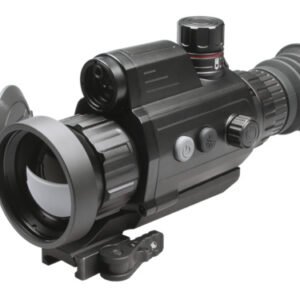
AGM Evolver Thermal Scope
The AGM Evolver is the highest-resolution thermal riflescope AGM build. The Evolver LRF 1280 carries a 1280×1024 sensor, four times the pixel count of a 640×512, behind a 65 mm F/1.0 Germanium lens, feeding a 2560×2560 OLED display.
Detection reaches 3,250 m, further than any other scope we stock. The integrated 1,000 m laser rangefinder and onboard ballistic calculator turn that reach into shots you can justify. Two rechargeable batteries ship in the box for a combined runtime approaching eight hours.
It is a specialist optic, and there is one trade-off worth knowing before you buy. We cover it below.
Quick-scan decision triggers:
- In stock now. Several of the largest US retailers are currently sold out of the Evolver.
- Shipped worldwide from Berlin, 2 to 3 days across Europe, with international delivery available. Most AGM stock sits in the US behind ITAR and EAR export restrictions that block shipping abroad.
- Two NE-4400 batteries and an American-made ADM quick-detach mount included, with a five-year warranty.
What a 1280 Sensor Actually Buys You
Most thermal riflescopes stop at 640×512. The AGM Evolver runs 1280×1024, which is four times the pixels of a 640 and roughly twelve times a 384.
The obvious gain is identification distance. Where a 640 sensor gives you posture and outline at 400 m, a 1280 gives you the same read considerably further out, and enough detail at closer range to pick individual animals out of a group rather than reading them as a mass.
The less obvious gain is what happens when you zoom. Every thermal scope degrades under digital magnification because you are enlarging pixels rather than adding information. Starting from 1280×1024 means you have pixels to spare, so the image at 5× and 8× holds together in a way a 640 scope cannot manage.
Base magnification is 2.5× with a 13.5° field of view, running to 20×. AGM set the base deliberately low: hog hunters get a wide enough field for close engagements, and predator hunters can zoom into it without the image falling apart.
On the 3,250 m detection figure. Detection means the scope registers a heat signature. Identification, knowing what the animal is, happens far closer. Even on a 1280 sensor, realistic identification runs well under half that number. The 1,000 m rangefinder, accurate to ±4 m with a 10 m minimum, is the more useful ceiling to plan around.
The 25 Hz Trade-Off, Which Nobody Else Will Tell You
The Evolver refreshes at 25 Hz. Every other AGM thermal riflescope we stock runs at 50 Hz.
Refresh rate governs how smoothly the image updates. At 50 Hz a running fox stays crisp as you track it across the frame. At 25 Hz there is visibly more motion blur on fast lateral movement, and panning the rifle feels less immediate.
The reason is arithmetic. A 1280×1024 sensor moves four times the data of a 640×512, and something has to give. AGM chose resolution.
What this means in practice:
| Your shooting | Verdict |
|---|---|
| Static or slow-moving targets at long range | The Evolver is the best scope we stock, full stop. |
| Long observation from a fixed position | 25 Hz is irrelevant. Buy it. |
| Fast-moving predators tracked across open ground | The Rattler V3 LRF 50-640 at 50 Hz will feel better in hand. |
| Running hogs at close range | 50 Hz matters more than 1280 resolution does. |
Nobody else selling this scope mentions the refresh rate. We would rather you knew now than found out on your first fast follow-up shot.
H3: Where the Evolver Sits in AGM’s Range
AGM builds most of its thermal riflescopes on a shared platform and differentiates by what gets added. Understanding that makes the choice much simpler.
| Scope | Housing | Sensor | What it adds | Refresh |
|---|---|---|---|---|
| Rattler V3 | Compact | 384 or 640, sub-15 mK | The current base platform, in-lens 1,000 m LRF | 50 Hz |
| Varmint V2 | Compact, smallest | 384 or 640, sub-20 mK | 600 m LRF, lowest price, doubles as a monocular | 50 Hz |
| Clarion | Compact | 384 or 640, sub-20 mK | Two mechanically switching lenses | 50 Hz |
| Evolver LRF 1280 | Compact | 1280, sub-18 mK | 65 mm lens, 1,000 m LRF, 2560×2560 display | 25 Hz |
| Adder | 30 mm tube | 384, 640 or 1280 | Standard ring mounting | 50 Hz |
One comparison worth making before you commit. The AGM Adder V2 LRF 60-1280 uses the same 1280×1024 sensor in a 30 mm tube with a 60 mm lens. If you want the resolution but prefer mounting in standard rings, ask us about it.
Sensitivity, and Why the Flagship Is Not the Most Sensitive
The Evolver is rated below 18 mK. Our Rattler V3 and Adder V2 ranges run below 15 mK.
That looks backwards for a flagship until you consider the engineering. Packing four times the pixels into a sensor gives each pixel less area to work with, which makes a very low noise floor considerably harder to hit. Sub-18 mK on a 1280×1024 detector is a harder result than sub-15 mK on a 384×288.
In practice: in heavy fog a Rattler V3 will hold a readable outline marginally longer. In every other condition the Evolver produces a substantially better image, because resolution does work that sensitivity alone cannot.
Power, Build and What Ships With It
Two NE-4400 rechargeable batteries in the box, each rated at more than four hours, giving a combined runtime approaching eight hours. AGM’s decision to include two rather than one matters on a scope drawing this much power. External USB-C power is supported for static positions.
64 GB of onboard storage with video, audio, image capture and Shot Activated Recording, which captures the seconds around the trigger break without you touching a button. Wi-Fi data transmission. Flat field correction in auto, semi-auto or manual.
Rated to 1,000 g recoil at 0.4 ms. IP67 waterproof and shockproof. 270 × 115 × 88 mm, 1.75 lb. Ten reticle types in four colours. Black Hot, White Hot, Red Hot and Fusion palettes.
An American-made ADM quick-detach mount is included, along with the charger, USB-C cable, lens tissue, carrying case and manual. Five-year warranty. Worth stating plainly, because at least one large retailer currently lists this scope with a six-month warranty in its product data.
Related buying guides and complementary gear
Cross-shopping brands at this level? Our best thermal scope buying guide compares AGM against Pulsar, ThermTec and Hikmicro on sensitivity, rangefinding and resale value. Thermal versus night vision covers where each technology wins, and thermal imaging for hunting explains why detection range and identification range are very different numbers, which matters a great deal on a scope quoting 3,250 m.
Across the rest of the AGM range: the Rattler V3 compact scopes for the most sensitive sensor at 50 Hz, the Adder 30mm tube scopes if you want to mount in standard rings, the Varmint V2 LRF scopes for affordable laser ranging, the Clarion dual focus scopes for two lenses in one optic, and the Secutor thermal scopes for extended tactical shifts.
A scope with a 13.5° field is not a scanning device. Pair it with a thermal monocular and scan with that instead of pointing a loaded rifle at everything you want to identify. See our guides to thermal monoculars for hunting and AGM thermal monoculars, or the Pulsar thermal monocular range for the premium option. For observing in groups, thermal binoculars are the alternative.
Working in low light rather than full dark? Compare against our night vision monoculars, night vision binoculars and night vision goggles. We also stock Pulsar thermal riflescopes and HIKMICRO thermal rifle scopes.
AGM Evolver Buying Questions
What makes the AGM Evolver different from a 640 thermal scope?
The Evolver uses a 1280×1024 sensor, four times the pixel count of a 640×512. That extends identification distance and lets you pick individual animals out of a group rather than reading them as a mass. It also means digital zoom degrades far less, because you have pixels to spare rather than enlarging what you already have.
Why does the AGM Evolver run at 25 Hz when other AGM scopes run at 50 Hz?
A 1280×1024 sensor moves four times the data of a 640×512, and AGM chose resolution over refresh rate. In practice you will see more motion blur when tracking fast lateral movement, and panning feels less immediate. For static or slow-moving targets at long range it makes no difference. For running hogs or fast predators, a 50 Hz scope such as the Rattler V3 will feel better in hand.
How far can the AGM Evolver LRF 1280 detect?
AGM publish 3,250 m against a six-foot object, the longest in their range. Detection is not identification: even on a 1280 sensor, realistic identification runs well under half that figure. The integrated laser rangefinder reaches 1,000 m with ±4 m accuracy and a 10 m minimum, which is a more useful ceiling to plan around.
Why is the Evolver’s NETD higher than the Rattler V3’s?
Packing four times the pixels into a sensor gives each pixel less area, which makes a very low noise floor harder to achieve. Sub-18 mK on a 1280×1024 detector is a harder engineering result than sub-15 mK on a 384×288. In heavy fog a Rattler V3 holds an outline marginally longer; in every other condition the Evolver produces the better image.
What is the battery life on the AGM Evolver?
More than four hours per battery, and two NE-4400 rechargeable batteries ship in the box, giving a combined runtime approaching eight hours. External USB-C power extends it further for static positions. Swapping takes about ten seconds.
Do you ship the AGM Evolver outside the United States?
Yes. We ship worldwide from Berlin, with 2 to 3 day delivery across Europe and international delivery available elsewhere. AGM’s own site and every major US dealer carry ITAR and EAR export restrictions that prevent shipping thermal optics abroad, so buyers outside the US regularly reach checkout and find the order blocked. Several of those US retailers are also currently out of stock on this model.
Is the AGM Evolver a clip-on?
No. It is a standalone riflescope built on a compact housing with a 65 mm objective. AGM’s clip-on products are the Secutor LRF-C and the Rattler-C, which convert an existing day scope to thermal and are a separate line.