
Thermal vs Night Vision: Which One Do You Actually Need? (2026)
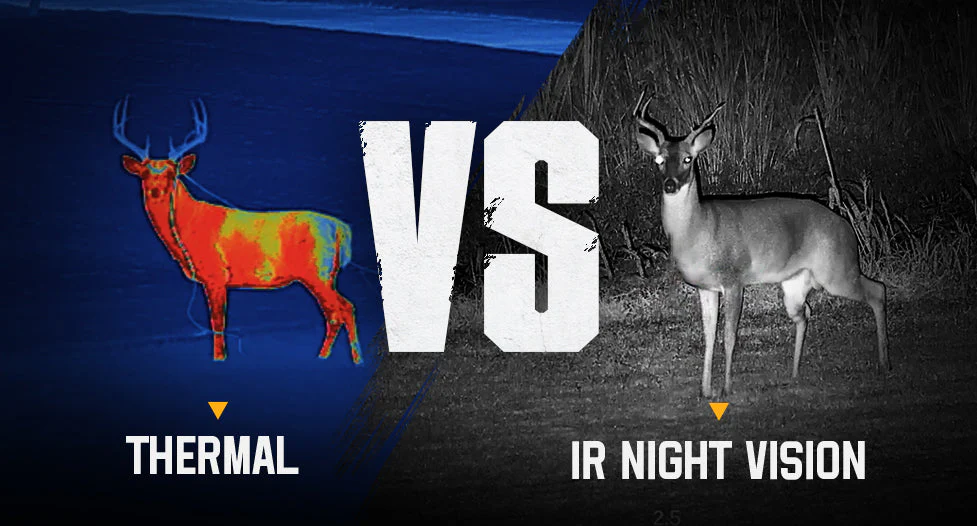
Thermal imaging detects heat. Night vision amplifies light. That one difference decides everything: thermal finds game in total darkness, and night vision gives you a more detailed, natural image when there is some light to work with. If you remember one thing about thermal vs night vision, remember that thermal is the better tool for finding an animal and night vision is the better tool for identifying it.
But that headline hides a lot you need to know before spending money. Which is actually better for hunting? Do you need both? Why is night vision green? Do thermal monoculars need an infrared illuminator? What does each cost? This guide answers all your questions in plain language, from a retailer that sells both and has no reason to push one over the other.
We stock every major make of thermal and night vision, so unlike the manufacturer pages you will compare this against, the advice here is about what fits the way you hunt, not what we happen to build.
Thermal vs night vision: the short answer
Short on time? Here is the whole comparison in one box.
- Thermal wins for detection. It reads heat through total darkness, light brush, and fog, needing no light at all. It is best for finding games quickly.
- Night vision wins for identification. It shows a natural, detailed image so you can read antlers, confirm a target, and navigate terrain, but it needs some light or an IR illuminator.
- For hunting, most people should buy thermal first. Finding the animal is the most challenging part, and thermal solves it at a lower entry price than quality night vision.
- Serious hunters often own both, scanning with thermal and then confirming and shooting with night vision or a lit day optic.
- Cost: entry thermal starts around €420; quality tube night vision starts around €2,000.
Now the full picture.
What is the difference between thermal and night vision?
The difference comes down to what each device uses to build an image. Thermal reads the heat that warm bodies give off, so it needs no light at all. Night vision collects and amplifies the small amount of light already in a scene, so it needs at least some starlight, moonlight, or infrared light to work.
That is why the two feel so different in the field. Point a thermal device into pitch black, and a warm animal glows instantly. Point night vision into the same black, and you see very little until an illuminator adds light. But once there is light, night vision shows you a detailed, lifelike scene that thermal simply cannot match.
How thermal imaging works
A thermal optic uses a sensor called a microbolometer that detects infrared radiation, the heat emitted by animals, people, and machinery, and turns tiny temperature differences into a picture. A warm boar stands out brightly against cool ground, even in pitch-dark fog or light cover.
Thermal cannot be blinded by a bright lamp, and it works in daylight too. What it does not give you is fine visual detail, so it shows a clear heat shape rather than the exact markings of an animal. It also cannot see through glass or solid objects, only through gaps where heat escapes.
How night vision works
Traditional night vision uses an image intensifier tube that takes faint ambient light, multiplies it many thousands of times, and shows it on a small screen as a bright green or white image. The result looks natural and detailed, close to looking at the world through a dim window, which makes recognizing an animal or a precise aiming point easier.
The catch is that it needs some light. On a truly dark, overcast night it relies on an infrared illuminator, and a bright light source can wash out or even permanently damage the tube.
Thermal vs night vision: side-by-side comparison
| Feature | Thermal imaging | Night vision |
|---|---|---|
| Source of image | Heat (infrared radiation) | Amplified ambient light |
| Works in total darkness | Yes, it needs no light. | Needs some light or an IR illuminator |
| Finds hidden or camouflaged game | Excellent | Limited |
| Image detail for identification | Heat shapes, less detail | Natural and detailed |
| Sees through light fog and smoke | Yes. | No |
| Sees through glass | No | Yes. |
| Spooks game | No light emitted | Some animals can see the IR illuminator. |
| Daytime use | Yes. | No, bright light can damage tubes. |
| Detects vs identifies | Detection | Identification |
| Typical entry price | From around €420 | From around €2,000 for quality tubes |
| Best role | Finding the game fast | Confirming the target |
Is night vision or thermal better for hunting?
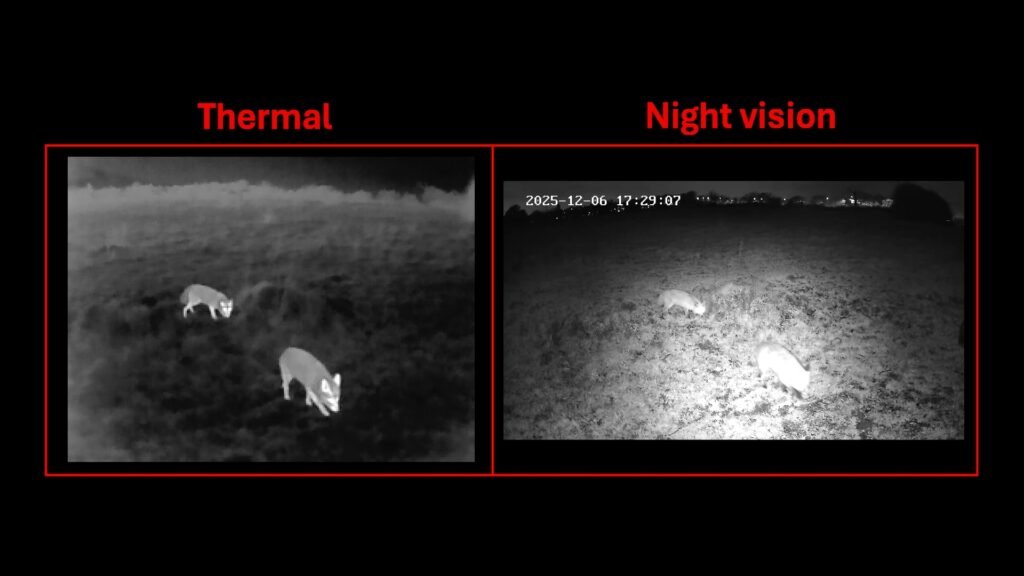
This is the question most hunters are really asking, and the honest answer is that thermal is better for finding game, while night vision is better for identifying it. Which matters more depends on how and what you hunt.
Thermal is better when detection is the more difficult part. Thermal imaging reveals heat at night and through light brush, allowing you to spot boar, hogs, foxes, and coyotes that move in darkness and hide in cover, which you would otherwise walk straight past. You sweep a whole field in seconds, and you throw no light to spook a wary game.
Night vision is better when identification is the hard part. If you need to read antlers, tell a fox from a cat, judge a precise aiming point, or move through terrain while reading branches and fences, night vision gives you the natural, detailed image that thermal cannot.
For most night hunting, detection is the harder problem, which is why most hunters should buy thermal first. But the two are not really rivals. The most effective setups use both: scan and find with thermal, then confirm and shoot with night vision or a lit day optic.
If you are choosing your first device, our thermal imaging camera for hunting guides and thermal monocular buying guide go deeper into the thermal side.
When thermal wins
Thermal wins whenever finding the animal is the hard part. It shows heat through darkness, light brush, long grass, and reeds, so a boar you would walk straight past appears as a bright shape on the screen. It lets you sweep a whole field in seconds, works in fog and drizzle, and throws no light to spook wary game.
It also works in daylight, sees through smoke, and cannot be blinded by a headlight or lamp. For night hunting, where detection comes first, and for game recovery, where a downed animal stays warm, thermal is the stronger choice. Most hunters reach for a thermal monocular first for exactly this reason.
When night vision wins
Night vision wins when you need a natural, detailed image to identify or confirm a target. It shows an animal much as your eye would in low light, so you can read antlers, distinguish a fox from a cat, or place a precise shot. It also gives a more relaxed, true-to-life view for moving through terrain, and it can see through glass, which thermal cannot.
On nights with moon or starlight, a quality night vision device, such as a Gen 2+ tube, provides detail that thermal cannot match. For navigation, identification, and any task where you need to see what something actually looks like rather than just its heat shape, night vision is the better tool.
The types of night vision explained (Gen 1, 2, 3, and digital)
“Night vision” is not one thing, and the differences matter, because they drive both price and performance. This area is where the manufacturer comparison pages tend to go quiet.
Gen 1
The oldest and cheapest image-intensifier technology. Gen 1 works under moonlight but is weak under cloud, has a shorter usable range, and the image is dimmer and less crisp. Fine for casual use, not for serious hunting.
Gen 2
A real step up. Brighter, clearer, and far better in low light, with a longer tube life. Gen 2 and Gen 2+ are the practical starting point for hunting-grade night vision.
Gen 3
Gen 3 is the military and professional standard, offering excellent performance in near-total darkness, long tube life, and the best low-light image available. It is expensive, often heavily export-controlled, and overkill for many civilian hunters.
Digital night vision
Instead of an intensifier tube, digital night vision uses a light-sensitive sensor, usually paired with an infrared illuminator. It costs far less than good tube night vision, records video, works in daylight without damage, and full-color digital models now exist. It does not match good analog night vision in the very darkest conditions, but for a hunter on a budget who wants a detailed image, it is worth knowing about. See our best night vision monocular guide for the full breakdown.
Why is night vision green?
If you have ever wondered why night vision goggles show that classic green image, here is the answer: it is a deliberate choice, not a limitation.
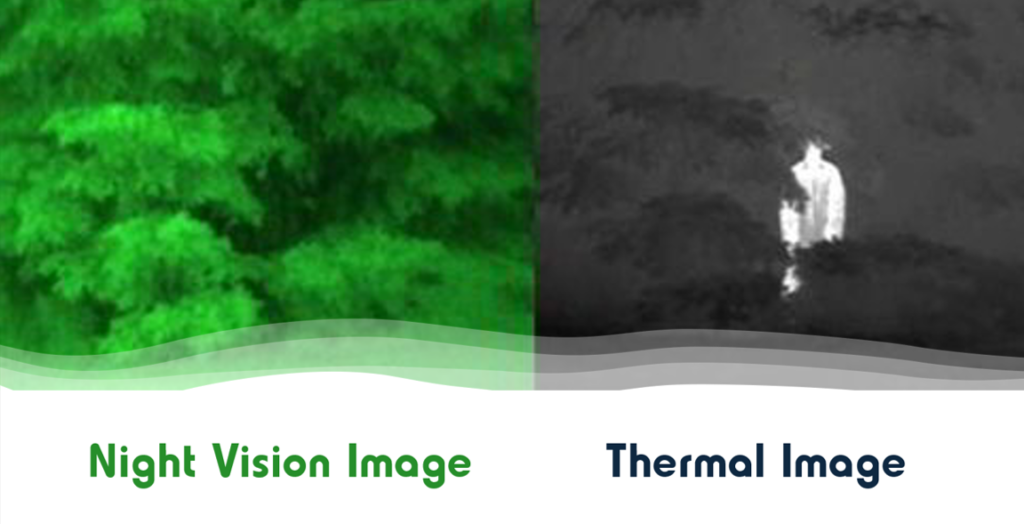
Traditional image intensifier tubes output a single color, and manufacturers chose green phosphor for two reasons. First, the human eye is more sensitive to green than to any other color, so a green image lets you pick out more detail at low brightness. Second, your eyes tire less when staring at green for long periods, which matters on a long night.
Newer tubes use white phosphor instead, giving a black-and-white image many users find more natural and easier to interpret. Neither is strictly better; white phosphor is simply the more modern option, and it usually costs more.
Do thermal monoculars need an infrared illuminator?
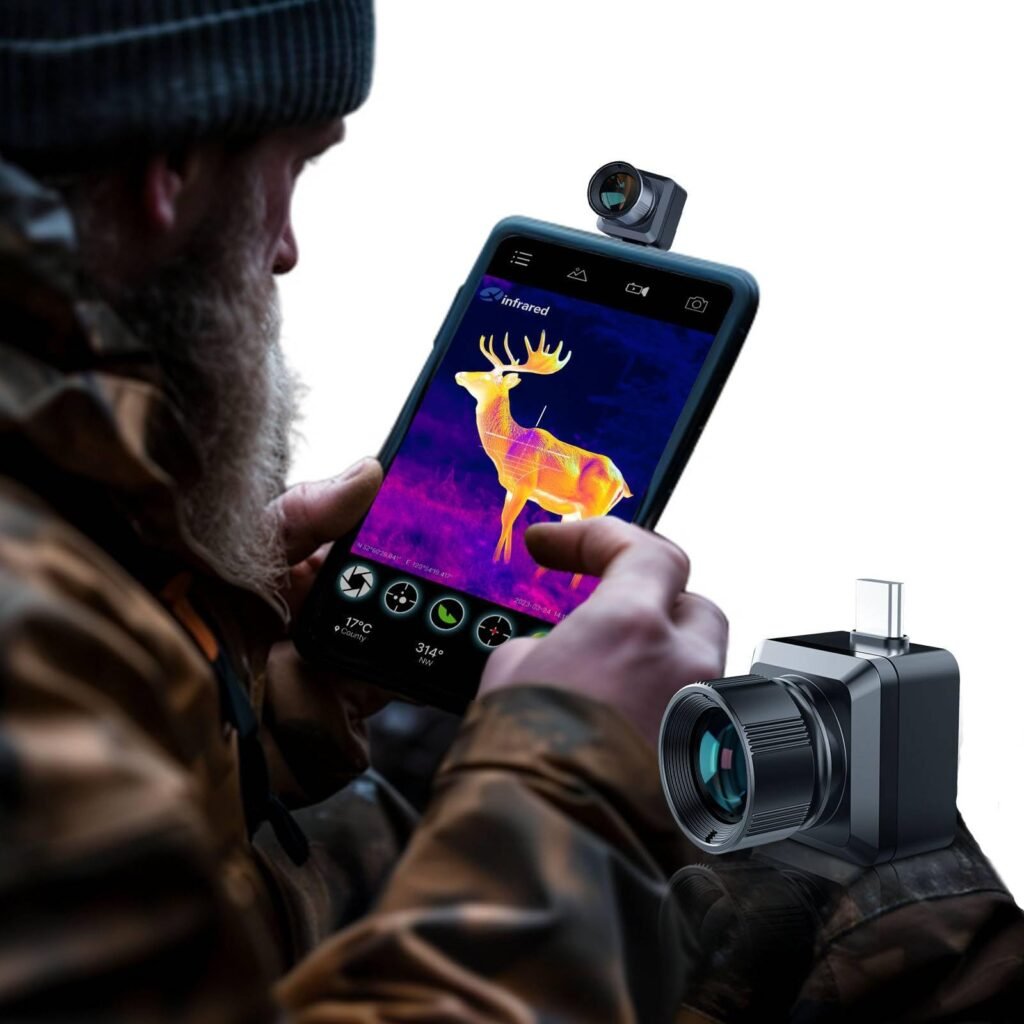
No, and this feature is one of thermal’s most significant advantages over night vision. A thermal monocular reads emitted heat, so it needs no light source of any kind, no moonlight, no starlight, and no infrared illuminator. It works in complete darkness without any additional equipment.
Night vision is the opposite. Analog and digital night vision both amplify light, so in genuine darkness they depend on an IR illuminator, an invisible torch the device can see. Other night vision users can spot that illuminator, and some hunters believe that certain animals can see it too. Thermal’s total independence from any light source is exactly why it has become the default for finding games in the dark.
Can you use thermal and night vision together?
Yes, and the best night-hunting setups often use both. The most common approach is to scan with a thermal monocular to find the game, then shoot with a night vision or day scope once you have identified the target.
Some hunters run a thermal clip-on on the rifle and carry a night vision monocular for navigation. Others have helmet-mounted night vision for walking and carry a handheld thermal for scanning. Combining the two gives you thermal detection and night vision’s detail in one workflow. We explain the wider device choice in thermal monocular vs scope vs clip-on.
What about fusion and thermal overlay devices?
A newer option blends both technologies into a single view. Fusion devices overlay a thermal image onto a night vision or visible image, so you get thermal’s heat detection and night vision’s detail at the same time, in the same eyepiece. Some multi-spectrum devices house both a thermal sensor and a day/night camera in one body and let you switch or blend between them.
Fusion is genuinely useful, because it pairs thermal’s detection with a detailed image for identification, but it is expensive and mostly found in premium binoculars rather than compact monoculars. If you want that capability, our thermal binoculars for hunting guide covers the multi-spectrum options.
Which should you buy first for hunting?
Buy thermal first. Finding game is the hardest part of night hunting, and thermal solves that problem better than anything else, with a lower entry price than quality night vision. A 384 thermal monocular detects and begins to identify game at realistic ranges and works on any rifle setup.
This is our honest view after years of selling both. Hunters who buy night vision first often come back for thermal once they realize how much game they were missing. Hunters who start with thermal rarely regret it. Add night vision later if your hunting needs the extra identification detail in the dark, or if local law requires it.
There is one exception worth naming: if your main need is navigating terrain on foot at night rather than spotting game at distance, night vision’s natural image is the better first buy. For almost everyone else hunting, thermal comes first.
How much do thermal and night vision cost?
Cost is often the deciding factor, and the two technologies price differently.
| Tier | Thermal | Night vision |
|---|---|---|
| Entry | ~€420-900 | ~€200-600 digital; Gen 1 analog |
| Mid | ~€1,000-2,000 | ~€2,000-3,500 Gen 2+ |
| Premium | ~€2,500-5,000+ | ~€3,500-6,000+ Gen 3 |
The pattern: entry thermal and entry digital night vision are both affordable, but quality analog night vision (Gen 2+ and Gen 3) starts higher than equivalent thermal. For most hunters, a capable thermal system costs less than night vision of equivalent real-world usefulness for finding game. Note too that Gen 3 night vision is often export-controlled, which can complicate buying and shipping.
Beyond hunting: security, marine, and search
Thermal and night vision split the same way outside hunting.
Security and property: thermal detects an intruder in total darkness and through light cover and is not blinded by security lighting; night vision provides detail to identify faces or read plates where some light exists. Many setups use both.
Marine: Boats use purpose-built thermal and low-light cameras for spotting hazards, other vessels, and man-overboard in the dark. See our guide to marine night vision cameras.
Search and rescue: thermal is unbeatable for finding a warm body in darkness or undergrowth; night vision helps rescuers navigate. The two are complementary here too.
When was night vision invented?
Night vision has a longer history than thermals. The first practical image-intensifier night vision devices appeared during the Second World War, and the technology advanced through the generations, Gen 1, 2, and 3, over the following decades, moving from military use into civilian hunting and security.
Thermal imaging for consumers is much newer. It stayed expensive and largely military or industrial until the last decade, when smaller, cheaper uncooled sensors brought thermal monoculars and scopes within reach of ordinary hunters. That price collapse is why thermal has moved so quickly from a specialist tool to a standard night-hunting kit.
Frequently asked questions
Is night vision or thermal better?
Neither is simply better; they do different jobs. Thermal is better at detecting game because it reads heat through darkness and cover and needs no light. Night vision is better at identifying game because it gives a natural, detailed image. For finding animals at night, thermal wins. For confirming exactly what you are looking at, night vision often wins. Many serious hunters own both and use them together.
Which is better for hunting, night vision or thermal?
For most night hunting, thermal is better because finding the animal is the hardest part, and thermal detects heat through darkness and cover that night vision cannot penetrate. Night vision earns its place for identification, reading fine detail, and navigating terrain. The ideal setup is often both: scan with thermal, confirm with night vision. If you buy one first, buy thermal.
Can thermal imaging work in daylight?
Yes. Thermal reads heat, not light, so it works day or night, and sunlight will not damage the sensor. Contrast is lower in the heat of the day when the ground warms up, so the strongest thermal images come at dawn, dusk, and through the night. Night vision, by contrast, cannot be used in daylight because bright light can damage the tube.
Does night vision work in complete darkness?
Only with help. Night vision needs some light, so on a truly dark night under heavy cloud it relies on an infrared illuminator, which lights the scene with light the tube can see but the eye cannot. Thermal needs no illuminator at all, which is one of its biggest advantages in genuinely dark conditions.
Do thermal monoculars need an IR illuminator?
No. Thermal monoculars read emitted heat, so they need no light source of any kind, no moonlight, no starlight, and no infrared illuminator. This feature is a key advantage over night vision, which depends on ambient light or an IR illuminator to work in the dark.
Which is cheaper, thermal or night vision?
Entry-level thermal and entry-level digital night vision are both affordable, starting at a few hundred euros. Quality analog night vision (Gen 2+ and Gen 3) usually starts higher, from around €2,000, than equivalent thermal. For most hunters, a capable thermal camera costs less than night vision of equivalent usefulness for finding game.
Why is night vision green?
The human eye is more sensitive to green than to any other color, so a green image reveals more detail at low brightness and is easier to look at for long periods. Newer white-phosphor tubes give a black-and-white image many find more natural, usually at a higher price.
Can you see through walls with thermal or night vision?
Neither can see through walls. Thermal reads surface heat, which a wall blocks completely, though it can see a warm animal through light brush and grass where heat escapes. Night vision needs a line of sight and reflected light, so it cannot see through solid objects either. Thermal can see through light fog and smoke; night vision cannot.
Is thermal or night vision better for identifying an animal?
Night vision works best when there is some light. It shows a natural, detailed image so you can read antlers, coat markings, and confirm a precise target. Thermal shows a heat shape that is excellent for detecting an animal but weaker for fine identification, especially at a distance. This is exactly why many hunters carry both types of optics.
Which do you need? Our verdict
If you hunt at night and can buy only one device, get a thermal, ideally a 384 monocular, because detection is the hard part and thermal solves it best at a sensible price. Add night vision when you need natural detail to identify targets or navigate terrain. Own both, and you have detection and identification covered, which is what serious night hunters end up doing.
We sell both and will tell you honestly which fits your hunting, your ground, and your budget. Tell us what and where you hunt, and we’ll help you find the right tool, not just the most expensive one.
Quick facts: thermal vs night vision
| Thermal uses | Heat (infrared) needs no light. |
|---|---|
| Night vision uses | Amplified ambient light or IR |
| Thermal is best for | Detecting and finding game |
| Night vision is best for | Identifying and confirming targets |
| Total darkness | Thermal, yes; night vision needs IR |
| Daytime | Thermal yes; night vision no. |
| Sees through light fog/smoke | Thermal yes; night vision no. |
| Sees through glass | Night vision yes; thermal no. |
| Entry price | Thermal: €420; quality NV: €2,000 |
| Buy first for hunting. | Thermal, usually a 384 monocular |
Ready to choose? Browse thermal imaging and night vision, or start with the thermal monocular buying guide, the best night vision monocular guide, and our complete thermal imaging camera guide for hunting. Not sure which one fits your hunting needs? Tell us what and where you hunt, and we will advise across every brand we carry.