
Clarion Thermal Scope
Showing all 2 results
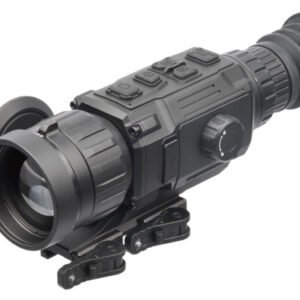
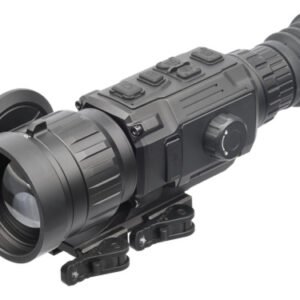
AGM Clarion Dual Focus Thermal Scopes
The AGM Clarion is the only thermal riflescope that carries two physical objective lenses and switches between them mechanically. Not digital zoom, not a software crop of the sensor: two real optical paths, so base magnification and field of view change with no loss of image resolution.
It solves the problem every thermal buyer faces. Short lenses give a wide field for finding and tracking. Long lenses give reach and detail. Normally you choose one and live with it. The Clarion 384 switches between 25 mm and 50 mm; the Clarion 640 switches between 35 mm and 60 mm.
- Two batteries in every AGM Clarion box, running up to 11 hours, so a swap covers a full night without charging.
- Shipped from Berlin in 2 to 3 days across the EU and other parts of the world.
- Five-year warranty, longer than the Pulsar, ThermTec, or Hikmicro offer.
How the AGM Clarion Dual Lens System Works
Every other thermal scope on the market makes you commit to one objective lens at purchase. Manufacturers soften this with digital zoom, but digital zoom adds no information. It enlarges the pixels you already have, and as a result, image quality falls in proportion.
The Clarion carries two objectives and a mechanism that swaps between them. Turn it one way for the short lens and a wide field. Turn it the other way for the long lens and reach. Both are real optical paths through real glass.
In practice: you walk a field edge in wide mode, and something moves at the far treeline. You switch to the long lens, and you are looking at the same animal, through the same sensor, at higher magnification, with no interpolation.
| Clarion 384 | Clarion 640 | |
|---|---|---|
| Sensor | 384 × 288 | 640 × 512 |
| Lenses | 25 mm F0.8 / 50 mm F1.0 | 35 mm F0.9 / 60 mm F1.1 |
| Magnification | 2×–16× / 4.5×–36× | 2×–16× / 3×–24× |
| Field of view | 10.5° × 7.9° / 5.3° × 4.0° | 12.5° × 10.0° / 7.3° × 5.9° |
| At 100 yards | 53 ft / 27 ft | 65 ft / 38 ft |
| Detection range | 1,200 m / 2,600 m | 1,800 m / 3,000 m |
| Minimum focus | 4 m | 7 m |
| Price | $2,365 | $3,520 |
Choose the AGM Clarion 384 if you want the widest operating envelope. It reaches 36× compared to the 640’s 24×, and it focuses down to 4 m in wide mode. Most thermal scopes will not focus closer than 7 to 10 m, which is important around farm buildings and in dense cover where an animal can appear very close.
Choose the AGM Clarion 640 if identification distance matters more than magnification range. Double the pixels on target, the widest wide-mode field in the pair at 12.5°, 3,000 m of reach, and the longer battery life.
Both run a 12 micron detector at 50 Hz rated below 20 mK, a 1024×768 OLED display, 16 GB of onboard storage, 10 reticle types in 4 colors, 5 zeroing profiles, and Black Hot, White Hot, Red Hot, and Fusion palettes. AGM publishes up to 11 hours of runtime with two batteries included, though some retailers list 8.5 to 11 hours depending on model and settings.
AGM Clarion or Rattler V3? The Honest Answer
This is the comparison most buyers actually need, and nobody in the search results will give it to you straight.
The Clarion is built on the previous sensor generation. It runs at sub-20 mK and has a 1024×768 display. Our AGM Rattler V3 range runs sub-15 mK with a 1920×1080 or 2560×2560 display, plus shutterless calibration and an in-lens laser rangefinder on three of four models.
On paper the Rattler V3 wins on sensor, display, calibration, and rangefinding.
The Clarion wins on one thing the V3 cannot do at any price: two real lenses.
| Your ground | Buy |
|---|---|
| Wet, foggy, low thermal contrast most of the season | Rattler V3. Sensitivity is the binding constraint. |
| Distances vary from shot to shot, but the terrain remains consistent. | Rattler V3 LRF. You need the rangefinder. |
| Terrain varies: woodland then open ground in one outing. | Clarion. Two lenses beat one better sensor. |
| You want a maximum magnification range in one optic. | Clarion 384. Nothing else reaches 2× to 36×. |
If both matter equally, the Rattler V3 LRF 35-640 gives you a 12.5° field at 2.5× on a sub-15 mK sensor, which covers much of what Clarion wide mode does without the lens switch.
One Thing the Clarion Does Not Have
No laser rangefinder. The AGM Clarion uses a stadiometric rangefinder, where you size a target of known height against a scale in the reticle, and the scope calculates the distance.
It draws no power and always returns a reading, but it is an estimate and it requires you to know the target’s height. If you want a confirmed distance to ±1 m at the press of a button, the AGM Varmint V2 LRF range has a 600 m laser and an onboard ballistic calculator at a similar price, and the AGM Adder V2 LRF models carry a 1,000 m laser in a 30 mm tube.
Related buying guides and complementary gear
If you are cross-shopping brands, our best thermal scope buying guide compares AGM against Pulsar, ThermTec, and Hikmicro on sensitivity, rangefinding, and resale value. Still deciding between technologies? Thermal versus night vision explains where each technology excels, while thermal imaging for hunting clarifies why detection range and identification range are not the same number.
Across the rest of the AGM range: the Rattler V3 compact scopes for the newest sensor, the Adder 30mm tube scopes if you want to mount in standard rings, the Varmint V2 LRF scopes for affordable laser ranging, the Secutor thermal scopes for long tactical shifts, and the Evolver thermal scope for AGM’s 1280 flagship.
Whichever you choose, pair it with a thermal monocular for scanning. Even a Clarion in wide mode has a narrower field than a dedicated scanning device, and scanning with a rifle-mounted optic means pointing a loaded rifle at everything you want to identify. Our guides to thermal monoculars for hunting and AGM thermal monoculars cover the pairing, and the Pulsar thermal monocular range is the premium option. For group observation, see thermal binoculars.
Are you working in low light rather than full dark? Compare these options to our night vision monoculars, night vision binoculars, and night vision goggles. We also stock Pulsar thermal rifle scopes and HIKMICRO thermal rifle scopes if you want to compare outside AGM.
AGM Clarion Buying Questions
How does the AGM Clarion dual focus system work?
The Clarion carries two physical objective lenses and switches between them mechanically. On the Clarion 384 those are 25 mm and 50 mm; on the Clarion 640 they are 35 mm and 60 mm. Because both are real optical paths rather than digital crops, switching changes base magnification and field of view with no loss of image resolution. No other thermal riflescope currently offers such versatility.
What is the difference between the Clarion 384 and the Clarion 640?
The Clarion 640 has a 640×512 sensor with 35 mm and 60 mm lenses, running 2× to 16× and 3× to 24×, and reaches 3,000 m detection with a 12.5° wide-mode field. The Clarion 384 has a 384×288 sensor with 25 mm and 50 mm lenses, running 2× to 16× and 4.5× to 36×, and focuses down to 4 m. The 640 has more pixels and longer reach; the 384 has higher maximum magnification and closer minimum focus.
Does the AGM Clarion have a laser rangefinder?
No. It uses a stadiametric rangefinder, which estimates distance by sizing a known-height target against a scale in the reticle. It needs no power and always returns a reading, but it is less precise than a laser and requires you to know the target’s height. For laser ranging, see the Varmint V2 LRF range or the Adder V2 LRF models.
Is the Clarion sensor as sensitive as the Rattler V3?
No. The Clarion runs below 20 mK, where the Rattler V3 runs below 15 mK, and the Clarion uses a 1024×768 display against 1920×1080 or 2560×2560. In heavy fog and drizzle, the Rattler V3 holds a readable image longer. The Clarion’s advantage is the dual-lens system, which the V3 does not offer at any price.
How long does an AGM Clarion run on a charge?
AGM publishes up to 11 hours of continuous operation, with two removable rechargeable batteries included in the box. Some retailers list 8.5 to 11 hours depending on model and settings. Two batteries and a ten-second swap covers a full night without charging, and external power is supported.