
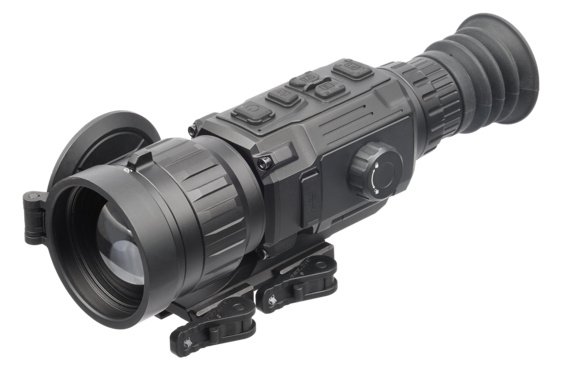
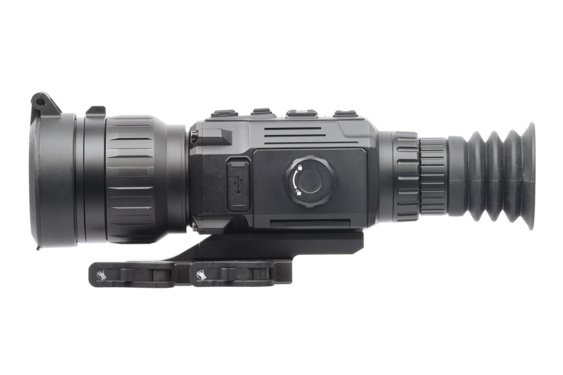
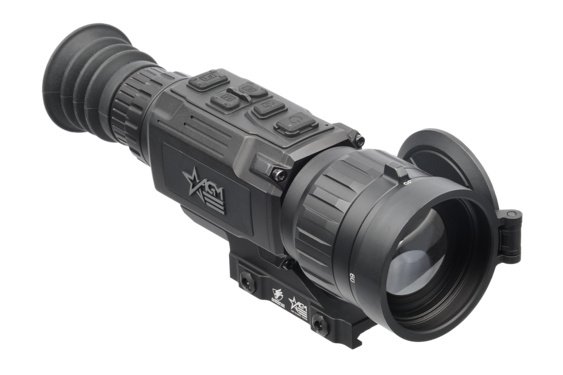
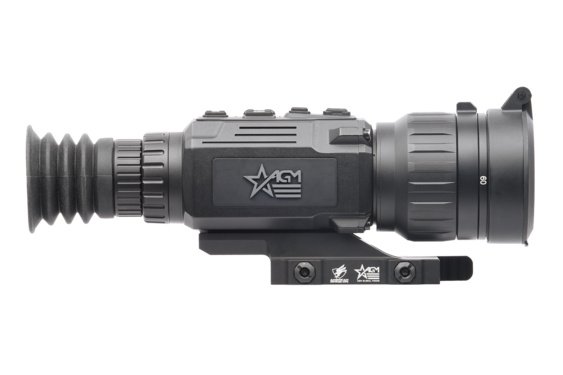
Two lenses, one scope, and why that matters
Every thermal scope buyer faces the same choice. A short lens gives a wide field of view, which helps you find and track animals but limits identification distance. A long lens gives reach and detail but a narrow window, which makes finding anything harder and tracking movement harder still.
Normally you pick one and live with it. Manufacturers try to soften the compromise with digital zoom, but digital zoom does not add information. It enlarges pixels you already have, and image quality degrades in proportion.
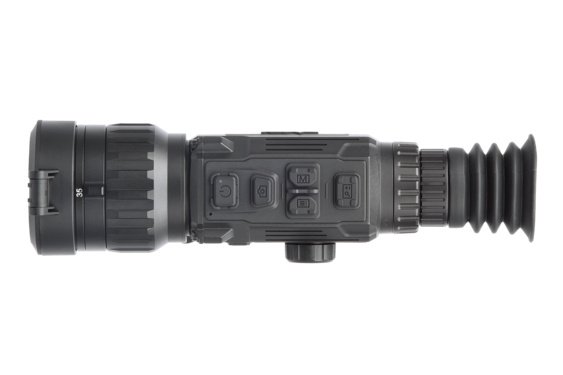
The Clarion 640 sidesteps the choice. It carries a 35 mm F0.9 objective and a 60 mm F1.1 objective, and a mechanical mechanism swaps between them. Both are real optical paths, so switching changes magnification and field of view with no degradation of image resolution.
In practice: you walk a field edge in wide mode at 2× with a 12.5° × 10.0° field, which is 65 ft at 100 yards. Something moves at the far treeline. You switch to 60 mm, and you are now at 3× with a 7.3° × 5.9° field and 3,000 m of detection range, looking at the same animal with the same sensor and no interpolation.
Which mode does what?
| Wide mode (35 mm) | Narrow mode (60 mm) | |
|---|---|---|
| Base magnification | 2× | 3× |
| Magnification range | 2× to 16× | 3× to 24× |
| Field of view | 12.5° × 10.0° | 7.3° × 5.9° |
| At 100 yards | 65 ft | 38 ft |
| Detection range | 1,800 m | 3,000 m |
| Focus range | 7 m to infinity | 10 m to infinity |
Wide mode is for finding, tracking, and following groups. Narrow mode is for identifying and shooting at a distance. That is the natural division of a hunt, and the Clarion lets one scope do both properly rather than compromising at a middle setting.
Worth noting that the 640 has a wider wide mode than the Clarion 384 at 12.5° against 10.5°, but a lower maximum magnification at 24× against 36×. The 384 model is the more specialized long-range configuration; the 640 is the more balanced one.
The sensor and what sub-20 mK means
A 640×512 detector at 12 micron pixel pitch, running at 50 Hz, rated below 20 mK.
NETD measures the smallest temperature difference the sensor can resolve, in millikelvins. Lower is more sensitive, and it matters most when thermal contrast is poor: ground fog, drizzle, high humidity, or a damp field where an animal is only marginally warmer than the grass.
Sub-20 mK is a solid figure. It is not the sub-15 mK of the Rattler V3 or Adder V2 ranges, and in the worst European weather those will hold an outline slightly longer. What the Clarion offers instead is optical flexibility that neither of those can match at any price.
The fast F0.9 wide objective helps here. A faster lens transmits more infrared energy to the detector, which partly offsets the higher NETD figure in low-contrast conditions.
Ranging, and an important limitation
The Clarion uses a stadiametric rangefinder, not a laser. You size a known-height target against a scale in the reticle, and the scope calculates distance. It works, it needs no power, and it never fails to return a reading.
It is also less accurate than a laser and requires you to know the target’s height. If you want a confirmed range of ±1 m at the press of a button, our Varmint V2 LRF 50-640, priced at €3,200.00, has a 600 m laser rangefinder and an onboard ballistic calculator. It does not have the dual-lens system.
That is the honest trade between those two scopes, and which matters more depends entirely on whether your ground varies more in distance or in terrain.
Power, storage, and build
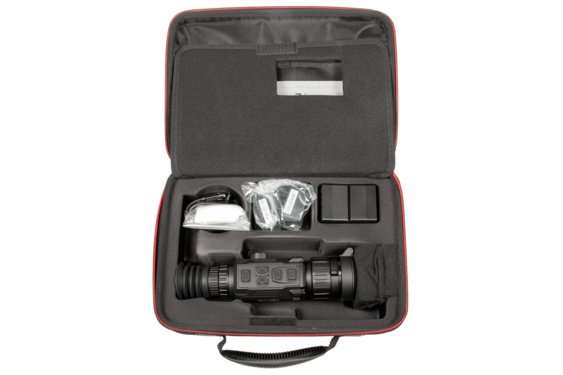
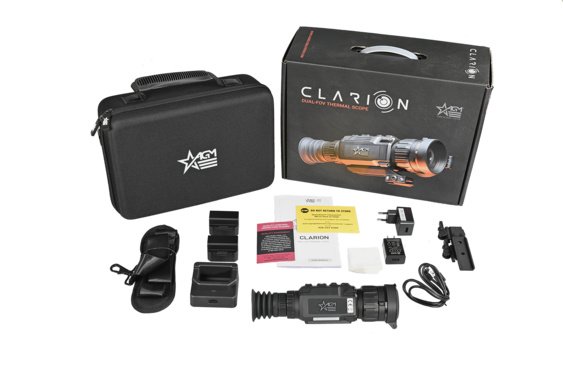
Two removable rechargeable batteries included, each running up to 11 hours. That is the longest runtime in the Clarion range and among the longest of any current thermal scope, so a single spare covers two full nights.
16 GB of onboard eMMC storage with video, audio, and image capture, plus Shot Activated Recording. Note that 16 GB is a quarter of the 64 GB fitted to the Rattler V3 and Adder V2, so plan to export more often if you record heavily.
Ten reticle types in four colors. Five customizable zeroing profiles, enough for two rifles with several loads. Ten brightness settings, ten contrast, and five sharpness. Four palettes plus cold and warm scene modes. Flat field correction in auto, manual, or external.
Waterproof and shockproof, Wi-Fi hotspot with AGM Connect app support, external power supported. Mount included and specified for both AR and bolt-action platforms. Five-year warranty.
Compare against our full thermal riflescope range or read the thermal scope buying guide.
Technical specifications
| Feature | Specification |
|---|---|
| Detector | 12 µm VOx uncooled focal plane array |
| Resolution | 640 × 512 |
| NETD | Less than 20 mK (25°C, F#=1.0) |
| Refresh rate | 50 Hz |
| Lens system | 35 mm F0.9 / 60 mm F1.1, mechanically switched |
| Magnification | 2× to 16× (35 mm) / 3× to 24× (60 mm) |
| Field of view | 12.5° × 10.0° / 7.3° × 5.9° |
| Field of view at 100 yd | 65 ft / 38 ft |
| Detection range (6 ft object) | 1,800 m / 3,000 m |
| Focus range | 7 m to infinity / 10 m to infinity |
| Display | 0.39 in OLED, 1024×768 |
| Diopter adjustment | -5 to +5 |
| Exit pupil | 6 mm |
| Eye relief | 45 mm |
| Digital zoom | 1×, 2×, 4×, 8× |
| Rangefinder | Stadiametric |
| Reticles | 10 types, 4 colors |
| Zeroing profiles | 5 |
| Display settings | 10 brightness, 10 contrast, 5 sharpness |
| Palettes | Black Hot, White Hot, Red Hot, Fusion |
| Flat field correction | Auto, manual, external |
| Scene modes | Cold, Warm |
| Storage | 16 GB eMMC |
| Battery life | Up to 11 hours |
| Batteries | Removable, rechargeable, two included |
| Recording | Video, audio, image capture, shot-activated recording |
| Connectivity | Wi-Fi hotspot, AGM Connect app |
| Build | Waterproof, shockproof |
| Warranty | 5 years |
FAQ
How does the AGM Clarion dual lens system work?
The Clarion carries two physical objective lenses and switches between them mechanically. On the Clarion 640, those are a 35 mm F0.9 and a 60 mm F1.1. Because both are real optical paths rather than digital crops, switching changes base magnification and field of view with no loss of image resolution. No other thermal riflescope currently offers this.
What is the difference between the Clarion 640 and the Clarion 384?
The 640 has a 640×512 sensor with 35 mm and 60 mm lenses, running 2× to 16× and 3× to 24×, with 11 hours of battery. The 384 has a 384×288 sensor with 25 mm and 50 mm lenses, running 2× to 16× and 4.5× to 36×, with 8.5 hours. The 640 has more pixels and a wider wide mode; the 384 reaches higher maximum magnification.
Does the AGM Clarion have a laser rangefinder?
No. The Clarion uses a stadiametric rangefinder, which estimates distance by sizing a known-height target against a scale in the reticle. It requires no power and always returns a reading, but it is less precise than a laser and requires you to know the target’s height. For laser ranging, see the Varmint V2 LRF range.
How long does the AGM Clarion 640 run on a charge?
Up to 11 hours per battery, and two removable rechargeable batteries are included. That gives 22 hours of field time with a swap, which is the longest in the Clarion range and among the longest of any current thermal riflescope. External power is also supported.
Is the Clarion 640 sensor as sensitive as the Rattler V3 or Adder V2?
No. The Clarion runs below 20 mK, whereas the Rattler V3 and Adder V2 run below 15 mK. In the worst fog and drizzle, those hold an image slightly longer. The Clarion’s advantage is the mechanically switching dual-lens system, which neither of those offers at any price. Choose whether optical flexibility or maximum sensitivity matters more for your ground.
Reviews
There are no reviews yet.