
The Best Marine Night Vision Camera: How to Choose (2026)
A marine night vision camera lets you see vessels, buoys, floating hazards, and people in the water when it is too dark to navigate safely by eye. Almost every marine night vision camera sold today is thermal, because thermal reads heat rather than light and continues to work on moonless nights offshore. This guide explains the three types of camera, the specifications that decide whether one is any good, what you should expect to pay, and which is the best marine night vision camera for your boat.
Browse the full range of marine night vision cameras whenever you want to see current stock and prices in euros. If you already know the type you need, jump to our guides on thermal versus low-light, chartplotter compatibility, or cooled versus uncooled.
The best marine night vision camera: quick picks
Short on time? Here is the best marine night vision camera for each kind of boating, from the FLIR range we stock. Details on every model are further down.
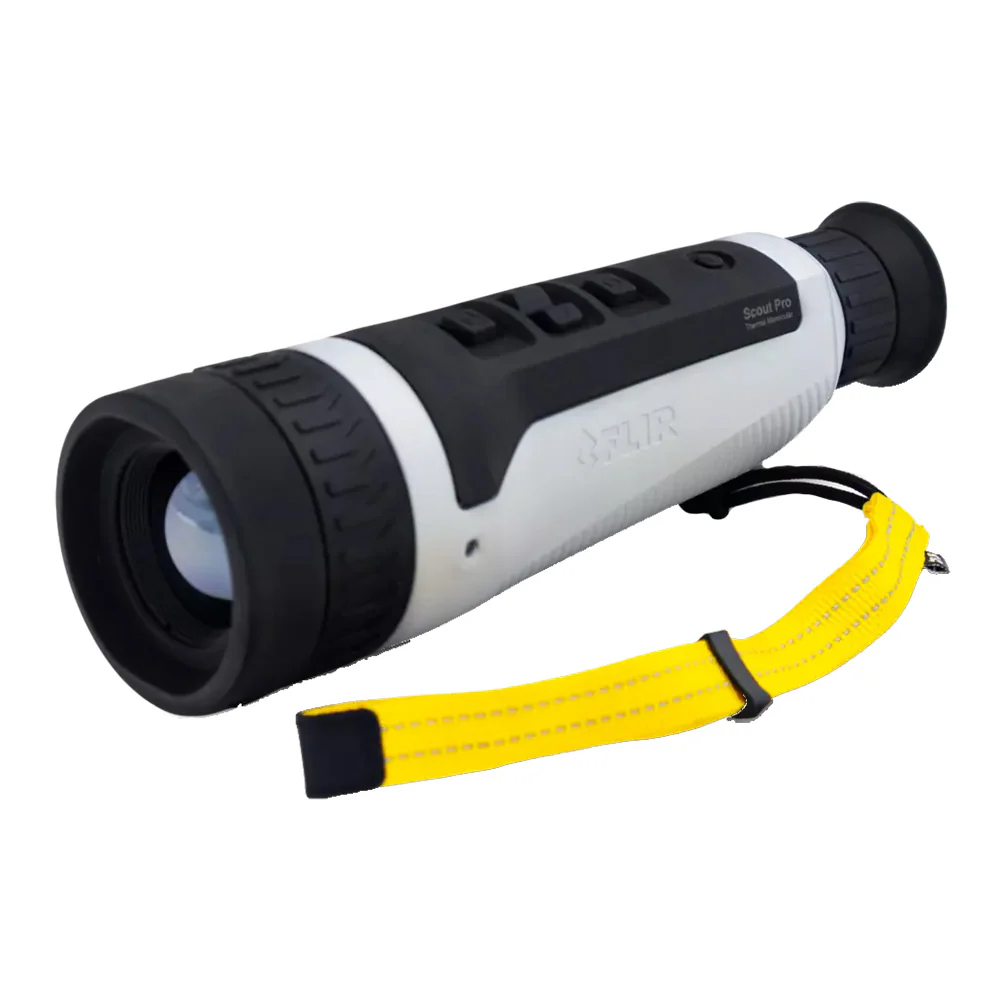
- Best for small boats and backup: FLIR Ocean Scout Pro handheld, from €1,499.
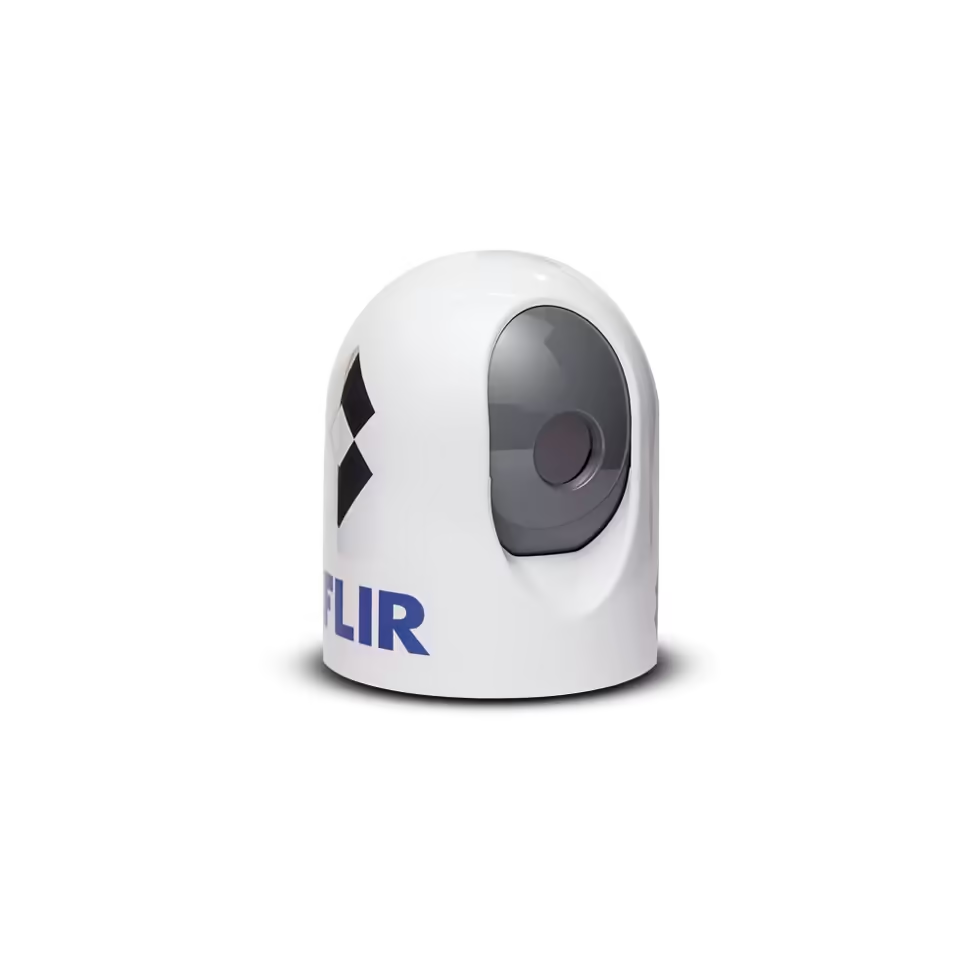
- Best for docking and inshore: FLIR MD Series fixed mount.
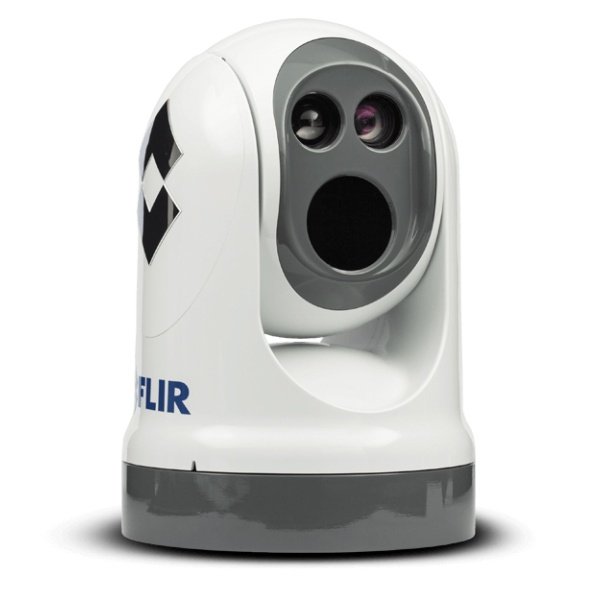
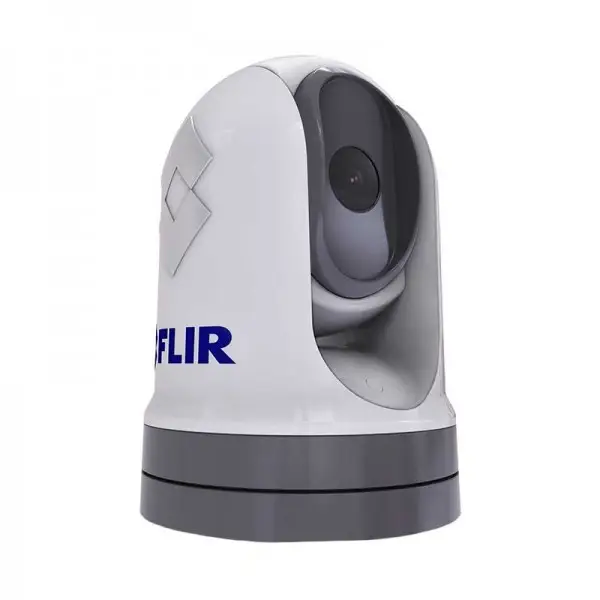
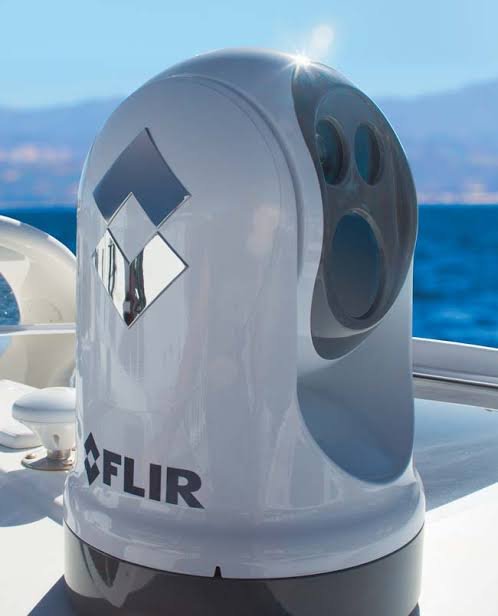
- Best for offshore and night passage: FLIR M-Series stabilized pan-and-tilt.
- Best for positive identification: FLIR M364C multi-spectrum.
- Best value overall: the Ocean Scout Pro handheld gives you real thermal capability aboard for the least outlay.
- Most important spec: thermal resolution. Buy 320×240 for inshore and 640×512 for offshore before you look at anything else.
Products by Category
Now here’s the full guide to choosing the right one.
Why thermal is the standard for night vision for boats
Ashore, you can choose between thermal and light-amplifying night vision. Afloat, thermal has won, and the reasons are practical rather than technical.
A thermal camera needs no ambient light whatsoever. It reads the long-wave infrared every object radiates, which means a marine night vision camera works identically at 3am under overcast conditions with no moon and no shore glow. It also handles glare. Point a light-based system at a marina, an approaching vessel’s masthead light, or your deck lights, and it blooms; thermal simply ignores them because it does not detect light.
Then there is contrast. Water holds a fairly steady, cool temperature, and almost everything you need to avoid is warmer than it. Another boat’s engine and cabin, a channel marker warmed by the day’s sun, a paddleboarder, and a swimmer all stand out against the cool sea as bright, obvious shapes. Against the cool sea, each shows as a bright, obvious shape. That contrast advantage is why a marine thermal night vision camera is now standard fit on serious night-running vessels, and it is also the single strongest argument for having one aboard during a man-overboard search. A person in the water is nearly invisible to the eye and to a searchlight beyond a short distance. On thermal, they appear as a white dot on black water.
The honest limitation: thermal shows heat and shape, not detail. It shows you that something is there and gives you a rough idea of its size. It will not read a hull number or show you a color. Where identification matters as much as detection, you want a second imaging channel, which our thermal versus low-light guide covers in full.
The three types of marine night vision cameras
Handheld thermal monoculars
The simplest way aboard. You pick it up, scan it, and put it down. A handheld suit backs up navigation, quick checks on contacts you cannot identify, and man-overboard searches where you need to sweep fast and follow the person. Marine handhelds should float and be properly waterproof, because sooner or later one goes over the side. The FLIR Ocean Scout Pro is built to that brief.
A handheld will not give you continuous vision while steering, nor will it appear on your chart plotter. Treat it as a complement to a fixed camera or as the entry point for a smaller boat.
Fixed-mount thermal cameras
A fixed camera bolts to the boat, looks forward, and streams a constant thermal picture to a display. There is nothing to aim at and nothing to hold on to. For docking, river and inshore running, and for keeping a permanent forward watch on passage, a compact fixed unit like the FLIR MD Series does the job at a lower price and in much smaller housing than a steerable system.
The trade is that you only see where the camera points. If a contact is out of your quarter, you will not have it.
Pan-and-tilt thermal cameras
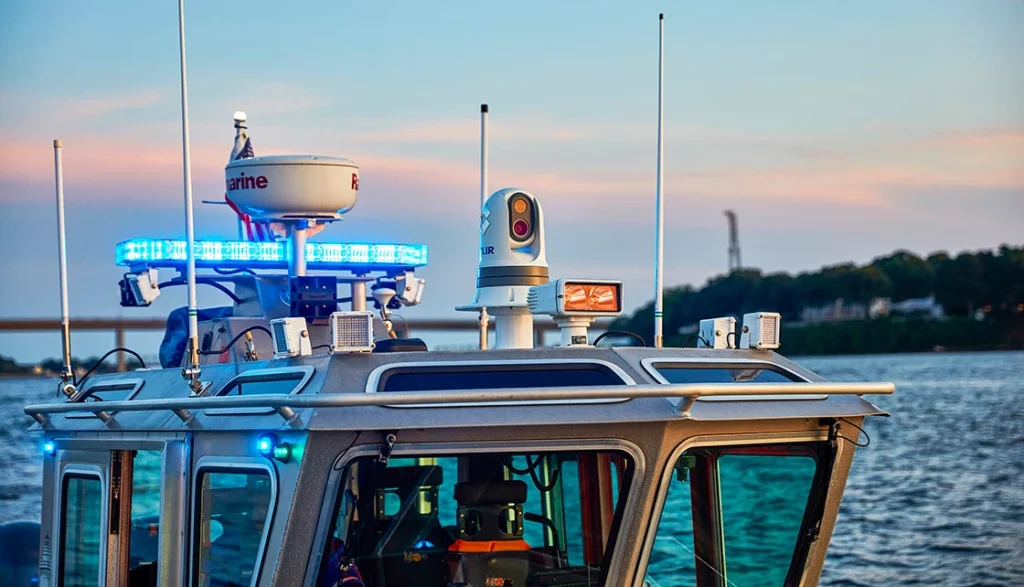
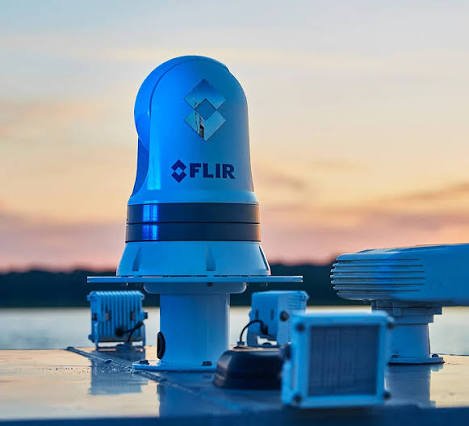
A pan-and-tilt camera steers left, right, up, and down under your control, and the better ones are gyro-stabilized to hold a level picture as the boat moves. This is the category for offshore running and active night navigation, allowing you to sweep around the vessel and hold contact as you close in on it. The FLIR M-Series spans this range, from the entry M232 up to the stabilized 640 M364. A full pan-and-tilt setup is the closest thing to a complete marine night vision camera system, giving you steerable all-round vision from the helm.
Stabilization is not a luxury here. An unstabilized camera at any real magnification is unusable in a seaway, because every pitch throws the image off the target.
Type comparison
| Handheld | Fixed mount | Pan and tilt | |
|---|---|---|---|
| Best for | Backup, MOB search | Docking, inshore | Offshore, night passage |
| Shows on chartplotter | No | Yes. | Yes. |
| Steerable | By hand | No | Yes. |
| Stabilized | No | No | On better models |
| Typical price | €1,500-1,900 | €5,800+ | €4,000-14,500 |
| FLIR example | Ocean Scout Pro | MD Series | M-Series |
How to choose the best marine night vision camera
Five decisions cover almost every purchase. Please work through them in this order.
Thermal resolution
Resolution sets how far out a shape stops being a blob and becomes something you can act on. A 320×240 core is genuinely capable for smaller boats, inshore work, and docking. A 640×512 core roughly doubles the linear detail, which matters offshore and on larger vessels where you want to make a decision about a contact earlier. If you want the underlying principle in more depth, our general explainer on 384 versus 640 thermal sensors applies equally at sea.
Buy resolution before you buy range figures. It is the specification you will notice every single night.
Camera type and mounting
Match the type to how you actually run, not to how you imagine running. Handheld for backup and search. Compact fixed for docking and inshore use. Stabilized pan-and-tilt for offshore and passage-making. Plenty of boats end up with a handheld plus one fixed or steerable camera, which is a sensible pairing rather than a redundancy.
Also consider where it will be physically located. Pan-and-tilt units need a clear arc, a solid mount, and a cable run, and radar arches and hardtops are the usual homes.
Cooled or uncooled
Nearly every marine camera is uncooled, using a microbolometer that runs at ambient temperature. Uncooled means instant-on, maintenance-free, and affordable, with excellent close- and mid-range performance. Cooled cameras reach several times further and cost several times more, and they belong on large yachts, patrol, and commercial vessels. Our cooled versus uncooled guide covers the choice properly, but the short version is that if you are asking, you want uncooled.
Chartplotter compatibility
A fixed or steerable boat thermal camera is only worth having if it appears on the screens you own. Cameras connect either through an open standard such as ONVIF, which many displays understand, or through a proprietary integration tied to one manufacturer’s ecosystem. Get this wrong and you have bought a camera your multifunction display cannot show.
Check it before you order. Our marine camera compatibility guide walks through exactly what to look for, and if you send us your plotter model, we will confirm the fit.
Realistic range expectations
Manufacturer detection figures are laboratory numbers against large, warm, high-contrast targets. They are useful for comparing two cameras against each other and close to useless as a prediction of your Tuesday night. Detection, where you see that something is there, always happens much further out than identification, where you can say what it is. Sea state, humidity, and rain all pull both numbers down. The same physics applies ashore, and our explainer on how far thermal actually sees is worth reading before you compare spec sheets.
Where a marine night vision camera earns its keep
The brochure use case is night passage-making. The real ones are more varied and worth knowing before you decide how much camera you need.
Docking and mooring after dark. Pontoon fingers, piles, mooring lines, and dinghies all read clearly on thermal, and so does the crew member standing on the dock waiting to take a line. For many owners, this alone justifies a fixed camera, as it is the maneuver where damage actually happens.
Unlit hazards. Semi-submerged debris, lost containers, timber, and unlit small craft are the classic night risks. Anything that has spent the day in the sun holds heat into the evening and shows against cooler water, which is precisely when you are least likely to spot it with the naked eye.
Man overboard. The strongest single argument for night vision on boats is that a person in the water is nearly invisible to the naked eye and to a searchlight beyond a short range, but stands out unmistakably on thermal. A person in the water is nearly invisible to the naked eye and to a searchlight beyond a short range, but stands out unmistakably on thermal. A steerable camera lets you hold it while maneuvering, which a handheld cannot do while driving the boat.
Anchor watch and security. A fixed or pan-and-tilt camera gives you a way to check what is moving around the boat at 2am without leaving the saloon, whether that is a dragging neighbor or an approaching tender. This makes a marine night vision camera a genuine security tool at anchor, not just a navigation aid.
Fishing gear and pot markers. Where pot buoys and unlit floats are common, a boat thermal camera saves propellers and rudders. Markers warmed during the day remain visible for hours after sunset.
Wildlife and collision avoidance. In some waters, whales, basking sharks, and large debris are a genuine hazard at speed. Thermal will not give you unlimited warning, but it gives you more than your eyes will.
Installation, mounting, and what else do you need?
A handheld needs nothing. A fixed or steerable marine night vision camera needs three things planned before it arrives.
A mount with a clear arc is needed. Radar arches, hardtops, and mast platforms are the usual homes. A pan-and-tilt unit needs an unobstructed sweep, and mounting it where the bow rail or a mast cuts the view forward defeats the purpose.
A cable run. Network cameras typically use a single Ethernet cable carrying data and often power. That run must reach from the mount to your network switch or display, and on many boats, routing it is the genuinely difficult part of the job, not the electronics.
Control hardware. Steerable cameras are operated either from the chartplotter or from a dedicated joystick control unit at the helm. Manufacturers frequently sell that unit and its cabling separately, which can add several hundred to nearly two thousand euros to an advertised camera price. We bundle the control unit and cables into our pricing rather than listing them as extras, so the figure you see is the figure you pay.
The FLIR marine range compared
FLIR covers every category of marine night vision camera, and it is the range we stock and rate. We price the control accessories into the camera rather than charging separately for the joystick control unit and cables, which is where a lot of the real cost hides.
| Model | Type | Core | Best for | Guide price |
|---|---|---|---|---|
| Ocean Scout Pro | Handheld | 320×240 | Backup, MOB search | €1,499-1,899 |
| MD Series | Fixed | 640×480 | Docking, inshore | €5,800 |
| M232 | Pan-tilt | 320×240 | Entry night navigation | €4,000 |
| M332 / M364 | Pan-tilt, gyro | 320×256 / 640×512 | Offshore passage | €8,700-14,500 |
| M364C | Multi-spectrum | 640×512 + color | Detect and identify | €26,000 |
| M500 / M560 | Cooled AI track | Cooled MWIR | Long-range, commercial | POA |
See the full FLIR Marine brand page for specifications on each.
How FLIR compares to other marine camera brands
If you have been researching, you will have seen names like SiONYX, Garmin, and Raymarine. It is worth knowing where they sit, even though we stock FLIR.
SiONYX built its name on low-light color cameras such as the Nightwave, which use a light-amplifying sensor rather than thermal. They give a natural, color-like night image and cost less, but they need some ambient light and cannot match thermal for detecting a cool-contrast target or a person in the water on a black night. Garmin and Raymarine both offer thermal marine cameras, often FLIR-derived technology under their branding, tied tightly to their own chartplotter ecosystems.
Our view: for pure detection on a dark night, and for man-overboard above all, a thermal camera is the safer choice, and FLIR’s marine range is the most complete and proven. If you want a color low-light view as well as thermal, that is the multi-spectrum case, which the M364C covers in one unit. We are happy to talk through the trade-offs for your boat.
What does the best marine night vision camera cost?
Handhelds start around €1,500. A compact fixed camera sits near €5,800. Entry pan-and-tilt begins around €4,000, and a stabilized 640 system runs to roughly €14,500. Multi-spectrum and cooled systems move into €26,000 and beyond.
Two things distort those numbers when you shop elsewhere. First, accessories: the joystick control unit and cabling are frequently sold separately, which can add several hundred to nearly two thousand euros to an advertised price. Second, ecosystem lock-in, where a cheaper camera only works properly with one brand of display and quietly commits you to that brand’s next plotter too. Both are worth pricing in before you compare.
Marine night vision camera mistakes worth avoiding
Four recur often enough to be worth naming.
Buying within the detection range. It is the most quoted number and the least useful. Published ranges assume large, warm targets in clean conditions, and identification range is a fraction of detection range in every case.
This process means skipping stabilization on a steerable camera. In any sea, an unstabilized pan-and-tilt camera at magnification produces an image that swings in and out of usefulness with every wave.
Leaving compatibility until last. The one mistake with no cheap fix. Confirm that your chartplotter will display the camera before anything else.
Treating a handheld camera as a substitute for a fixed camera is a mistake. It is an excellent complement and a poor replacement, because it requires a free hand at exactly the moment both of yours are busy.
Which marine night vision camera should you choose?
For a small boat, or as backup on any boat, start with a handheld Ocean Scout Pro. For docking and inshore night running, a fixed MD Series is best. For offshore passage-making, start with a stabilized M-Series, and step up to the 640 M364 if you want to make decisions about contacts earlier. Where positive identification matters, the multi-spectrum M364C. And for long-range professional work, you should choose the cooled Elite systems.
Confirm chartplotter compatibility before you order, whichever you pick. It is the one mistake that cannot be fixed with a bracket.
Frequently asked questions
What is the best marine night vision camera?
The best marine night vision camera depends on your boat and how you run it. For a small boat or as a backup, the FLIR Ocean Scout Pro handheld is the best choice. For docking and inshore use, we recommend the fixed FLIR MD Series. For offshore passage-making, a stabilized FLIR M-Series is recommended, and for positive identification, the multi-spectrum M364C is also recommended. Choose by boat size, how far offshore you go, and whether you need the camera on your chartplotter. Thermal resolution matters more than any headline range figure.
Do I need a thermal camera on my boat?
If you ever run at night or in poor visibility, yes. A marine night vision camera reveals unlit vessels, floating debris, channel markers, and people in the water that you cannot see by eye or by searchlight. A man-overboard search is the clearest case: a swimmer is almost invisible to the naked eye at any distance and unmistakable on thermal.
What resolution should I look for in a marine night vision camera?
A 320×240 core is fine for smaller boats, docking, and inshore running. Step to 640×512 for offshore work and larger vessels, where the extra detail lets you judge a contact earlier. Resolution affects every night you use the camera, so prioritize it over headline detection range.
Is SiONYX or FLIR better for a marine night vision camera?
They do different jobs. SiONYX low-light cameras such as the Nightwave provide a natural color image and cost less, but they need some ambient light and cannot match thermal for detecting a cool target or a person in the water on a dark night. FLIR’s thermal cameras detect heat with no light at all, which is why they are the safer choice for night detection and man-overboard. For both in one unit, a multi-spectrum camera combines thermal and color.
Can I add a night vision camera to my existing chartplotter?
Usually, but confirm it first. Cameras using the open ONVIF standard work across many display brands, while proprietary systems may only function fully within one manufacturer’s ecosystem. Please provide your plotter make, model, and software version, and we will verify compatibility before you place your order.
Is a handheld thermal enough, or do I need a fixed camera?
A handheld is superb for backup and search and costs a fraction of a fixed system. It needs a free hand and never appears on your displays, which rules it out as your only night-navigation tool on a boat that runs regularly after dark. Most owners who run at night end up with both.
How far can a marine thermal camera see?
Far enough to matter, and rarely as far as the brochure suggests. Published figures assume large, warm, high-contrast targets in optimal conditions. Rain, humidity, and sea state reduce them, and identification range is always much shorter than detection range.
Does a marine night vision camera work in fog?
Better than your eyes and better than a searchlight, but not perfectly. Thermal penetrates haze and light fog well because it uses longer wavelengths than visible light. Dense fog and heavy rain do degrade it. No night vision technology sees through thick fog, so it supplements radar rather than replacing it.
Ready to choose the best marine night vision camera for your boat? Browse the full range of marine night vision cameras, or read our companion guides on thermal versus low-light, chartplotter compatibility, and cooled versus uncooled cameras. Not sure which fits your boat? Send us your vessel and plotter details, and we will recommend a camera.