
Marine Thermal vs Low-Light Camera: Which Do You Need?
A marine thermal camera detects heat and works in complete darkness, while a low-light camera amplifies the small amount of visible light already present to build a picture closer to normal vision. Both let you see at night on the water, but they answer different questions. Thermal is better at finding things; low light is better at telling you what they are. This guide explains how each works, where each wins, and why the most capable marine cameras now have both.
New to this field? Start with our guide to choosing a marine night vision camera, then come back for the details. You can browse the marine camera range at any time.
How a marine thermal camera works
Every object radiates infrared energy according to its temperature. A thermal camera reads that radiation directly and turns it into an image, using a microbolometer detector in almost all marine units. Visible light plays no part in the process.
That gives a marine thermal camera three properties that matter afloat. It works in absolute darkness because it is not waiting for photons from the sky. It is immune to glare, so a marina’s floodlights or an approaching vessel’s navigation lights will not wash out your image. And it produces excellent contrast against water, since the sea sits at a fairly uniform, cool temperature while nearly every hazard you care about is warmer.
The cost of all this is detail, though. Thermal renders heat and shape. It does not show color, it cannot read a name on a transom, and two objects at similar temperatures can blend together. You will reliably see that a contact is there and often judge its size and heading without necessarily knowing whether it is a fishing boat or a RIB.
How low-light marine cameras work
A low-light camera takes the opposite approach. It uses a very sensitive sensor to gather and amplify the faint visible light coming from the moon, stars, shore lighting, or another vessel, and then presents an image that looks broadly like what your eye would see with much better night adaptation. The best marine sensors do this in color.
Because the output resembles normal vision, identification is far easier. You can distinguish vessel types, read some markings, pick out a person rather than a warm blob, and judge what a light on the water actually belongs to. Anyone who has tried to work out what a distant contact is on a thermal-only screen understands why that matters.
The limitation is structural: the camera needs light to amplify. On an overcast, moonless night well offshore, the camera has little to work with due to the lack of shore glow and other traffic, and its performance declines when it is most needed. That is the same night on which the thermal is at its strongest.
Thermal versus low-light: where each wins
| Marine thermal camera | Low-light camera | |
|---|---|---|
| Works in total darkness | Yes | No, needs some light |
| Affected by glare | No | Yes |
| Sees through haze | Well | Poorly |
| Detects contacts | Excellent | Moderate |
| Identifies contacts | Limited | Strong |
| Shows colour | No | On better sensors |
| Man-overboard search | Excellent | Limited |
The pattern is consistent. A thermal is a detection and safety instrument. Low light is an identification instrument. If you are running offshore at night and your priority is not hitting anything and finding anyone who has gone over the side, thermal is the tool. If you operate inshore, near harbors, under some ambient light, and your priority is working out exactly what is around you, low light contributes more than its price suggests.
For most owners, the sensible reading is that thermal comes first and low light is an addition rather than an alternative. That is also how the market has settled: thermal-only cameras are common at every price point, while low-light-only marine cameras are comparatively rare.
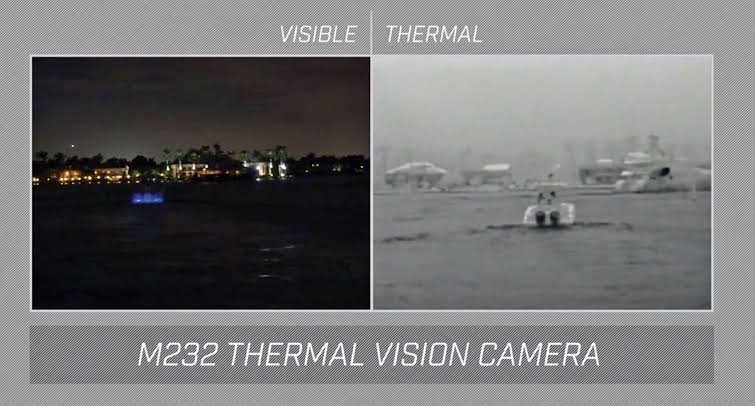
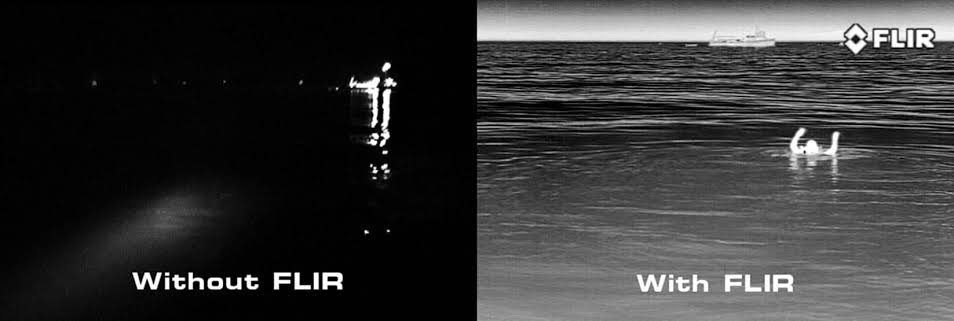
What each looks like on screen
Specifications describe the difference; the screen shows it.
A marine thermal camera gives you a monochrome or false-color image where brightness maps to temperature. Warm objects glow, cool water reads dark, and edges are soft rather than crisp. Reading it is a skill you acquire quickly, and once you have it, a heat signature registers faster than a shape does in a normal image. What you will not obtain is texture, color, or writing.
A low-light camera produces something much closer to normal night vision: a recognizable, sometimes color picture with real detail and texture, provided the light is there. Where it degrades, it does so by becoming grainier and dimmer rather than by losing the picture outright.
The practical consequence is that scanning is faster with thermal cameras, while interpretation is faster with low-light cameras. On a busy inshore night with harbor lighting, the low-light channel often gives you the answer sooner. Ten miles offshore under cloud, only the thermal channel gives you anything at all.
Common mistakes when choosing
Assuming low-light is a cheaper thermal is a mistake. It is a different instrument, not a budget version of the same one, and it fails in the conditions where night vision matters most.
Buying multi-spectrum for a boat that needs detection. If your night runs are about not hitting things, a better thermal camera beats a dual-channel one at the same price.
Ignoring glare. Owners who run near lit coastlines and marinas often underestimate how badly light-based systems handle other vessels’ navigation lights. A marine thermal camera is unaffected.
Forgetting the handheld. Whichever fixed system you choose, a floating handheld at the helm covers the search case that a bow-mounted camera cannot.
Why multi-spectrum combine both
The best answer to “which one” is increasingly “both, in one housing.” A multi-spectrum camera puts a thermal core and an ultra-low-light color camera in the same stabilized turret, letting you pick up a contact by heat on the thermal channel and then switch to the visible channel to identify it before you commit to a decision.
The FLIR M364C is built precisely around that detect-then-identify workflow. For commercial operators, patrol vessels, and larger yachts, being able to confirm what you are looking at, rather than simply that it exists, justifies the step up from a thermal-only camera such as the M-Series M364.
Multi-spectrum is not the entry point. It sits at the top of the range, and if your budget is better spent on a stabilized thermal camera and a good handheld, that combination will serve most boats better than stretching to a single multi-spectrum unit.
Which should you buy?
Start with thermal. A fixed or pan-and-tilt thermal camera covers navigation, hazard detection, and search, which are the safety-critical jobs. Add a handheld Ocean Scout Pro for quick checks and man-overboard work.
Consider multi-spectrum when identification is genuinely part of your job rather than a nice-to-have, which usually means commercial, patrol, or large-yacht operation. And if your interest is long-range detection rather than identification, the relevant comparison is not thermal against low-light at all, but our cooled versus uncooled guide.
One practical sequence works for most owners. Fit a marine thermal camera first and live with it for a season, because it changes how you run at night more than any other single piece of equipment. If, after that season, your recurring frustration is not being able to tell what a contact is, then Multi-Spectrum is worth the upgrade, and you will know precisely why. If the frustration is instead that you want to see further, the answer lies in resolution, or in our cooled versus uncooled guide, rather than in a second imaging channel.
Whatever you choose, confirm it will display on your existing electronics. Our chartplotter compatibility guide covers that in full, and you can see current stock on the FLIR Marine brand page.
Frequently asked questions
Is thermal or low light better for a boat?
Thermal, for most owners. It works in total darkness, ignores glare, and is far stronger for detecting hazards and finding a person in the water. Low light is better at identifying what a contact actually is, but only when some ambient light is available, which makes it a complement rather than a replacement.
Can a marine thermal camera identify what a contact is?
Only broadly. Thermal shows heat and shape, so you get size, heading, and rough form, but no color and no fine detail. Positive identification in near-darkness needs a visible-light channel, which is why multi-spectrum cameras pair the two technologies.
Does a low-light camera work in complete darkness?
No. It amplifies existing light, so without a moon or shore glow, it has very little to amplify. Thermal has no such dependency.
What is a multi-spectrum marine camera?
A camera housing both a thermal core and an ultra-low-light color sensor, usually in one stabilized turret. You detect a contact on the thermal channel and identify it on the visible channel without switching devices.
Which is better for a man overboard search?
Thermal, without qualification. A person in the water presents very little to see and almost no contrast in visible light, while their head and shoulders read clearly as a warm object against cool sea on a marine thermal camera. A low-light camera may help identify them once close, but thermal imaging is what finds them.
Do I need both a thermal and a low-light camera?
Most boats do not. A good thermal camera plus a handheld covers the safety-critical work at far lower cost. Both channels become worthwhile when identification is a routine part of your operation, in which case a single multi-spectrum unit is tidier than two separate cameras.
Next, read about chartplotter compatibility and cooled versus uncooled cameras, return to the main buying guide, or browse the marine camera range.