
Thermal Clip On: How to Choose (Guide 2026)
A thermal clip on is a thermal device that mounts to the front of your existing day scope, turning it into a night-capable system without changing your reticle, your zero, or your eye relief. It is the least disruptive way to add thermal to a rifle you already shoot well, because you keep the optic you know and simply put a thermal unit in front of it. This guide covers how clip-ons work, what separates a good one from a poor one, how they fit your particular scope, and how the ThermTec Hunt range compares.
New to thermal entirely? Start with our complete guide to thermal imaging for hunting. Otherwise, browse the thermal clip on range or see the full ThermTec brand page.
What a thermal clip on is and how it works
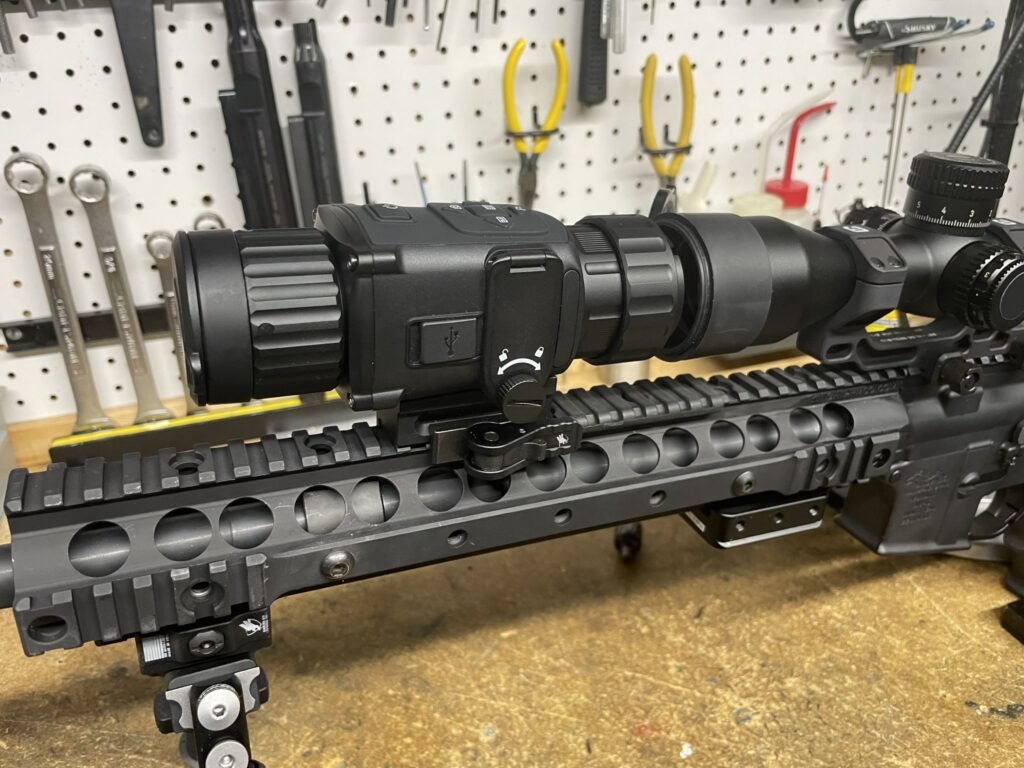
A thermal clip on, also called a front attachment or thermal clip-on attachment, fits onto the objective end of your day scope. Your scope keeps aiming its reticle and its own magnification. The clip-on sits in front of it and projects a thermal image into that optical path, so what you see through the eyepiece is a thermal picture with your familiar crosshair laid over it.
That arrangement explains the two things clip-on buyers care about most. First, no re-zeroing: because the unit sits ahead of the scope rather than replacing it, your point of impact is unchanged. Second, cost: you are not buying a second complete sighting system, only the thermal front end.
By day you take the clip-on off and shoot normally. At night, you simply put it back on. For a hunter who already owns a good day scope and shoots well, learning a new sight picture on a dedicated thermal scope is considerably more challenging than using a thermal clip-on.
Thermal clip on vs dedicated thermal scope
This is the decision most buyers are actually making, so it is worth setting out plainly.
| Thermal clip on | Dedicated thermal scope | |
|---|---|---|
| Keeps your day scope | Yes | No, replaces it |
| Re-zeroing needed | No | Yes |
| Day use | Remove and shoot normally | Thermal only |
| Reticle | Your existing one | Built-in digital |
| Doubles as a monocular | On many models | No |
| Typical cost | €1,490-2,690 | €1,690-3,690 |
| Added weight | ~400 g on the objective | Replaces scope weight |
A clip-on wins when you value your existing setup, want one rifle that works day and night without swapping optics, and would rather not learn new controls. A dedicated thermal scope wins when you want a purpose-built display, integrated ballistics, and controls designed for thermal use from the ground up, or when your day scope is not suitable for a clip-on in the first place. Our comparison of monocular, scope and clip-on goes further into where each fits.
One thing worth being honest about: a clip-on adds weight at the very front of the rifle, on the objective bell, which is the worst place for balance. Around 400 g out there is noticeable, and on a light stalking rifle, it changes how the gun handles.
How to choose a thermal clip on
Six specifications decide whether a thermal clip on for scope use will satisfy you. Work through them in order.
Sensor resolution
Resolution drives how far out you can identify what you are looking at, rather than merely see that something is there. A 384×288 sensor is genuinely capable for mid-range work and keeps the price down. A 640×512 sensor roughly doubles the linear detail, which shows when you are trying to separate a fox from a hare at a distance or confirm what is standing in the treeline. The same trade-off applies to every thermal device, and our explainer on 384 versus 640 sensors covers the math.
Buy a resolution first. It is the specification you notice on every single outing.
Thermal sensitivity (NETD)
NETD is the smallest temperature difference a sensor can distinguish, measured in millikelvins, and lower is better. Below 20mK is strong; below 15mK is pro-grade. It governs how clean the image stays in fog, drizzle, and high humidity, which in most of Europe is the majority of the season. On a damp night, a lower NETD sensor will often outperform a higher-resolution one with mediocre sensitivity.
Lens size and detection range
The objective lens sets both reach and field of view, and the two pull against each other. A 35mm lens gives a wider view and detection to roughly 1,800 m. A 50mm lens narrows the view and pushes detection toward 2,600 m. Match the lens to your ground rather than to the highest number: in woodland, a wide field helps you find and follow an animal, while an over-magnified narrow view makes that harder.
Treat published detection ranges as a way to compare two units against each other, not as a prediction of your night. Identification always happens much closer than detection, as our guide on how far thermal actually sees explains.
Day scope compatibility and magnification
This is where clip-on purchases go wrong. Your clip-on has to physically fit your day scope’s objective, and it has to tolerate the magnification you intend to use.
Entry clip-ons are typically rated to around 8x. Push a clip-on beyond its rated magnification, and you are enlarging a fixed thermal image beyond its useful resolution, so the picture goes soft and grainy. Premium units such as the Hunt Pro handle 12x to 16x. Note your day scope’s maximum magnification and its objective diameter before you shop, because both determine what will actually work.
Mounting and adapters
Clip-ons attach through an adapter ring sized to your day scope’s objective diameter, usually onto a standard thread on the clip-on body. ThermTec’s Hunt range uses an M52x0.75 thread. Get the adapter wrong and the unit either will not fit or will not sit square, and a clip-on that sits off-axis will shift your point of impact.
Please measure your objective diameter or provide your scope model, and we will ensure you receive the correct ring with the unit.
Rangefinder, battery and weight
Most clip-ons do not range. If you shoot beyond comfortable holdover distances and want an exact range without reaching for a separate device, a model with a built-in laser rangefinder is worth the premium. Battery life is relevant for all-night sessions, and replaceable packs let you swap rather than stop. Weight matters more on a clip-on than on any other thermal device, for the balance reason above.
The ThermTec Hunt clip on range compared
ThermTec’s Hunt line runs from entry to flagship, all around 400 g, and all keep your day scope’s zero.
| Model | Sensor | NETD | Lens | Detection | Day scope | Rangefinder | Price |
|---|---|---|---|---|---|---|---|
| Hunt 335 | 384×288 | ≤20 mK | 35 mm | 1,800 m | to 8x | No | €1,490 |
| Hunt 635 | 640×512 | ≤20 mK | 35 mm | 1,800 m | to 8x | No | €1,690 |
| Hunt 650 | 640×512 | ≤20 mK | 50 mm | 2,600 m | to 8x | No | €1,790 |
| Hunt 335 Pro | 384×288 | ≤15 mK | 35 mm F0.9 | 1,800 m | to 16x | No | €1,690 |
| Hunt 635 Pro | 640×512 | ≤15 mK | 35 mm F0.9 | 1,800 m | to 16x | No | €1,890 |
| Hunt 650 Pro | 640×512 | ≤15 mK | 50 mm | 2,600 m | to 16x | No | €2,190 |
| Hunt 650 LRF Pro | 640×512 | ≤15 mK | 50 mm | 2,600 m | to 16x | Yes | €2,690 |
Entry: ThermTec Hunt
The ThermTec Hunt is the affordable route in, with NETD ≤20 mK, a 400 g magnesium body, day scopes up to 8x, and a 2-in-1 design that works as a handheld monocular off the rifle. For a first thermal clip-on attachment on a moderate-power day scope, it is a sensible starting point.
Premium: ThermTec Hunt Pro
The ThermTec Hunt Pro is a meaningful upgrade rather than a cosmetic one. It features sub-15mK sensitivity, a 1920×1080 OLED display, a fast F0.9 lens on the 35 mm models, dual interchangeable batteries for up to 14 hours, and compatibility with day scopes up to 16x magnification. If you shoot a higher-magnification day scope, this model is the tier you need, not a preference.
Long range with ranging: ThermTec Hunt LRF
The ThermTec Hunt LRF adds a built-in laser rangefinder to the flagship 640 platform, with a 50 mm lens for 2,600 m detection. A clip-on that ranges is unusual, and for anyone converting a day rifle for genuine long-range night work, it removes the last real limitation of the format.
How the ThermTec Hunt compares to Pulsar, AGM, and HIKMICRO
We stock every major thermal brand, so there is no reason for us to steer you toward one. If you are seriously comparing a thermal clip on across manufacturers, here is the honest landscape.
| Model | Sensor | NETD | Detection | Day scope | Battery | Notes |
|---|---|---|---|---|---|---|
| ThermTec Hunt 650 | 640×512 12µm | ≤20 mK | 2,600 m | to 8x | 7 h | 2-in-1 monocular |
| ThermTec Hunt 650 Pro | 640×512 12µm | ≤15 mK | 2,600 m | to 12-16x | 14 h dual | Shutter-free to 1 h |
| Pulsar Krypton 2 FXG50 | 640×480 12µm | <40 mK | ~2,300 m | 2-6x quoted | 11 h | Stream Vision 2, BT remote |
| Pulsar Krypton 2 FXQ35 | 384×288 17µm | <25 mK | Shorter | 1.5-4x quoted | 11 h | Compact, lighter |
| AGM Rattler-C V2 | 384 / 640 12µm | <20 mK | to ~2,400 m | to 8x | 11 h, 2 packs | 5-year warranty |
| AGM Rattler TC50-640 | 640×512 12µm | <35 mK | 2,500 m | to 8x | 4.5 h CR123 | ADM QD mount |
Pulsar Krypton 2: Build an ecosystem
The Krypton 2 is the best-made thermal clip-on attachment on the market. It features a fast F50/1.0 germanium lens, a 1920×1080 HD AMOLED display, eight palettes, 16 GB of memory, an IPX7 magnesium and alloy body, a Bluetooth remote, and 11 hours of battery life from a quick-release IPS7 pack. Stream Vision 2 remains the most polished app in thermal, and like the ThermTec Hunt, it doubles as a handheld monocular. Pulsar also scales its menu to your day scope’s magnification, which is a small touch that tells you how much thought went in.
There are two things to weigh against that. The FXG50’s 640×480 Lynred sensor has an NETD of <40 mK, the least sensitive figure in this comparison and less than a third as sensitive as the Hunt Pro at ≤15 mK. Pulsar’s optics and image processing partly compensate, and in practice the Krypton produces a decent picture, but on a wet, low-contrast night that specification is doing real damage. The compact FXQ35 is actually more sensitive at <25 mK despite its lower 384 resolution, which tells you something.
Second, Pulsar quotes comfortable use across roughly 2x to 6x of day scope magnification on the FXG50. That is a narrower window than the 8x of the AGM Rattler or the 12x to 16x of the Hunt Pro. Manufacturers state this differently, so compare carefully rather than assuming the numbers are equivalent.
AGM Rattler: value and warranty
The Rattler line made clip-on thermal technology accessible to many hunters, and the current Rattler-C V2 represents a significant improvement over the older TC generation. NETD moved from less than 35mK to less than 20mK on the 384 and 640 models, and battery life moved from a poor 4.5 hours on CR123 cells to 11 hours on two replaceable rechargeable packs. Detection reaches roughly 2,400 m. AGM backs it with a five-year warranty, the longest here.
If you are cross-shopping, note the generation carefully. An older Rattler TC50-640 at <35 mK and 4.5 hours is a different proposition from a Rattler-C V2 at <20 mK and 11 hours, and both are still on shelves.
HIKMICRO and the mounting standard nobody mentions
Worth knowing before you buy anything: HIKMICRO’s Thunder bayonet mounting standard has become something close to a de facto standard in this category, to the point that AGM’s Rattler TC35-384 adopts it directly. If you already own an adapter or mount built to it, that widens your options considerably and may save you buying a second set of rings.
Confirm HIKMICRO’s current clip-on lineup and specifications with us before ordering, as the range changes more often than the rest of the market.
ATN
ATN concentrates its thermal effort on riflescopes and binoculars rather than clip-ons, so it is a smaller presence here. If you want ATN specifically, the comparison worth making is against a dedicated thermal scope instead.
Where the ThermTec Hunt sits
ThermTec argues that clip-ons offer the best sensitivity and endurance per euro. The Hunt Pro’s ≤15 mK sensor is the most sensitive figure in this comparison by a clear margin; its 14 hours across dual batteries is the longest runtime, and its 12x to 16x day-scope tolerance is the widest. At €1,690 to €2,190, it undercuts the Krypton 2 substantially.
What ThermTec lacks, however, is the build reputation and app maturity of Pulsar, as well as the resale strength and five-year warranty of AGM. If you want the most refined clip-on and expect to sell it on, go for the Krypton 2. If warranty length is your priority, AGM. If you want the cleanest image on a foul night for the money, get the Hunt Pro.
The number that separates these devices
Line up the NETD figures, and the spread is remarkable: ≤15mK on the Hunt Pro, <20mK on the Rattler-C V2, <25mK on the Krypton 2 FXQ35, <35mK on the older Rattler TC50, and <40mK on the Krypton 2 FXG50. That is nearly a threefold difference in how small a temperature difference these devices can resolve across products sold at broadly similar prices.
Resolution gets the headline. Sensitivity decides whether a fox in wet grass at 200 m is an animal or a smudge. Check both figures on any clip-on you consider, including ours.
Fitting a clip-on: what actually happens to your zero
The claim that a clip-on needs no re-zeroing is true, with one qualification worth understanding.
Because the unit sits ahead of your scope and does not touch the reticle, your zero is preserved in principle. In practice, a small point-of-impact shift can appear if the clip-on is not seated square, if the adapter is a loose fit, or if the unit is heavy enough to flex a lightweight objective bell. This phenomenon is not a fault; it is physics, and it is why quality clip-ons offer a fine adjustment. The Hunt Pro’s 1.1 cm at 100 m click value exists precisely for these situations.
The sensible procedure is to fit the clip-on, confirm your zero on paper at your usual distance once, and note any offset. After that first check you can fit and remove it freely.
What a thermal clip on costs
Entry units start around €1,490 for a 384 sensor. A check with an entry-level sensor costs around €1,690 to €1,790. The premium Pro tier, with sub-15mK sensitivity and higher magnification tolerance, runs €1,690 to €2,190. Adding a rangefinder takes you to €2,690.
Compare that against a dedicated thermal scope at €1,690 to €3,690, and the economics are clear enough: the clip-on is cheaper in absolute terms and cheaper again once you count the day scope you are not replacing. Where it stops being the cheaper option is if you end up buying a new day scope to suit the clip-on, which happens more often than people expect.
Legality: check before you buy
Rules on thermal devices vary considerably across Europe and change periodically. Several countries clearly distinguish between handheld thermal devices used for observation, which are widely permitted, and thermal devices mounted on a firearm, which may be restricted, limited to particular species, or permitted only under specific licenses. Because a clip-on mounts on the rifle, it usually falls into the more tightly regulated category, even though it is not itself a sight.
We are a retailer, not a legal adviser. Confirm the current position with your national or regional hunting authority before you buy, particularly if you hunt across borders.
Mistakes worth avoiding
Buying before checking your day’s scope. Objective diameter and maximum magnification determine what will work. Establish both first.
Chasing detection range is more important than NETD. On a damp European night, sensitivity does more for your image than a bigger headline number.
Over-magnifying. Running a clip-on beyond its rated day-scope magnification produces a soft, grainy picture and disappoints people who blame the unit.
Ignoring balance. Four hundred grams on the objective changes how a light rifle handles. Try it before your first serious outing.
Which thermal clip on should you choose?
For your first clip-on on a day scope of 8x or less, use the Hunt Pro, and step up to the 650 if you want the extra reach. The Hunt Pro, featuring a sub-15mK sensor and 16x tolerance, performs exceptionally well for higher-magnification day scopes or for hunting in consistently poor weather. For long-range shooting where ranging matters, the Hunt LRF is the choice.
Whichever you choose, pair it with a handheld thermal monocular for scanning. Finding game through a rifle-mounted device means pointing a firearm at whatever you are trying to identify, which is poor practice regardless of what the optic is.
Frequently asked questions
Do you have to re-zero with a thermal clip on?
No. A thermal clip on mounts ahead of your day scope and does not alter the reticle, so your zero carries over. Confirm it on paper once after first fitting, because a small offset can appear if the adapter is not perfectly square, and quality units include a fine click adjustment for exactly that.
Is a thermal clip on as effective as a thermal scope?
For most hunters, yes, in some ways a thermal clip-on is better. You keep your familiar reticle, zero, and eye relief; you retain full day use of the rifle and eye relief, and you spend less. A dedicated thermal scope offers purpose-built controls, an integrated display, and often built-in ballistics. The clip-on’s real weakness is weight at the front of the rifle.
What day scope do I need for a thermal clip on?
One display objective diameter matches an available adapter ring, and its magnification stays within the clip-on’s rating. Entry models such as the Hunt suit day scopes up to about 8x; the Hunt Pro handles 12x to 16x. Please send us your scope model, and we will confirm the fit and provide the scope’s go ring.
Can a thermal clip on be used as a monocular?
Many can. The ThermTec Hunt range features a 2-in-1 design, allowing the unit to function as a handheld thermal monocular for scanning and tracking and then clip onto the day scope for the shot. That effectively gives you two devices for one price, and it is a genuine reason to prefer a clip-on.
Will a thermal clip on work with my variable magnification scope?
Yes, within its rated range. You can use your day scope’s zoom as normal up to the clip-on’s limit. Beyond that limit, you are magnifying a fixed thermal image past its resolution, and the picture becomes soft rather than more detailed.
How much does a thermal clip on weigh?
The ThermTec Hunt range sits around 400 g. That is light for the category, but it hangs on the objective bell, where it most affects balance, so it will change how a light rifle points.
Which brand makes the best thermal clip on?
There is no single winner. Pulsar’s Krypton 2 has the best build quality, display, and app ecosystem, but the FXG50’s <40mK sensor is the least sensitive here. ThermTec’s Hunt Pro leads on sensitivity at ≤15mK, runtime, and day-scope magnification tolerance. AGM’s Rattler-C V2 offers strong value and a five-year warranty. Match the brand to whether you value refinement, image quality in poor weather, or warranty cover.
Is the ThermTec Hunt better than the Pulsar Krypton 2?
On specification, largely yes: the Hunt Pro is more sensitive at ≤15 mK against the Krypton 2 FXG50’s <40 mK, runs longer on dual batteries, and tolerates higher day-scope magnification at a lower price. The Krypton 2 answers with better build quality, a superior display, the Stream Vision 2 app, and stronger resale value. Choose the Hunt Pro for image quality per euro and the Krypton 2 for refinement and long-term ownership.
What is the best clip on thermal scope for the money?
For value, the Hunt 650 at €1,790 has a 640 sensor and 2,600 m of detection. For image quality per euro, the Hunt 635 Pro at €1,890 buys sub-15mK sensitivity and 16x compatibility, which is where most hunters see the biggest real-world gain.
Ready to choose? Browse the ThermTec thermal clip on range, compare it with thermal scopes and thermal monoculars, or read the complete guide to thermal imaging for hunting. Not sure your day scope is compatible? Send us the model, and we will confirm before you order.