
AGM Rattler V2 Review: How It Compares to V1 and V3
The AGM Rattler is the thermal riflescope most hunters actually buy, because it is the point where genuine thermal capability meets a price a working hunter can justify. It is also, right now, the most confusingly named optic on the market. There are three generations in circulation, two different naming conventions, six lens and sensor configurations per generation, and a parallel clip-on line that names itself differently again.
That confusion costs people money. A buyer comparing a “Rattler TS35-384” to a “RattlerV2 35-384” and a “RattlerV3 25-384” is not comparing three products. They are comparing two generations of the same optic plus a third that launched in January 2026, and the differences between them are large enough to change what you should pay.
This guide sorts it out. You will finish knowing exactly which generation a model code refers to, what genuinely changed between V1, V2, and V3, what the honest detection ranges are rather than the marketing figures, what the scope costs to own once you account for a mount AGM no longer includes, and which configuration suits your rifle and your ground. Everything referenced ships from our Berlin warehouse with euro pricing and export confirmed before payment.
Decoding the Model Codes
Start here, because nothing else makes sense until the model is clear.
The V1 naming convention
The original Rattler used a two-letter prefix followed by “lens” and “sensor”:
TS = Thermal Scope, a dedicated riflescope that replaces your day optic. TC = Thermal Clip-on, which mounts ahead of an existing day scope.
Then the numbers. TS35-384 means a 35 mm germanium objective with a 384×288 sensor. TC19-256 means a 19 mm objective with a 256×192 sensor on a clip-on.
The V1 range covered TS19-256, TS25-256, TS35-384, and TS50-640 on the scope side, with TC19-256, TC35-384, and TC50-640 as clip-ons.
The V2 naming convention
AGM dropped the TS prefix entirely for scopes. The V2 range is RattlerV2 19-256, 25-256, 25-384, 35-384, 35-640, and 50-640.
Products by Category
-
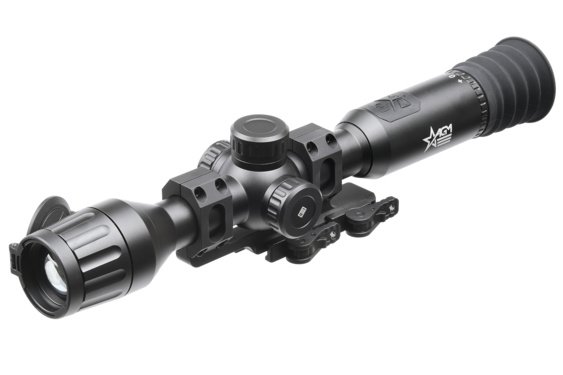
AGM Adder TS35-384 Thermal Imaging Riflescope
-
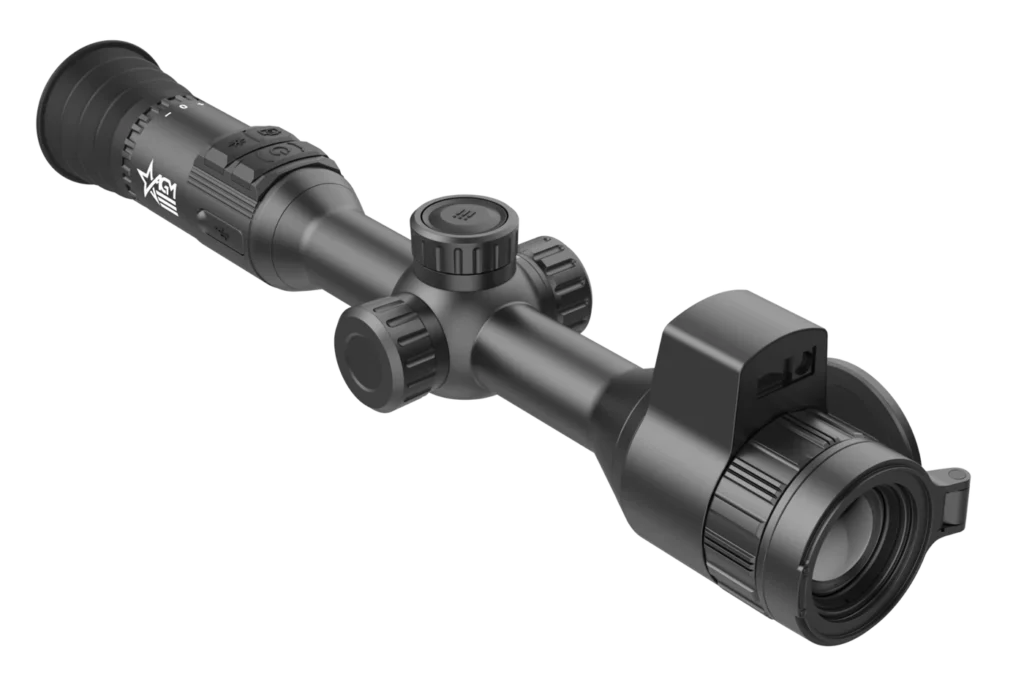
AGM Adder TS35-640 Thermal Imaging Riflescope
-
AGM Adder TS50-384 Thermal Imaging Riflescope
-
AGM Adder TS50-640 Thermal Imaging Riflescope
-
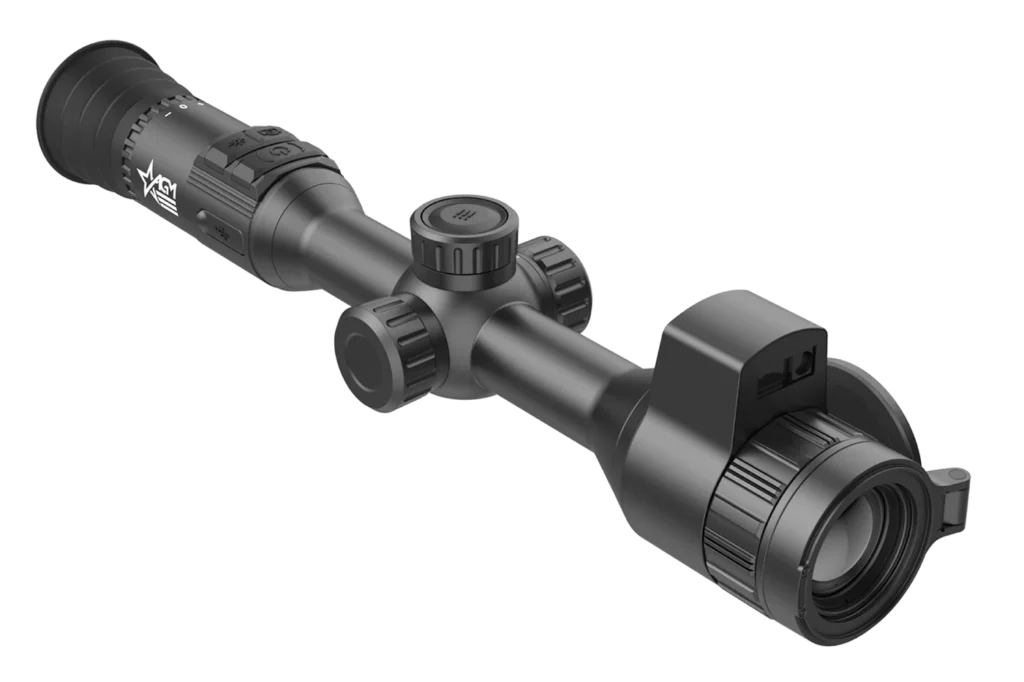
AGM Adder V2 LRF 35-384 Thermal Scope | Sub-15 mK, LRF
-
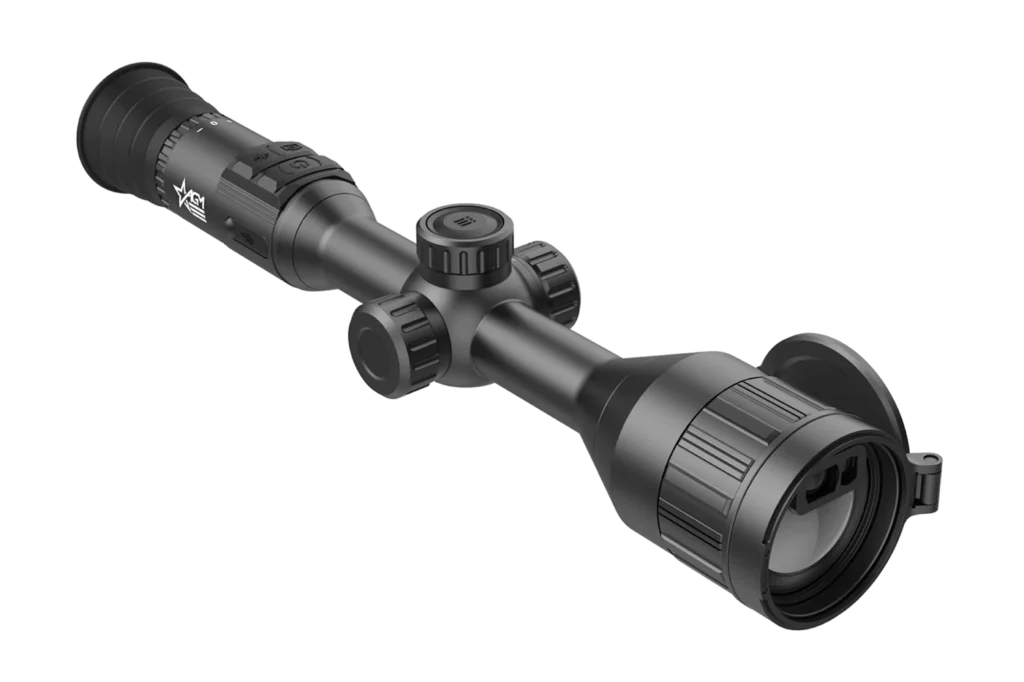
AGM Adder V2 LRF 50-640 Thermal Imaging Riflescope
-
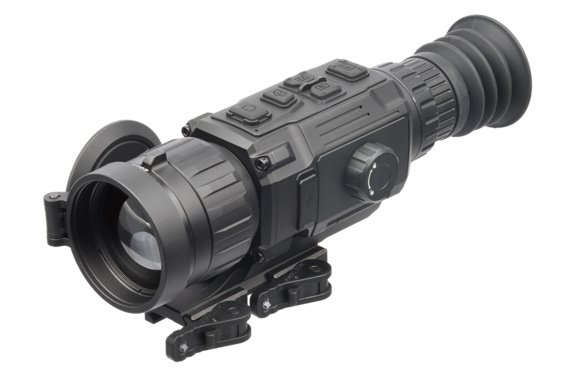
AGM Clarion 384 Dual Focus Thermal Imaging Riflescope
-
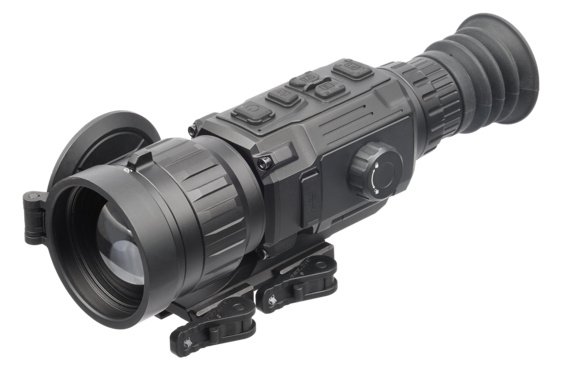
AGM Clarion 640 Dual Focus Thermal Imaging Riflescope
-
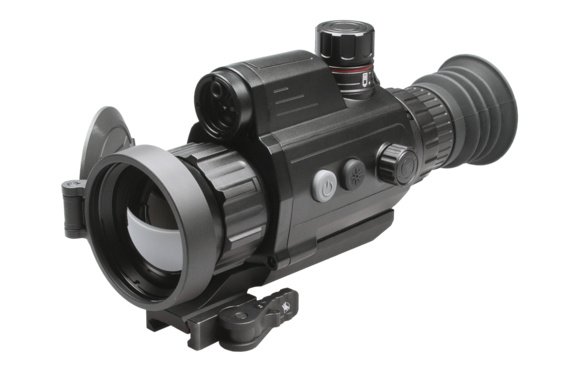
AGM Evolver LRF 1280 Thermal Imaging Riflescope
Clip-ons went a different way and became Rattler-C V2 19-256, Rattler-C V2 35-384, and Rattler-C V2 50-640.
This asymmetry is the main source of the confusion. Scopes lost their prefix. Clip-ons moved their prefix and gained a version number. Two different rules applied to two halves of the same product family.
The V3 naming convention
Launched 13 January 2026. Reads as RattlerV3 followed by lens and sensor, for example, RattlerV3 25-384.
The rule that resolves it
| If the model code reads | It is |
|---|---|
| Rattler TSxx-xxx | Version 1 scope |
| Rattler TCxx-xxx | Version 1 clip-on |
| RattlerV2 xx-xxx | Version 2 scope |
| Rattler**-C V2** xx-xxx | Version 2 clip-on |
| RattlerV3 xx-xxx | Version 3 scope |
If a listing provides you a bare TS or TC code with no version number, it is describing a V1 unless the seller states otherwise. If you are unsure, there is a thirty-second physical check covered further down.
What Actually Changed: AGM Rattler V1 to V2
The V2 was not a refresh. It changed the sensor, the sensitivity, the frame rate, and the power system.
Detector pitch: 17 μm to 12 μm
Pixel pitch is how much sensor area collects each pixel’s worth of infrared radiation. Moving from 17 microns to 12 microns means the same resolution fits into a smaller sensor area, allowing a smaller objective to deliver the same range or the same objective to deliver more.
In practical terms the V2 reaches further with the same glass and packages more neatly.
NETD: sub 35 mK to sub 20 mK
This feature is the upgrade that matters most, and it is worth being precise because the market has muddled it.
NETD, or Noise Equivalent Temperature Difference, is the smallest temperature difference the sensor can resolve. Lower is better. A sub-20 mK sensor distinguishes a temperature difference of 0.02 degrees Celsius.
Note a spec conflict you will encounter. At least one major US retailer lists the Rattler V2 NETD as under 35 mK. AGM’s own material and independent field reviews both state sub 20 mK for the V2, with sub 35 mK being the V1 figure. The most likely explanation is a V1 specification sheet carried across to a V2 listing. If you see 35 mK attached to a V2, treat it with suspicion and check the source.
Why it matters practically: NETD is decisive exactly when conditions are worst. On a freezing night almost any sensor produces a hard image, because a 38-degree animal against near-freezing ground is enormous contrast. In September at 16 degrees, with a deer barely twenty degrees above background, sub 20 mK works and sub 35 mK gives you a grey smear. The same applies in rain, fog, and humidity, which is precisely when you most need the scope to earn its cost.
Refresh rate: 25 Hz to 50 Hz
Doubling the frame rate removes the lag that made V1 scanning feel disconnected. Panning across ground is smoother, and tracking a moving animal is materially easier. This is a bigger quality of life improvement than the number suggests.
Power: CR123A to rechargeable pack
V1 ran two CR123A cells for roughly four and a half hours. V2 uses a removable rechargeable battery pack and runs 9 to 11.5 hours depending on model.
Two consequences. Running costs drop sharply because you stop buying lithium primaries. The practical difference between four hours and eleven is that one scope lasts a session while the other lasts a night.
The trade is that the V2 pack is proprietary. You cannot buy a replacement in a village shop at midnight the way you can with CR123As. Carry the spare that ships with it.
Recording: video only to audio and video
V1 recorded video without sound. V2 records both and adds Shot Activated Recording, which automatically captures a clip around the moment of the shot. For anyone reviewing their shooting or documenting a cull, that is a genuine feature rather than a specification.
Interface and reticles
The V3 features a simplified menu structure, 10 reticle options, and multiple zeroing profiles, allowing one scope to hold zeros for several rifles or loads.
What Changed Again: V2 to V3
The V3 arrived in January 2026 and is an evolution rather than a rewrite.
Sensitivity improves again to sub-15 mK, extending the advantage in warm and wet conditions.
The display moves to 1920×1080 from the V2’s 1024×768 OLED, so the sensor’s output is presented at higher resolution.
Shutterless NUC removes the periodic shutter click and momentary image freeze that every thermal device performs to recalibrate. Anyone who has had a shutter fire mid-stalk will understand why this matters.
Image Boost 2.0, AGM’s processing algorithm, is claimed to produce the cleanest image in the 384 class.
The NE-4400 battery replaces the V2 pack, with over seven hours quoted.
Ergonomics address gloved operation with larger buttons and a manual focus ring.
AGM quotes a 1,770 m detection range for the RattlerV3 25-384 at 2.5 to 20x.
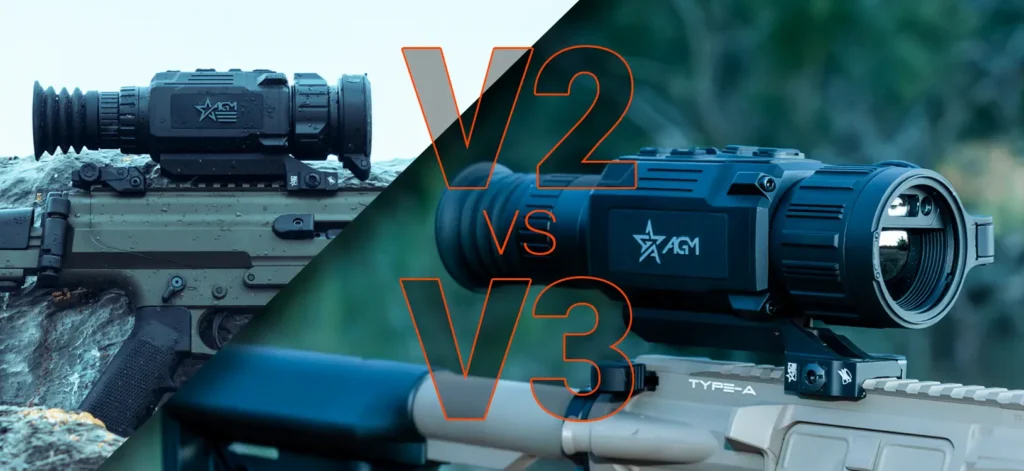
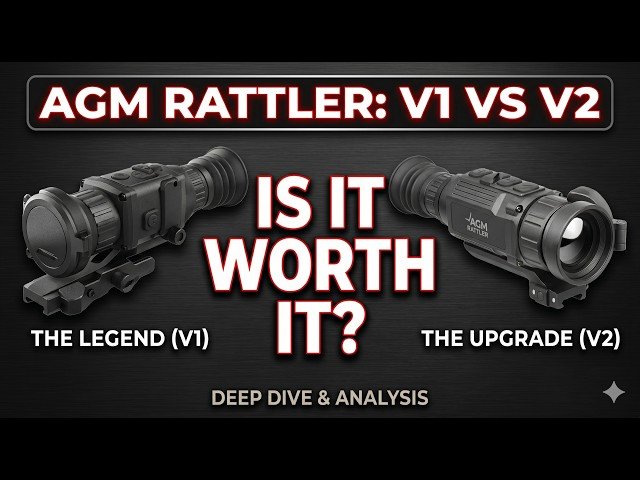
So which generation should you buy?
Not the reflexive answer.
Choose the AGM Rattler V3 if you hunt in warm or wet conditions where sub 15 mK earns its money, or if the NUC shutter genuinely bothers you.
Choose the AGM Rattler V2 if you want the biggest jump for your money. The V1 to V2 step is far larger than the V2 to V3 step, and V2 pricing softens as V3 takes shelf space.
The AGM Rattler V1 is available only at a substantial discount and is intended solely for close-range work. The 25 Hz refresh and four-and-a-half-hour runtime are real limitations, and sub-35 mK struggles on the damp, low-contrast nights you probably bought thermal for.
Generation Comparison
| V1 (TS/TC) | AGM Rattler V2 | AGM Rattler V3 | |
|---|---|---|---|
| Detector pitch | 17 μm | 12 μm | 12 μm |
| NETD | sub 35 mK | sub 20 mK | sub 15 mK |
| Refresh rate | 25 Hz | 50 Hz | 50 Hz |
| Display | OLED | 1024×768 OLED | 1920×1080 |
| Power | 2× CR123A | Rechargeable pack | NE-4400 pack |
| Runtime | ~4.5 h | 9 to 11.5 h | 7+ h |
| Audio recording | No | Yes. | Yes. |
| Shot Activated Recording | No | Yes. | Yes. |
| Shutterless NUC | No | No | Yes. |
| Launched | Original | 2024 | January 2026 |
Choosing Your Configuration
Within any generation, two numbers decide everything: sensor resolution and objective size.
Sensor resolution
256×192 is entry level. It detects nearly as far as a larger sensor but identifies at substantially shorter range. Correct for close woodland work, for a second rifle, or for a first thermal where budget is the binding constraint.
384×288 is the sweet spot most hunters should buy. The resolution is sufficient to identify a beast before the shot at realistic European ranges; however, if you don’t pay for the reach, you won’t use it.
640×512 is for open country and longer shots. It buys identification range, which is the metric that actually matters, not detection range.
Our 384 versus 640 guide works through the decision in detail.
Objective size
A larger germanium objective gathers more infrared and reaches further, at the cost of a narrower field of view and more weight on the rifle.
19 mm provides the widest view and the fastest scanning. Close woodland. 25 mm balances the two. 35 mm is the general-purpose choice for mixed ground. 50 mm reaches furthest and shows you the least. Open country.
AGM’s quoted detection ranges by configuration
| Configuration | Sensor | Base mag | Detection |
|---|---|---|---|
| 19-256 | 256×192 | 2.5x | 950 yd |
| 25-256 | 256×192 | 3.5x | 1,250 yd |
| 25-384 | 384×288 | 2x | 1,200 yd |
| 35-384 | 384×288 | 3x | 1,800 yd |
| 35-640 | 640×512 | 2x | 1,800 yd |
| 50-640 | 640×512 | 2.5x | 2,600 yd |
Read these as detection, not identification. Detection means you can perceive that a heat source exists. Identification, where you can confirm species, sex, and shot angle, comes in at roughly a third of that distance. A 50-640 detecting at 2,600 yards identifies at perhaps 800 to 900 under good conditions and considerably less in warm weather.
Anyone quoting detection range as though it were shooting distance is not being straight with you.
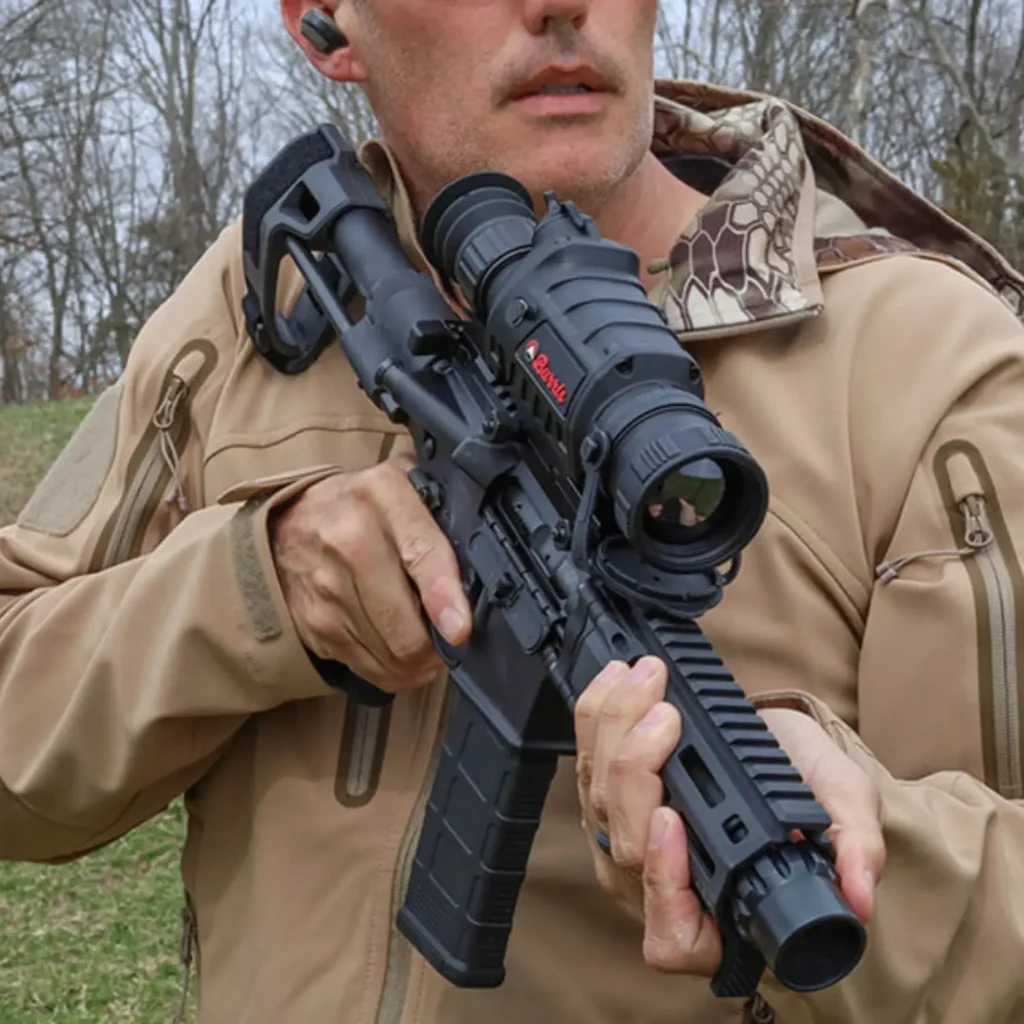
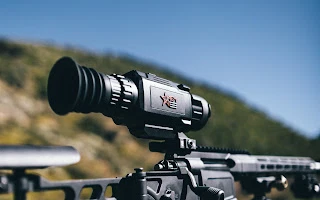
Scope or Clip-On?
The scope is the first decision, and the two are genuinely different tools.
Dedicated thermal riflescope
Replaces your day optic. You mount it, zero it, and shoot through it. It is the simplest and most capable option if the rifle is mainly for night work, with everything integrated: reticles, zeroing profiles, recording, and ballistic support.
The trade is that the rifle becomes a night rifle. A thermal scope is a poor daytime sight, so you either accept that or you swap optics.
Our Rattler scopes:
| Model | Sensor | Price | Best for |
|---|---|---|---|
| AGM Rattler TS19-256 | 256×192 | $1,100 | Budget, close range, AR platform |
| AGM Rattler TS35-384 | 384×288 | $2,200 | All-round night hunting |
| AGM Rattler TS50-640 | 640×512 | $3,685 | Long range, open ground |
Thermal clip-on
Mounts ahead of your existing day scope. Your zero is retained, your reticle is your own, and the rifle handles as it always has. Come daylight, you take it off, and you have your normal optic back.
For a hunter who shoots one rifle day and night and does not want to relearn a sight picture under pressure, this is usually the smarter buy.
Our Rattler clip-ons:
| Model | Sensor | Price | Best for |
|---|---|---|---|
| AGM Rattler TC19-256 | 256×192 | $1,100 | Entry clip-on, close range |
| AGM Rattler TC35-384 | 384×288 | $1,980 | All round, keeps your zero |
| AGM Rattler TC50-640 | 640×512 | $3,300 | Long range without re-zeroing |
Notice that the 384 clip-on undercuts the 384 scope by $220. If you already own a day scope you trust, the clip-on route is both cheaper and more flexible.
Browse the full thermal riflescope range for Pulsar, ATN, and Konus alternatives.
The Cost Nobody Mentions: The Mount
The AGM no longer includes a quick-detach mount with the Rattler. The V2 ships with a fixed mounting system.
If you want quick detach, and most people do because it lets you swap between rifles or pull the optic for transport, budget for it separately. An ADM extended cantilever QR mount for a Rattler runs around $169 on the open market.
That is not a trivial addition on a $1,100 scope. It is roughly 15 percent on top, and almost nobody tells you before you order.
Two further ownership costs are worth knowing. The V2 battery pack is proprietary, so carry the spare that ships with it rather than assuming you can buy replacements locally. And on the clip-on side, you will need the correct mount ring for your day scope’s objective diameter.
Caliber and Recoil: The Riflescope Specific Warning
This matters more for a scope than for any other thermal device, because a riflescope absorbs the full recoil impulse shot after shot while a monocular or clip-on does not.
A 5.56 AR platform is gentle on optics. A .308 generates substantially more recoil. A .300 Win Mag or . 338 Lapua will destroy a scope not engineered for it, and thermal scopes contain a sensor, a processor, a display, and a battery, all of which have to survive that impulse.
Check the manufacturer’s stated recoil rating against your rifle before ordering, particularly for magnum calibers. A clip-on sidesteps some of this because it mounts forward, and your day scope, already proven on that rifle, does the aiming.
If you shoot a hard recoiling rifle and are uncertain, ask us before you order rather than after.
Is It Actually a Rattler V2? A Thirty-Second Check
Because the naming is a mess, here is how to verify what you are holding.
Check the battery. Two CR123A primary cells mean V1. A removable rechargeable pack means V2 or V3.
Refer to the menu for Shot Activated Recording. This feature is present on V2 and V3, but absent on V1.
Pan across the ground. V1 runs at 25 Hz, and the image visibly lags. V2 and V3 run 50 Hz and pan smoothly.
Check whether audio records. V1 records video without sound. V2 and V3 record both audio and video.
Verify the model plate. A bare TS or TC code with no version number indicates V1. RattlerV2, Rattler-C V2, and RattlerV3 are explicit.
If a seller cannot tell you which generation they are shipping, that is information in itself.
What About the ATN Rattler?
There is no such thing, and enough people search for it that it is worth stating plainly.
ATN does not make a Rattler. The Rattler is a product line from AGM Global Vision. ATN makes the MARS and Thor thermal riflescopes, which are different optics from a different manufacturer.
The confusion is understandable, as both brands sell thermal scopes in overlapping price brackets and appear in the same search results. If you are cross-shopping the two, we carry both: the ATN MARS 4 2-8x 384 at $2,750 and the ATN MARS LT 3-6x at $1,540, which sit alongside the Rattler range.
Broadly, ATN leans harder on software features and ballistic calculators. AGM leans harder on sensor quality per euro. Our best thermal scope guide compares them properly.
Rattler Against the Alternatives
| AGM Rattler 384 | Konus Flame-R | ATN MARS LT | Pulsar Talion XQ35 Pro | |
|---|---|---|---|---|
| Sensor | 384×288 | 384 | 320 | 384 |
| Type | Scope or clip-on | Scope | Scope | Scope |
| Magnification | 2 to 16x | 2.5 to 20x | 3 to 6x | 2.5 to 10x |
| Clip-on option | Yes. | No | No | No |
| Price | $2,200 | $1,375 | $1,540 | See listing. |
| Best for | All around | Value | Lightweight | Premium value |
The Rattler’s distinguishing feature within this group is that the same platform exists as both a scope and a clip-on at similar specifications. If you are undecided between the two formats or think you might want both across different rifles, that consistency has real value.
The Konus Flame-R at $1,375 undercuts the Rattler 384 significantly and is the value pick. The Pulsar range sits above it, with laser rangefinding integrated on the Thermion 2 LRF models.
Should You Scan With Something Else?
A point worth making because it saves people money.
A thermal riflescope is a shooting tool. Scanning ground with a rifle-mounted optic means pointing a loaded rifle at everything you want to look at, which is poor practice regardless of how careful you are.
Most hunters running thermal seriously carry a thermal monocular for scanning and use the scope only once a target is identified and the shot is on. That workflow is safer and faster.
If your budget stretches to just one device, and you already shoot a day scope you trust, a clip-on plus a handheld monocular often beats a dedicated thermal scope for the same total spend. Our thermal imaging for hunting guide covers the scanning side.
Pricing and EU, America, and the rest of the world delivery
Our Rattler range runs from $1,100 for a 256 scope or clip-on to $3,685 for the 50-640. Every unit is genuine AGM stock with a full warranty, dispatched and tracked from Berlin.
Thermal optics attract export restrictions in some destinations, though far fewer than image intensifier night vision does. If you are ordering from outside Germany and are unsure whether we can ship to you, ask before you order and we will confirm.
Frequently Asked Questions
What is the difference between the AGM Rattler V2 and V1?
The V2 moved from a 17-micron to a 12-micron detector, improved NETD from sub-35 mK to sub-20 mK, doubled the refresh rate from 25 Hz to 50 Hz, replaced CR123A cells with a rechargeable pack running 9 to 11.5 hours, and added audio recording plus Shot Activated Recording. It is a substantial upgrade rather than a refresh.
Does TS35-384 mean the same as Rattler V2 35-384?
No, TS refers to the version 1 naming convention. AGM describes the Rattler V2 19-256 as an improved version of the Rattler TS19-256, which makes TS a V1 designation. If a listing gives a bare TS or TC code with no version number, assume V1 unless the seller states otherwise.
What do the numbers in the model code mean?
Objective diameter in millimeters, then sensor resolution. TS35-384 is a 35 mm germanium lens with a 384×288 sensor. TC50-640 is a 50 mm lens with a 640×512 sensor on a clip-on.
Is the Rattler V2 NETD sub-20 mK or sub-35 mK?
Sub 20 mK. Sub 35 mK is the V1 figure. At least one major retailer lists 35 mK against V2 products, most likely a stale spec sheet carried over. If you notice 35 mK on a V2 listing, please verify the source.
Is the Rattler V3 worth waiting for?
It depends on your conditions. V3 improves NETD to sub-15 mK, moves to a 1920×1080 display, and adds shutterless NUC. This is especially meaningful if you hunt in warm or wet weather. The V1 to V2 jump is considerably larger than V2 to V3, so if the budget is tight, a V2 at a softening price is the better value.
How much does an AGM Rattler cost?
Ours runs from $1,100 for a 256 scope or clip-on, $1,980 to $2,200 for the 384 models, and $3,300 to $3,685 for the 640 models. Budget an additional amount for a quick detach mount, which AGM no longer includes.
Does the AGM Rattler come with a mount?
It ships with a fixed mounting system. The AGM no longer includes a quick detach mount. If you want QD, budget roughly $169 separately.
Should I buy the scope or the clip-on version?
Choose the scope if the rifle is mainly for night work and you want everything integrated. Clip-on if you shoot the same rifle day and night and want to keep your existing zero and reticle. The 384 clip-on is also cheaper than the 384 scope.
How far can an AGM Rattler detect?
AGM quotes 950 yards for the 19-256 and up to 2,600 yards for the 50-640. Read those as detection figures. Identification, where you can confirm the animal and the shot angle, comes in at roughly a third of the detection distance and less in warm weather.
Is there an ATN Rattler?
No. The Rattler is an AGM Global Vision product. ATN makes the MARS and Thor lines. Both brands compete in similar price brackets, which is where the confusion comes from.
What sensor resolution should I buy?
384×288 for most hunters. 256×192 only for close woodland or a tight budget. 640×512 for open country and longer shots. Resolution drives identification range, which is the number that matters.
Does my caliber matter?
More than for any other thermal device, because a riflescope takes full recoil shot after shot. A 5.56 is easy on optics. 308 much less so, and magnums demand a scope rated for hard recoil. Check the stated recoil rating before ordering.
Where to Go From Here
- Compare against other brands: best thermal scope for the money
- Sensor decision: 384 vs 640 thermal
- Predator specific: best thermal scope for coyote hunting
- Scanning side: thermal imaging for hunting
- Browse: thermal riflescopes · thermal monoculars · Pulsar scopes · AGM Global Vision
Not sure which configuration suits your rifle, your ground, and your caliber? Tell us what you shoot and where, and we’ll tell you which Rattler to buy or if a clip-on and monocular would serve you better for the same money. Talk to us.