
Handheld Thermal Monocular: Buyer’s Guide (2026)
A handheld thermal monocular is a one-handed, single-eyepiece device that shows you heat instead of light, so you can find animals and people in complete darkness without a torch and without mounting anything to a rifle. It is the most practical thermal format, and for most buyers it should be their first thermal device.
This guide focuses on what makes a handheld device particularly effective to actually hold and use: weight, balance, one-handed controls, battery format and pocketability, alongside the sensor specifications. For the wider category overview, see our complete thermal monocular guide, or browse the thermal monocular range.
Why does the handheld format outperform all other thermal formats?
Thermal comes as handhelds, binoculars, riflescopes and clip-ons. The handheld wins on four counts that matter to most people.
It is the only format that is safe to search with. A rifle-mounted thermal device means pointing a firearm at everything you want to identify. A handheld thermal monocular lets you sweep ground, find a heat signature and work out what it is with no weapon involved.
It is the cheapest way into thermal imaging. Entry devices start around €329, against roughly €1,490 for a clip-on, €1,690 for a scope and €2,990 for a binocular.
It is the most versatile. The same device works for hunting, checking livestock, finding a lost dog, watching wildlife, inspecting a building for heat loss, and searching a garden at 2am.
It goes in a pocket. The lightest units weigh around 255 g and genuinely fit in a jacket pocket, so you can carry them and use them.
The trade-offs are real too. One eye tire over a long session, a handheld occupies a hand you may need, and it will not appear on any screen. If you glass for hours at a time, consider comparing it to a thermal binocular.
What makes a good handheld: the physical specifications
Most buying guides jump straight to sensors. For a device you hold one-handed for hours in the cold, the physical side deserves equal weight.
Weight
The practical range runs from about 255g to over 650g, and you notice every gram after an hour.
- Under 300 g: genuinely pocketable, no fatigue, one-handed all night. The ThermTec Cyclone at 255 g and Pulsar’s compact Axions sit here.
- 300-450g: the mainstream. Comfortable for extended use, still one-handed.
- Over 450g: noticeable. This weight is usually the price of a 50mm lens or an integrated rangefinder. Fine if you are static; tiring if you walk.
Weight is the specification most often ignored at the point of purchase and most often complained about afterwards.
Size and pocketability
A portable thermal monocular you leave in the truck is worth nothing. Compact models around 150mm long can slide into a jacket pocket. Long-lens models do not fit in a pocket and need a case or a harness.
Be honest about how you will carry it. Most people who buy the biggest lens end up carrying it less.
One-handed operation
Check that the buttons fall under your fingers without changing grip. Reviewers have criticised more than one popular compact for controls that are awkward to reach depending on hand size, and it matters more than it sounds when you are holding a device, a lead and a torch in the cold.
Look for a small number of clearly separated buttons rather than a dense cluster.
Battery format
This is the most underrated specification on any handheld thermal imaging monocular.
- Replaceable proprietary packs, like Pulsar’s APS5, can be swapped in seconds. Carry a spare and battery life stops being a topic.
- Standard 18650 cells, used by AGM and others, are cheap and available anywhere.
- Sealed internal batteries are tidier and end your night when they run out.
Runtimes range from about 6 to 20 hours. A 20-hour device with a sealed battery is fine; a 7-hour device with a sealed battery is a genuine limitation.
Building and sealing
Magnesium alloy housings are standard at mid-range and above, and they survive drops onto wet grass and stones. Look for IP67 or IPX7, both of which mean rain and brief immersion are not a problem. Consider that you will use this device in the worst weather of the year, at night, probably while fatigued.
The sensor specifications that matter
Thermal sensitivity (NETD)
If you read one number, read this one. NETD measures the smallest temperature difference the sensor can separate from its noise, in millikelvins, and the lower is better.
- Under 15 mK: professional grade
- Under 20mK: strong
- 20-40 mK: acceptable in cold, dry conditions
- Above 40 mK: struggles in damp weather
On a wet night, a soaked animal may be only slightly warmer than the soaked ground. Sensitivity is what sets them apart. Resolution sells devices; sensitivity finds animals.
Resolution
256×192 for close work and garden checks. 384×288 for general hunting at practical ranges. 640×512 for open country and earlier identification. See our explainer on 384 versus 640 sensors.
Lens and field of view
Short lenses (19-25mm) give a wide view for fast scanning. A 35mm lens is the all-rounder’s compromise. A 50mm lens reaches furthest with the narrowest view. Finding a moving animal through a narrow field is genuinely harder, so do not automatically choose the largest lens.
Detection versus identification range
Quoted detection figures assume a large, warm target in clear cold conditions. Identification, which means you know what the animal is, occurs at roughly a quarter to a third of that distance, and weather affects both detection and identification. Use the figures to compare devices, but never treat them as a promise. Our guide on how far thermal really sees covers these points.
Display
A superb sensor behind a small, low-resolution screen is wasted. Check display resolution alongside sensor resolution, since this is a known weak point on some otherwise excellent compacts.
Best handheld thermal monocular: our picks
We stock every brand below and have no incentive to favor one.
| Category | Pick | Sensor | NETD | Weight | Price |
|---|---|---|---|---|---|
| Best overall value | ThermTec Cyclone | 640×512 | <20 mK | 255 g | €899 |
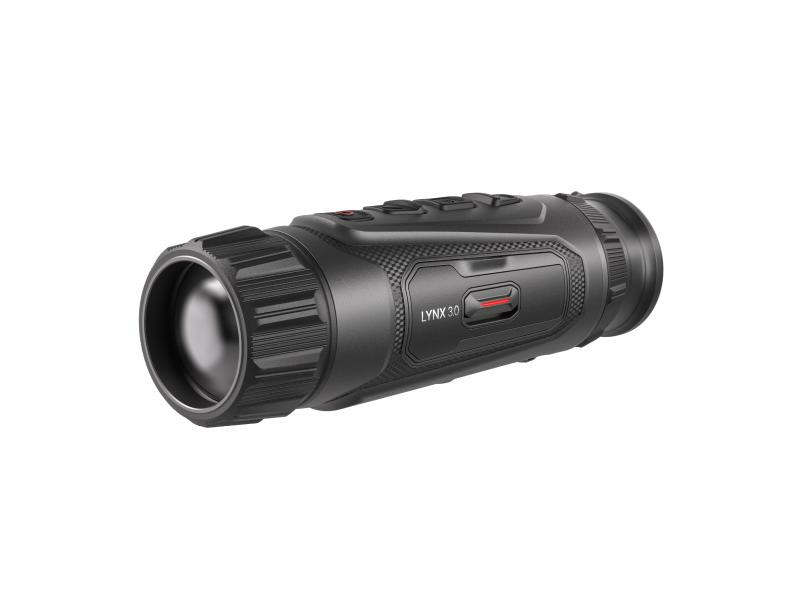
| Best on a budget | HIKMICRO Lynx 3.0 | 256 / 384 | Varies | Light | From €329 |
| Best all-rounder | ThermTec Cyclops 3.0 | 640×512 | ≤25 mK | Mid | €1,190-1,390 |
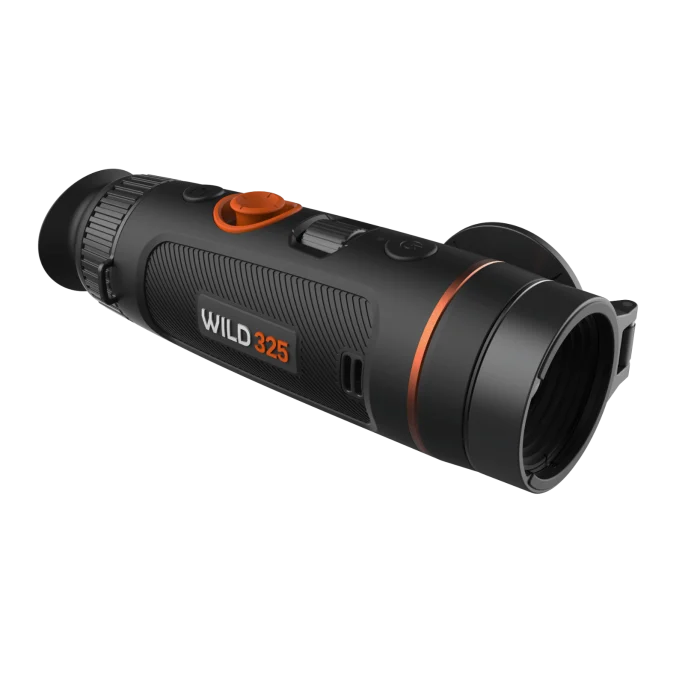
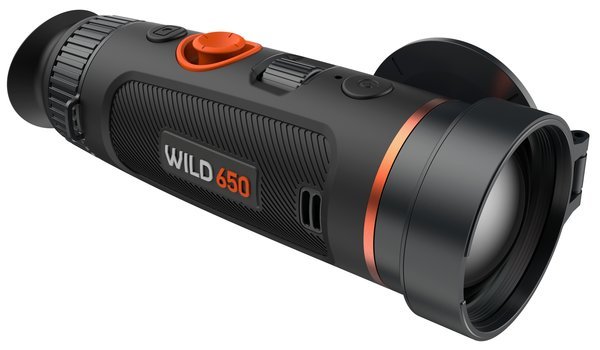
| Best image quality | ThermTec Wild Pro | 640×512 | <15 mK | 653 g | €2,890 |
| Best build and software | Pulsar Telos LRF XP50 | 640×480 | <18 mK | Full size | POA |
| Most pocketable | Pulsar Axion XQ19 | 384×288 | Low | ~270 g | POA |
| Best dual field of view | ThermTec Cyclops-D | 640×512 | ≤25 mK | Mid | €1,890 |
| Longest warranty | AGM Sidewinder | 384 12 µm | ≤20 mK | Mid | POA |
Why the Cyclone leads on value
It has a 640 sensor, operates at under 20mK, weighs 255g, offers roughly 20 hours of battery life, and costs €899. Two years ago, that specification cost twice as much. It has a short lens, so it is a scanner rather than a long-range spotter, but for most people scanning is the job.
Where the budget ends
HIKMICRO’s Lynx from around €329 is the cheapest genuinely usable handheld we are willing to sell. Below roughly €300 you get a small sensor, weak sensitivity and a poor display, and it will disappoint in exactly the damp conditions you bought it for. If €329 is your ceiling, the Lynx is a real device. At €899, you get a much bigger capability jump than price jump.
Handheld thermal monocular brands compared
| Brand | Strength | Weakness | Sensitivity range |
|---|---|---|---|
| ThermTec | Specification per euro | Less software polish, weaker resale | <15 to 25 mK |
| Pulsar | Build, software, resale | Price: 12 µm models are less sensitive. | <18 to 40 mK |
| HIKMICRO | Widest price ladder, owns budget end | Fewer standout flagships | Varies by model |
| AGM | Five-year warranty, good value | Older stock sits beside new | 20 to 35 mK |
| ATN | Deepest feature set, long battery | Optical quality per euro | To ≤15 mK |
Full model-by-model detail is in our complete thermal monocular guide and specifically in our Pulsar guide.
Matching a handheld to what you do
The right handheld thermal monocular depends far more on your ground and quarry than on your budget.
Woodland, hedgerows, and close cover. A short 19-25mm lens and a lightweight body are ideal. You need a wide field to find animals moving through gaps, and you will be walking. The ThermTec Cyclone, or a compact Pulsar Axion suit, does the job exactly.
Open fields and hill ground. A 35mm or 50mm lens provides the reach, and a 640 sensor allows you to identify the animal before it is right on top of you. The ThermTec Wild is built for such terrain.
Mixed ground in one outing. A dual field-of-view device such as the Cyclops-D switches between a wide scanning lens and a narrow identification lens, which solves a problem no single-lens handheld can.
Foxing and predator control. You find and follow a moving animal rather than spot a stationary one at a distance, which affects sensitivity and field of view.
Deer management and counting. Reach and resolution are important, since you need to identify species and often sex at a distance. A 640 sensor earns its cost here.
Farming and livestock. Almost any device works. Finding a ewe lambing in a far corner or a calf separated from the herd needs detection, not identification at range, so an entry unit is genuinely enough.
Security and property. A short lens with a wide field and a long battery life is ideal if it stays by the door.
For the hunting-specific breakdown, see our thermal monocular for hunting guide.
Accessories worth buying with a handheld
A spare battery. It’s the single most useful accessory, and it’s also the cheapest. Buy one with the device, not later.
A wrist lanyard. You will be holding this one-handed, in the dark, in the wet, and often while also holding something else. Most units ship with one. Use it.
A case or harness. Long-lens models do not pocket. A chest harness keeps the device accessible and out of the way and stops it from swinging into gates and fence posts.
A tripod adapter. If you do static observation, counting deer or watching a set piece of ground, mounting a handheld on a tripod removes arm fatigue entirely and steadies the image at magnification.
A power bank. Devices charging over USB-C can be topped up in the field between sessions.
What to check when your device arrives
Set the dioptre before anything else. The eyepiece adjusts to your eye. Focus on the on-screen graphics using the dioptre ring first, then use the lens focus for the scene. Most people never touch the dioptre ring, so they think the device is soft.
Test it on known ground. Walk somewhere with animals you know about. Understanding what a fox looks like at 200m through your specific device is worth more than any specification.
Check the buttons with gloves on. If they are unusable in gloves, you will have learned this in your garden rather than on the hill in February.
Run the battery flat once. You then know the real runtime rather than the advertised one.
Update the firmware. Most brands ship improvements after release, and it takes minutes through the manufacturer’s app.
Using a handheld thermal monocular well
Scan slowly in overlapping strips. The instinct is to sweep like a torch. Thermal rewards the opposite. Work in bands, pausing at the edges of the cover where often only a head or flank shows.
Brace your arm. A handheld device wanders at magnification. Tuck your elbow into your ribs, or rest against a post, gate, or tree. It transforms the image at higher zoom levels.
Use two palettes. Use white-hot for finding and black-hot for detail once found.
Let it acclimatise. A warm device brought into cold air gives a poor image until temperatures settle.
Learn your ground’s false positives. Sun-warmed rock, ploughed soil, compost heaps, and standing water all read as warm.
Carry the spare battery charged. The most common avoidable complaint we hear.
Mistakes to avoid
Buying on detection range. This is the most quoted figure, but it is the least useful.
Ignoring weight. You will hold this one-handed for hours. Over 450g becomes tiring.
Buying too many lenses. A narrow field of view is genuinely harder to use, and most people scan more than they reach.
Accepting a sealed battery on a short-runtime device is a poor choice. Replaceable cells solve the problem permanently.
Buying a rifle scope instead. A handheld is safer, cheaper, and more versatile. Buy it first.
Frequently asked questions
What is a handheld thermal monocular?
A one-handed, single-eyepiece device that builds an image from emitted heat rather than light. Because it reads infrared directly, it can find animals and people in complete darkness, through haze and cover, with no torch and nothing mounted to a rifle.
What is the best handheld thermal monocular?
For overall value, the ThermTec Cyclone at €899 has a 640 sensor, under 20 mK, in a 255 g body and roughly 20 hours of battery life. For the best image quality, the ThermTec Wild Pro is under 15 mK. For build and software, Pulsar’s Telos LRF XP50. On a tight budget, HIKMICRO’s Lynx is around €329.
How heavy should a handheld thermal monocular be?
Under 300g is genuinely pocketable and causes no fatigue over a long night. The 300 to 450 g range is the comfortable mainstream. Above 450g you notice it, and that weight usually buys a 50mm lens or an integrated rangefinder, which is a fair trade if you are static rather than walking.
Is a handheld thermal monocular better than a thermal scope?
For finding and identifying, yes, and it is also the only one of the two that is safe to search with. A scope is for aiming. The standard setup is to scan with the handheld, then bring the rifle up once you know what you are looking at.
Can a handheld thermal monocular be mounted on a helmet?
Many can, using a bridge and shroud arrangement borrowed from night vision, which frees both hands. Look for a device under about 400g with a compatible mounting interface and a relatively short lens, since a narrow field of view is disorienting when walking. Check adapter compatibility for your specific model before ordering.
How long do handheld thermal monocular batteries last?
Between roughly 6 and 20 hours. The ThermTec Cyclone reaches around 20 hours, and Pulsar’s Axion 2 XG35 is about 7. More important than the headline figure is whether the battery is replaceable, since a spare removes the limit entirely.
What is a decent NETD for a handheld thermal monocular?
Under 20 mK is strong, and under 15 mK is professional grade. Above 40 mK the image degrades noticeably in damp weather. In most of Europe, sensitivity matters more than resolution because the season is wet.
What is the cheapest handheld thermal monocular worth buying?
Around €329 for a HIKMICRO Lynx. Below roughly €300, the combination of a small sensor, weak sensitivity, and a poor display means it disappoints in exactly the conditions you bought it for.
Is a portable thermal monocular waterproof?
Most quality devices carry IP67 or IPX7 ratings, meaning they handle heavy rain and briePlease verify the specific rating instead of assuming, especially for budget models.e budget end.
Can I use a handheld thermal monocular in daylight?
Yes, and daylight will not damage it the way it would damage a night-vision tube. Contrast is often lower in bright sun because the ground warms up and the temperature gap between an animal and its background narrows.
Do I need a rangefinder on a handheld thermal monocular?
Only if you need distance readings. For scanning, finding and tracking, it is a luxury that adds several hundred euros. If you scan and then shoot, or judge whether a stalk is worth starting, models with LRF in the name earn their premium.
Should I buy a handheld thermal monocular or a binocular?
A handheld monocular for almost everyone starting out. It is lighter, costs a third as much, fits in a pocket, and covers every job a first-thermal needs to do. Binoculars become worth the difference only when you glass for hours at a stretch, since two-eye viewing removes the eye strain a single eyepiece builds up over a long session.
How far can a handheld thermal monocular see?
Entry devices detect a large warm animal at roughly 800 to 1,300 m, mid-range models at 1,800 to 2,500 m, and long-lens units beyond. Those are detection figures. Identifying the animal occurs at a distance of a quarter to a third of that range.
Ready to choose? Browse thermal monoculars for sale, read our complete thermal monocular guide for the full brand comparison, or see the Pulsar range and how thermal vision works. Hunting specifically? See the thermal monocular for hunting guide. Also compare thermal scopes, clip-ons and binoculars.