
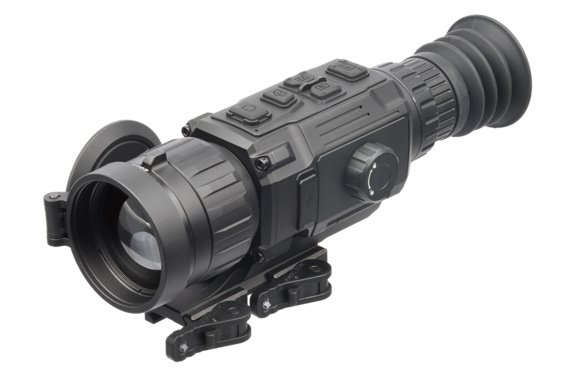
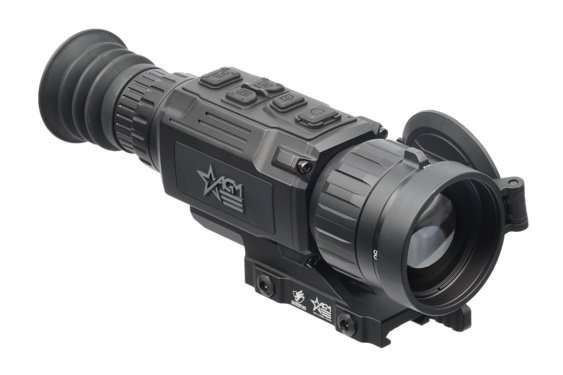
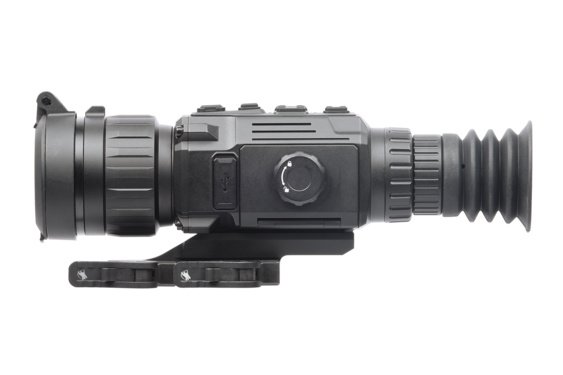
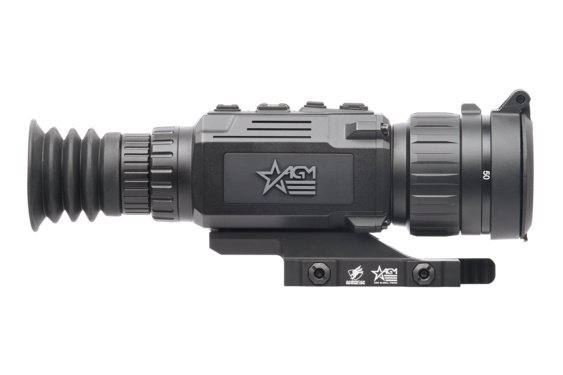
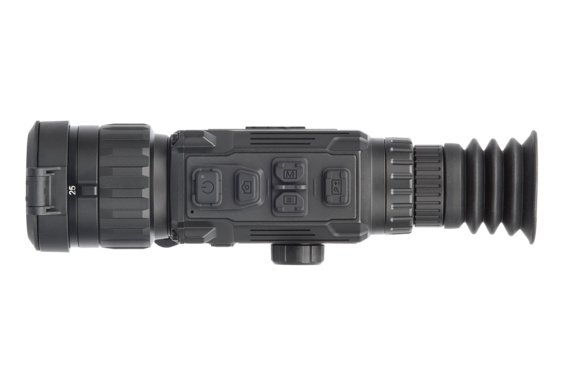
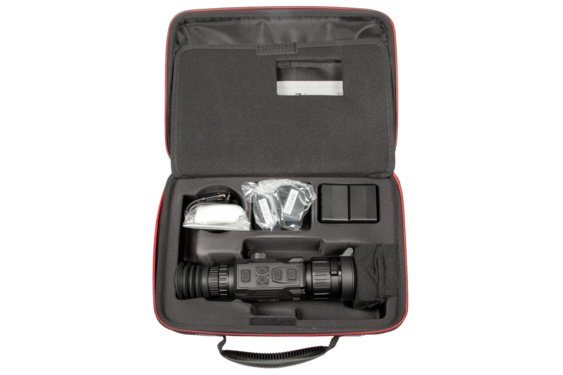
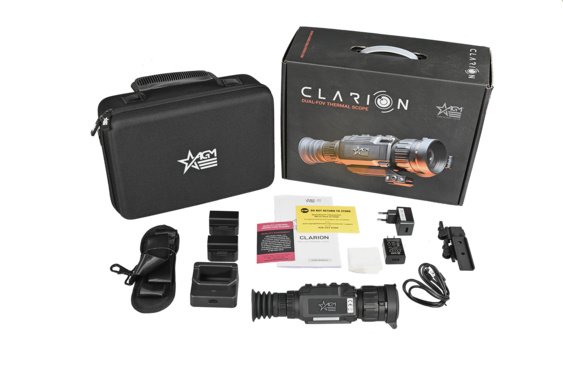
The widest spread between modes of any Clarion
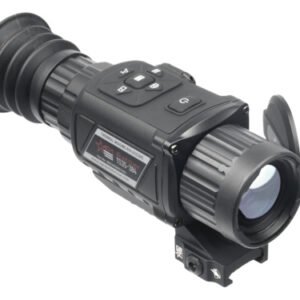
The Clarion’s whole proposition is having two optical configurations in one scope. The 384 model takes that further than the 640 does.
Its 25 mm objective gives 2× base magnification and a 10.5° × 7.9° field, 53 ft at 100 yards, and focuses from 4 m to infinity. Its 50 mm objective gives a 4.5× base and a 5.3° × 4.0° field, with 27 ft at 100 yards. Maximum magnification runs to 36×.
Compare that to the 640, which spans 2× to 3× base and tops out at 24×. The 384 gives you a genuinely wider operating envelope: closer minimum focus at 4 m, and half again the maximum magnification.
The cost is sensor resolution. A 384×288 detector resolves less detail than 640×512, and at 36× you are well past the point where the sensor limits what you can see rather than the optics. Use the upper end of that magnification range to confirm what you have already identified, not to identify it in the first place.
Which mode does what?
| Wide mode (25 mm) | Narrow mode (50 mm) | |
|---|---|---|
| Base magnification | 2× | 4.5× |
| Magnification range | 2× to 16× | 4.5× to 36× |
| Field of view | 10.5° × 7.9° | 5.3° × 4.0° |
| At 100 yards | 53 ft | 27 ft |
| Detection range | 1,200 m | 2,600 m |
| Focus range | 4 m to infinity | 10 m to infinity |
The 4 m minimum focus in wide mode is worth noting. Most thermal scopes will not focus closer than 7 to 10 m, which is a real limitation around farm buildings and in dense cover where an animal can appear very close. The Clarion 384 in wide mode handles that.
Sensor and sensitivity
The sensor is a 384×288 detector with a 12 micron pixel pitch, a 50 Hz refresh rate, and a NETD rated below 20 mK.
NETD is the smallest temperature difference the sensor can resolve. Sub-20 mK is a solid mid-range figure that holds a usable image in most conditions, including moderate fog and drizzle. It is not the sub-15 mK of the Rattler V3 or Adder V2 ranges.
The F0.8 wide objective is unusually fast, faster than anything else in your options here, and that helps. A faster lens puts more infrared energy on the detector, which partly offsets the NETD gap in low-contrast conditions.
Ranging, and what it does not do
Stadiametric, not laser. You size a known-height target against a reticle scale, and the scope calculates distance. It has no power draw and no failed returns, but it is less precise than a laser and depends on knowing the target’s height.
If confirmed range matters more than optical flexibility, our Varmint V2 LRF 35-384 at €2,650.00 uses the same 384 sensor resolution with a 600 m laser rangefinder and onboard ballistic calculator, for €1,40 less. It has a single 35 mm lens rather than two.
That is a genuine fork in the road and worth thinking about properly before you buy either.
Power, storage, and build
Two removable rechargeable batteries are included, each running up to 8.5 hours, giving 17 hours with a swap. That is shorter than the Clarion 640’s 11 hours per cell, which is a function of driving the faster optics.
16 GB of eMMC storage with video, audio, image capture, and Shot Activated Recording. A quarter of the 64 GB in the Rattler V3 and Adder V2 ranges, so export regularly if you record a lot.
Ten reticle types in four colors, five zeroing profiles, ten brightness and contrast settings, five sharpness levels, four palettes, cold and warm scene modes, and flat field correction in auto, manual, or external.
Waterproof and shockproof. Wi-Fi hotspot with AGM Connect. External power supported. Mount included, specified for AR and bolt-action platforms. Five-year warranty.
See the full thermal riflescope range or our thermal scope buying guide.
Technical specifications
| Feature | Specification |
|---|---|
| Detector | 12 µm VOx uncooled focal plane array |
| Resolution | 384 × 288 |
| NETD | Less than 20 mK (25°C, F#=1.0) |
| Refresh rate | 50 Hz |
| Lens system | 25 mm F0.8 / 50 mm F1.0, mechanically switched |
| Magnification | 2× to 16× (25 mm) / 4.5× to 36× (50 mm) |
| Field of view | 10.5° × 7.9° / 5.3° × 4.0° |
| Field of view at 100 yd | 53 ft / 27 ft |
| Detection range (6 ft object) | 1,200 m / 2,600 m |
| Focus range | 4 m to infinity / 10 m to infinity |
| Display | 0.39 in OLED, 1024×768 |
| Diopter adjustment | -5 to +5 |
| Exit pupil | 6 mm |
| Eye relief | 45 mm |
| Digital zoom | 1×, 2×, 4×, 8× |
| Rangefinder | Stadiametric |
| Reticles | 10 types, 4 colors |
| Zeroing profiles | 5 |
| Display settings | 10 brightness, 10 contrast, 5 sharpness |
| Palettes | Black Hot, White Hot, Red Hot, Fusion |
| Flat field correction | Auto, manual, external |
| Scene modes | Cold, Warm |
| Storage | 16 GB eMMC |
| Battery life | Up to 8.5 hours |
| Batteries | Removable, rechargeable, two included |
| Recording | Video, audio, image capture, shot-activated recording |
| Connectivity | Wi-Fi hotspot, AGM Connect app |
| Build | Waterproof, shockproof |
| Warranty | 5 years |
FAQ
What magnification does the AGM Clarion 384 offer?
Two optical configurations. The 25 mm lens provides 2× base magnification, increasing to 16×. The 50 mm lens gives 4.5× base magnification, running to 36×. Switching between them is mechanical, so there is no loss of image resolution. That 36× maximum is the highest in the Clarion range.
How close can the Clarion 384 focus?
In wide mode with the 25 mm lens, it can focus down to 4 m, and in narrow mode with the 50 mm lens, it can focus down to 10 m. The 4 m figure is unusually close for a thermal riflescope, where 7 to 10 m is more typical, and it matters around farm buildings and in dense cover where animals can appear very close.
Should I buy the Clarion 384 or the Varmint V2 LRF 35-384?
Both use a 384×288 sensor with a NETD of less than 20 mK. The Clarion 384 at €2,890.00 gives you two mechanically switched lenses spanning 2× to 36×. The Varmint V2 LRF 35-384 at €2,650.00 gives you a single 35 mm lens plus a 600 m laser rangefinder and ballistic calculator. Choose the Clarion if your terrain varies, and the Varmint if your distances do.
Does the AGM Clarion 384 have a rangefinder?
It has a stadiametric rangefinder, which estimates distance by sizing a known-height target against a scale in the reticle. It draws no power and always returns a reading, but it is less accurate than a laser and requires you to know the target’s height. No Clarion model has a laser rangefinder.
How long does the Clarion 384 battery last?
Each battery lasts up to 8.5 hours, and two removable rechargeable batteries are included, providing a total of 17 hours of field time. That is shorter than the Clarion 640’s 11 hours per cell. External power is supported for extended sessions.
Reviews
There are no reviews yet.