
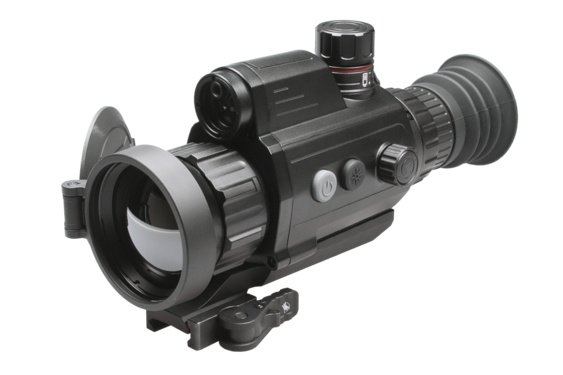
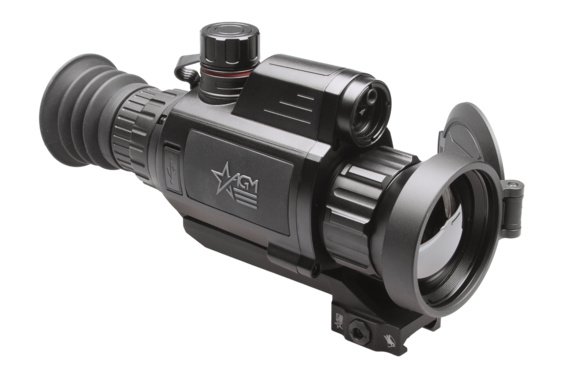
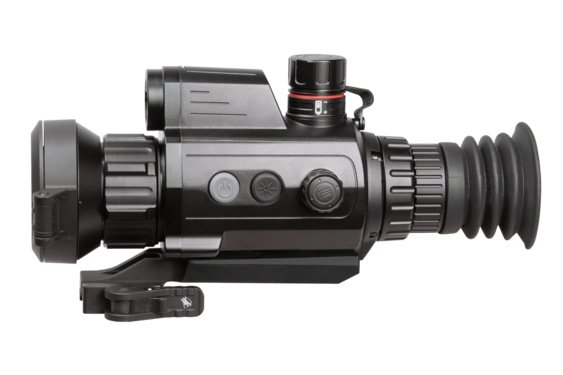
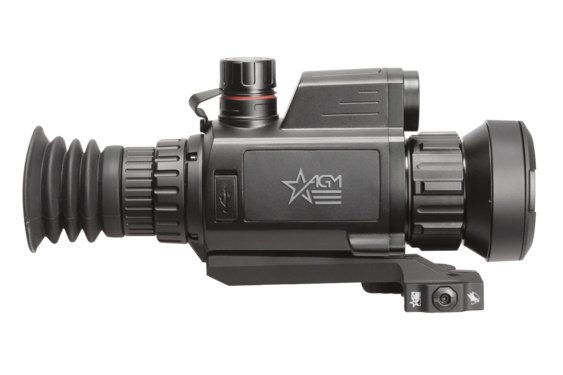
Why the rangefinder is the point
Thermal scopes present a flat digital image. None of the depth cues your brain uses through glass optics are there, so distance estimation through a thermal display is unreliable, and it gets rapidly worse past 200 m.
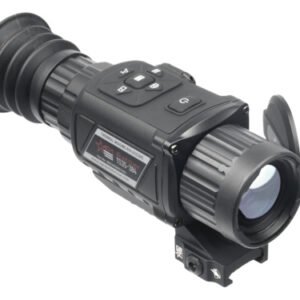
Most hunters solve this by carrying a separate rangefinder, which means taking a hand off the rifle at exactly the wrong moment. AGM built a 600 m laser into the Varmint body, accurate to ±1 m, running at 905 nm as a Class 1 device. Press it, read the number, and the ballistic calculator applies your stored load data to correct the aim point.
At €2,750.00, the Varmint is the cheapest way into laser rangefinding across everything we stock. The Rattler V3 LRF 35-384 at €2,520.00 is cheaper, but the Rattler V3 25-384 below it has no LRF at all, so within a like-for-like comparison, this model sits at the entry point.
The 35 mm lens and 3× base magnification
A 35 mm F1.0 objective on a 384×288 detector gives 3× base magnification, a 7.5° × 5.7° field of view, and a 1,800 m detection range against a six-foot object.
Detection is not identification. Realistically you will identify a fox-sized animal at around 350 to 400 m and a deer-sized animal past 500 m, depending on thermal contrast. The rangefinder’s 600 m ceiling sits comfortably beyond where you can identify with confidence on this sensor, which is the right way round: you will run out of identification before you run out of ranging.
Digital zoom runs 1×, 2×, 4× and 8× on top of the 3× optical base, giving 24× maximum. As with any thermal scope, the top of that range is for confirming a target you have already identified rather than identifying one.
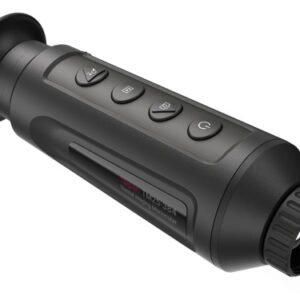
It works as a handheld monocular.
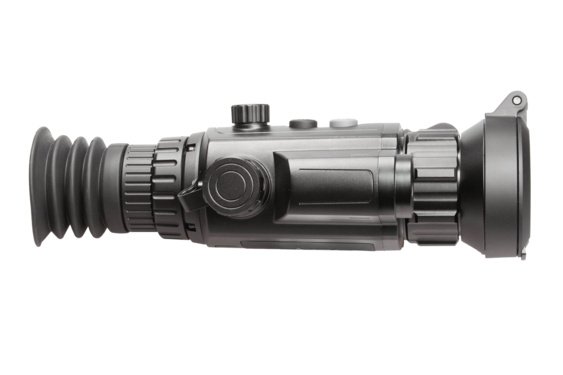
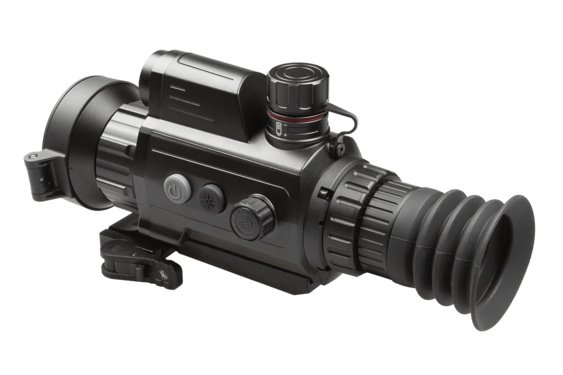
The Varmint V2 body is compact at 214 × 67 × 87 mm, and AGM designed it so it can be used off the rifle as a handheld scanning device.
That matters more than it sounds. Scanning with a rifle-mounted optic means pointing a loaded rifle at everything you want to look at, which is poor practice regardless of what the scope costs. The usual solution is buying a separate thermal monocular, which is another €1,500 or more.
The quick-detach ADM mount makes this practical: pull the scope, scan handheld, remount, and it returns to zero. It is not as comfortable as a purpose-built monocular for extended scanning, but for a hunter working within a budget it is a genuine dual-use case.
Interface and field features
Ten reticle types in four colors, switchable off. Four palettes plus Jungle and Recognition scene modes, which adjust processing for cluttered versus open backgrounds.
Picture-in-picture, highest temperature spot tracking for picking an animal out of clutter, and standby mode. Digital boresight at 0.13 mil or 0.44 MOA per click. Recoil-activated video with sound records the shot automatically.
Power, storage, and build
A single removable 18650 rechargeable cell gives 5 to 6 hours. That is shorter than most alternatives, and the honest read is that it is the weakest specification on this scope. Carry two spares for a full night.
The offsetting point is that 18650 is a non-proprietary standard format. Spares cost a few euros from any supplier, against €80 or more for manufacturer-specific packs, and availability is not tied to AGM continuing to make them. USB external power is supported.
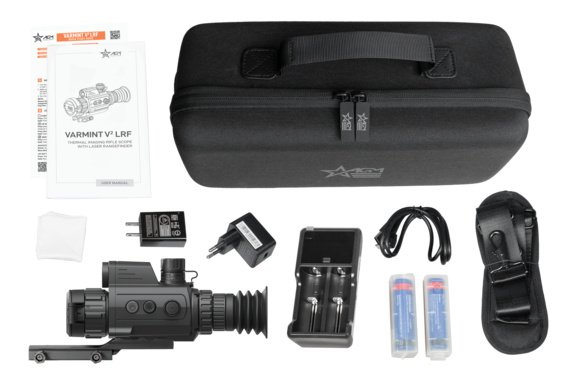
16 GB internal storage. IP67, drop tested to 1.5 m. The ADM American-made quick-detach mount is included.
Compare against the Clarion 384 at €2.890,00 if optical flexibility matters more than laser ranging, or see our thermal scope buying guide.
Technical specifications
| Feature | Specification |
|---|---|
| Detector | 12 µm VOx uncooled focal plane array |
| Resolution | 384 × 288 |
| NETD | Less than 20 mK (25°C, F#=1.0) |
| Refresh rate | 50 Hz |
| Response waveband | 8 µm to 14 µm |
| Lens system | 35 mm, F1.0 |
| Magnification | 3× to 24× |
| Field of view | 7.5° × 5.7° |
| Detection range (6 ft object) | 1,800 m / yd |
| Digital zoom | 1×, 2×, 4×, 8× |
| Display | 1024×768 OLED |
| Laser rangefinder | Up to 600 m, ±1 m accuracy |
| Laser wavelength | 905 nm |
| Laser safety class | Class 1 |
| Ballistic calculator | Onboard |
| Reticles | 10 types, 4 colors, on/off |
| Palettes | Black Hot, White Hot, Red Hot, Fusion |
| Scene modes | Jungle, Recognition |
| Boresight | Digitally controlled, 0.13 mil / 0.44 MOA |
| Other features | Picture-in-picture, highest temperature spot tracking, standby mode |
| Storage | 16 GB internal |
| Battery | Single removable non-proprietary 18650, 5 to 6 hours |
| External power | USB supported |
| Dimensions | 214 × 67 × 87 mm |
| Drop test height | 1.5 m |
| Housing | IP67 |
| Recording | Recoil-activated video with sound |
| Connectivity | Wi-Fi via AGM Connect app |
| Mount | ADM American-made quick-detach, included |
FAQ
What is the detection range of the AGM Varmint V2 LRF 35-384?
AGM published 1,800 m against a six-foot object. Detection means the scope registers a heat signature, not that you can identify it. Realistic identification on a 384 sensor at 3× runs to roughly 350 to 400 m for fox-sized animals and past 500 m for deer-sized, depending on thermal contrast.
Can the Varmint V2 be used as a handheld monocular?
Yes. The compact 214 mm body and included ADM quick-detach mount make it practical to remove the scope, scan handheld, and remount at the same zero. It is less comfortable than a purpose-built thermal monocular for long scanning sessions, but it means you are not pointing a loaded rifle at everything you want to identify.
How long does the Varmint V2 LRF 35-384 battery last?
5 to 6 hours on a single removable 18650 cell, which is the shortest runtime across our AGM range. The offsetting advantage is that 18650 is a non-proprietary standard format, so spares cost a few euros rather than the €80 or more typical of manufacturer-specific packs. Carry two spares for a full night.
What is the difference between the Varmint LRF TS35-384 and the Varmint V2 LRF 35-384?
The V2 replaced the TS generation. AGM upgraded to a sub-20 mK 12-micron sensor, added an onboard ballistic calculator, redesigned the user interface, and added customisable image settings, as well as recoil-activated video with sound. The integrated laser rangefinder, compact housing, and removable 18650 battery were carried across from the original.
Should I choose the Varmint V2 LRF 35-384 or the Clarion 384?
Both use a 384×288 sensor below 20 mK at similar prices. The Varmint at €2,750.00 has a 600 m laser rangefinder and ballistic calculator with a single 35 mm lens. The Clarion 384 at €2,890.00 has two mechanically switching lenses spanning 2× to 36× but only stadiometric ranging. Varying distances favor the Varmint; varying terrain favors the Clarion.
Rick –
Real nice thermal scope. Quick delivery and very happy.