
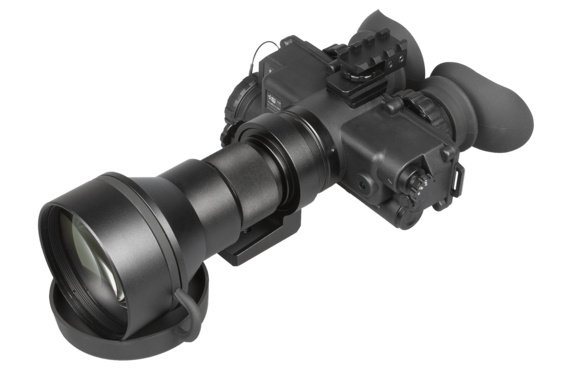
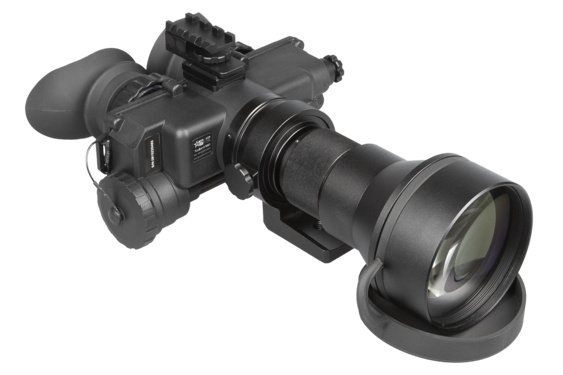
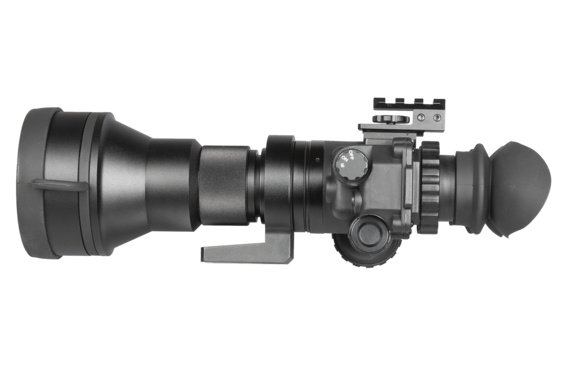
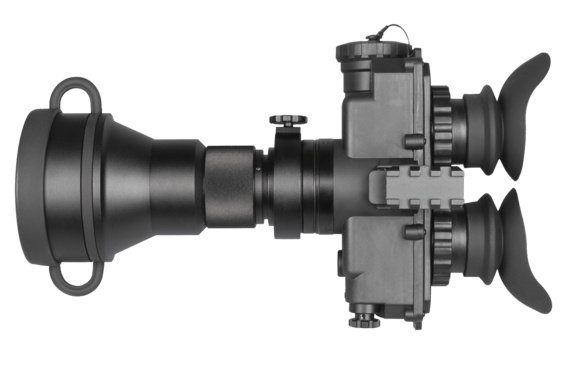
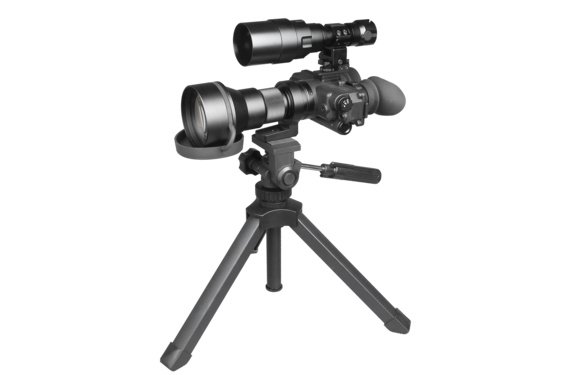
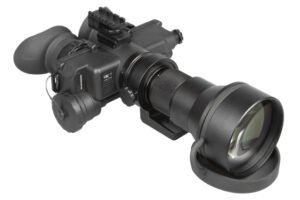
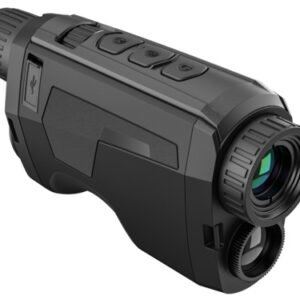
The AGM Foxbat-5 NL1 is a 5x night vision bi-ocular designed for mid-to-long-range observation rather than movement. Where a 1x goggle or monocular helps you walk and navigate, the Foxbat-5 magnifies the scene five times through a large 140 mm objective, letting you study subjects at a distance, a feeding deer across a valley, a fox working a far hedge line, or the limit of your property with a clarity that digital night vision cannot match in low light. It is, in effect, a pair of night vision observation binoculars on a tripod.
Design and build
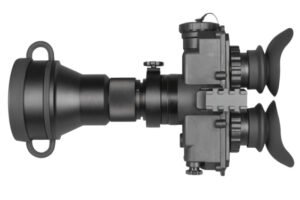
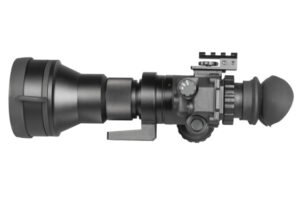
The optical heart is a 140 mm F/2.0 superfast, multi-coated, all-glass objective. At 5x, the large aperture matters: magnification spreads the available light, so a big, fast lens keeps the image bright. That light goes into a single Gen 2+ image intensifier tube, and an image beam splitter sends the result to two eyepieces, allowing relaxed two-eyed viewing for long sessions. The diopter adjusts from -4 to +2, and automatic brightness control plus a bright-light cut-off protect the tube.
Because 5x magnification also magnifies hand shake, the Foxbat-5 is built to be tripod-mounted, and a tripod is included. Power is two common AA cells for up to roughly 40 hours of use, and a detachable long-range 850 nm infrared illuminator clips on to light distant subjects in total darkness. The water- and fog-resistant housing is made for working outdoors through a damp night.
What it is and what it is not for
This is an observation instrument, not a navigation device. With a narrow 9.4-degree field of view and a 10 m minimum focus distance, it is not designed for walking, close work, or scanning wide areas quickly for that you want a 1x goggle or monocular. Its strength is holding on to a distant point and resolving detail there, which is exactly what wildlife watchers, land managers, and security users need from a fixed position.
The NL1 designation marks a Gen 2+ green-phosphor (P43) tube at AGM’s Level 1 grade their cleanest selection, with very few spots in the central image zone. Green phosphor is the traditional choice and gives strong perceived contrast in the lowest light. As a bi-ocular it shares one tube with both eyes, so the view is comfortable but flat; depth perception is not the point at observation distances.
Real-world applications
Wildlife and nature observation: the 5x view and large objective make it ideal for watching nocturnal animals, birds, and game from a hide or vehicle without disturbing them with white light. Independent reviewers single out its clean, bright image against cheaper digital units in dark woodland.
Property and perimeter security: from a fixed vantage point it lets you check field edges, gates, and outbuildings at a distance, with the 850 nm illuminator reaching into unlit corners.
Land management and predator control: glass a far feed line or livestock field to confirm predators before acting, and use the tripod for steady, hours-long watches.
Scientific and recreational use: stargazing-adjacent nature study, research observation, and general long-range night watching all suit the Foxbat-5’s stable, magnified image.
How it compares
Against 1x night vision (goggles and monoculars), the Foxbat-5 trades mobility for reach: it sees far but is not for moving. Against the AGM Foxbat-8, which steps up to 8x with a 216 mm lens and a narrower 4.5-degree field, the Foxbat-5 is more versatile and easier to hold a subject in view. Against digital night vision binoculars such as 4K day/night units, this analog Gen 2+ device gives a brighter, lower-noise image in true darkness, though it cannot record video. Against the white-phosphor Foxbat-5 NW1, this green model costs a little less; the NW1 returns a more natural greyscale image.
Technical specifications
| Specification | Detail |
|---|---|
| Phosphor | P43 green phosphor |
| Configuration | Bi-ocular: single Gen 2+ tube, image beam splitter, dual eyepieces |
| Image intensifier | Gen 2+ IIT, AGM Level 1 |
| Magnification | 5x |
| Objective lens | 140 mm, F/2.0; super-fast multi-coated all-glass optics |
| Field of view | 9.4 degrees |
| Focus range | 10 m to infinity |
| Diopter adjustment | -4 to +2 |
| IR illuminator | Detachable long-range 850 nm IR illuminator (included) |
| Bright-light protection | Automatic brightness control + bright-light cut-off |
| Battery | 2x AA; up to ~40 h (AGM rates up to 80 h continuous) |
| Weather resistance | Water- and fog-resistant |
| Mounting | Tripod mountable (tripod included) |
What’s in the box
Night vision bi-ocular, a detachable long-range IR illuminator, a tripod, a lens cloth, a hard case, and a user manual.
Pairs well with
- If you want the natural white-phosphor image: AGM Foxbat-5 NW1 Night Vision Binocular
- If you want more magnification at longer range: AGM Foxbat-8 NW1 Night Vision Binocular
- If you need a 1x device for moving in the dark: Night Vision Goggles
FAQ
- Is the Foxbat-5 for walking or for observation? Observation. At 5x magnification with a 9.4-degree field of view and a 10 m minimum focus, it is built to study subjects at a distance from a fixed or tripod-mounted position, not to navigate or walk.
- Why does it need such a large 140 mm lens? Magnification spreads the available light, so a large, fast F/2.0 objective is needed to keep the 5x image bright enough in low light.
- Does it come with a tripod and IR illuminator? Yes. A tripod and a detachable long-range 850 nm IR illuminator are both included, along with a durable case.
- Green (NL1) or white phosphor (NW1)? NL1 is green and slightly cheaper with strong low-light contrast; NW1 is white phosphor for a more natural greyscale image that many users find clearer over long sessions.
Reviews
There are no reviews yet.