
Thermal Imaging Camera for Hunting: The Complete 2026 Buyer’s Guide
A thermal imaging camera for hunting finds game by its body heat in total darkness, through light fog, and across open ground, with no ambient light at all. It is the fastest, most reliable way to detect animals at night, which is why a thermal imaging camera has become a standard kit for hog, coyote, fox, boar, and deer hunters across the US and Europe.
But most buying guides come from a single brand that wants to sell you that brand. This guide is different. We sell every major make, so this guide tells you which thermal imaging camera for hunting actually fits the way you hunt, what the specs really mean, how far these devices truly see, what the law says where you hunt, and which models are worth your money in 2026.
By the end, you’ll know what to look for, what to ignore, and which type and model to buy first. No fluff, no single-brand spin.
Quick answer: what to buy
Short on time? Here is the honest shortlist.
- Buy a monocular first, not a scope. You scan far more than you shoot. A handheld thermal imaging camera finds game, works with every rifle you own, is legal in more places, and doubles as a recovery tool.
- Best all-round sensor: 384×288. It provides enough detail for most hunting, and the price is sensible. Step up to 640×512 only if you hunt open ground at long range.
- The spec that matters most in bad weather: NETD (thermal sensitivity). Aim for under 20 mK.
- Best value pick: ThermTec Cyclone or HIKMICRO Lynx at the entry level; AGM Sidewinder for a mid-range 384.
- Check the law first. Thermal for hunting is legal in many places for hogs and predators, restricted for big game, and varies by US state and EU country. Details below.
Now the full guide.
What is a thermal imaging camera for hunting?
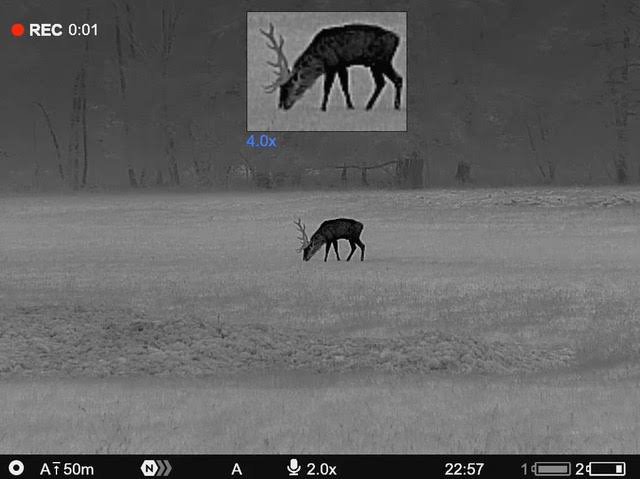
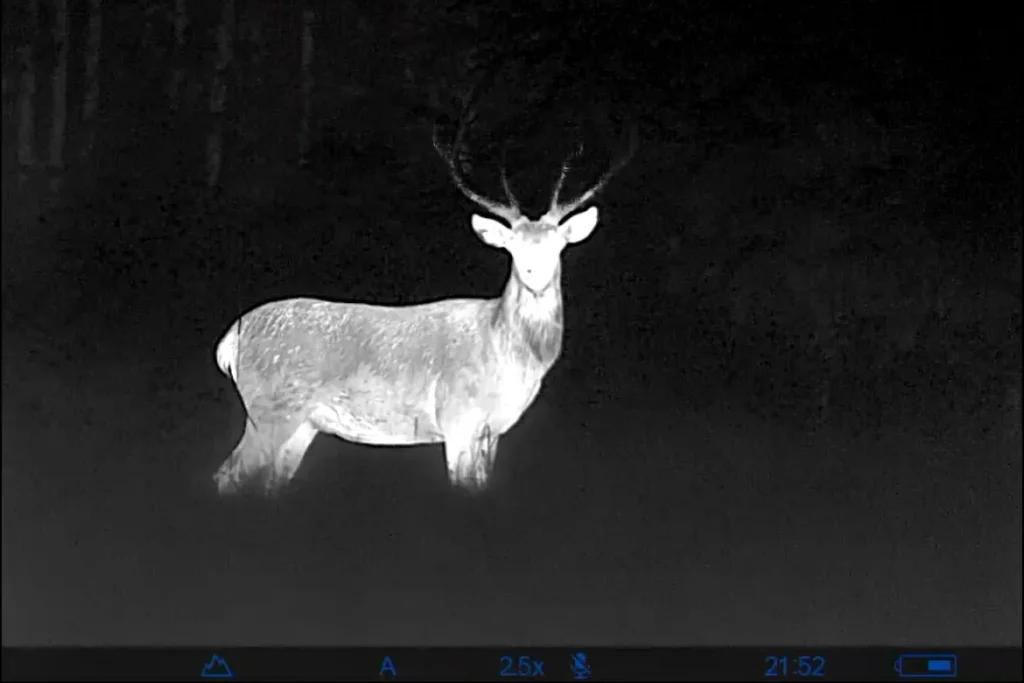
A thermal imaging camera detects infrared radiation, the heat every warm body gives off, and turns it into a visible picture. It does not amplify light the way night vision does, so it needs no moon, no stars, and no torch. A warm animal glows against cooler ground, even in total dark.
Inside every thermal imaging camera for hunting is an uncooled sensor called a microbolometer. It reads tiny temperature differences across the scene and paints them as an image, with hotter objects shown brighter or in a warm color. Because the picture comes from heat and not light, a thermal camera works as well at midnight as at midday, sees through smoke and light fog, and cannot be blinded by a bright lamp.
One limit matters up front: thermal shows you heat shapes, not fine detail. It is brilliant for finding an animal but weaker for studying antlers, coat markings, or a precise aiming point at distance. That is why many hunters pair a thermal imaging camera with night vision or a day scope, which we cover below. Curious about the physics? See how thermal imaging works.
Why hunters choose a thermal imaging camera over a lamp
A thermal imaging camera gives you three things a lamp never can.
You spot the game the eye would miss, because heat cuts through darkness and light cover. You stay hidden, because there is no white light to spook a wary boar, coyote, or fox. And you scan fast, sweeping a whole field in seconds to pick out what is warm and moving.
That detection power is why thermal has largely replaced the lamp for night hunting. A coyote crossing a stubble field at 300 yards is invisible to your eye and obvious on thermal. A hog holding tight in a cedar break shows up as a bright shape that you would otherwise walk right past.
Thermal imaging camera vs night vision for hunting
Thermal detects heat, so it is the best tool for finding game. Night vision amplifies light, so it gives a more natural, detailed image for identifying and confirming a target. They solve different problems, and serious hunters often own both. The full breakdown is in thermal vs night vision, but here is the short version.
| Capability | Thermal imaging camera | Night vision |
|---|---|---|
| Works in total darkness | Yes, it needs no light. | Needs some light or an IR illuminator |
| Detects hidden or camouflaged game | Excellent, reads heat through cover | Limited, sees only what light reveals |
| Image detail for identification | Heat shapes, less fine detail | Natural, detailed image |
| Sees through light fog and smoke | Yes. | No |
| Spooks game with IR | No | The IR illuminator can reveal your position. |
| Daytime use | Yes. | No, bright light can damage tubes. |
| Best role | Detection, finding the game fast | Identification, confirming the target |
Our view after years of selling both: if you buy one device first, buy a thermal imaging camera, because finding the animal is the most challenging part. Add night vision later if your hunting needs precise identification in the dark. Many hunters settle on the proven combination of scanning with thermal and confirming with night vision or a lit day optic.
The specs that actually matter
Five numbers decide how a thermal imaging camera for hunting performs: sensor resolution, thermal sensitivity, detection range, refresh rate, and lens. Get these specs right for your quarry and terrain, and the rest is just detail.
Sensor resolution (256 vs 384 vs 640)
Resolution is the pixel count of the thermal sensor, and it is the biggest single driver of image quality and how far out you can identify the game. Common sizes are 256×192, 384×288, and 640×512. More pixels pack more detail into the image, so you can not only detect warmth but also start to tell what it is.
For most hunting, 384×288 is the sweet spot. A 640×512 sensor has roughly three times the pixels and pulls detail from much further out, but it costs significantly more and only earns that cost on open ground at long range. The full comparison is in the 384 vs 640 thermal section.
Thermal sensitivity (NETD)
NETD measures the smallest temperature difference the sensor can detect, expressed in millikelvin, with lower values indicating better performance. A sub-20 mK sensor separates a warm animal from cool grass far more crisply than a 35 mK sensor, and the gap shows most on damp, mild nights when the temperature contrast is small.
This number is the spec brochures bury and hunters underrate. Under 20 mK is the quality bar in 2026, and under 15 mK is elite. If you hunt in the wet US Southeast or wet European weather, NETD matters more than an extra hundred pixels. More on what NETD is.
Detection range, and the DRI truth nobody tells you
Here is the most important thing in this guide and the one thing every competitor glosses over.
Manufacturers advertise detection range, the distance at which the device can tell something warm is out there. That is not how far you can tell what it is. The industry frames real-world performance as DRI: detection, recognition, and identification.
- Detection: “Something warm is there.” The big advertised number.
- Recognition: “It’s an animal, not a rock or a person.”
- Identification: “It’s a coyote, not a fox” or “a legal boar, not a sow with piglets.”
Under the Johnson Criteria, the framework the whole industry uses, recognition happens at roughly a quarter of the detection range, and identification at roughly an eighth in the conservative reading. More generous modern sensors stretch that to maybe 40 to 50 percent for recognition in perfect conditions, but weather is rarely perfect, and rain, fog, humidity, and warm nights all shorten it.
Here is what that means in practice:
| Advertised detection | Realistic recognition (~25%) | Realistic identification (~12.5%) |
|---|---|---|
| 1,000 m | ~250 m | ~125 m |
| 1,800 m | ~450 m | ~225 m |
| 2,600 m | ~650 m | ~325 m |
So a thermal imaging camera advertised at “2,600 m detection” realistically lets you identify an animal well enough for an ethical shot at a few hundred meters, not 2,600. Never buy based on the detection number alone. Sensor resolution and NETD drive real identification distance, which is what fills the freezer. Read how far a thermal camera can see.
Refresh rate
Refresh rate is how many times per second the image updates, and 50 Hz is what you want for hunting. A 50 Hz image stays smooth as you pan across a field or track a running hog, while slower rates smear and lag. Almost every current hunting-grade thermal runs at 50 Hz.
Lens, magnification, and field of view
The objective lens sets your reach and your field of view, and the two pull against each other. A longer lens (35 mm or 50 mm) reaches further and magnifies more but narrows the field of view. A shorter lens gives a wide view for quick scanning at closer range.
Match the lens to your typical distance: short (15 to 25 mm) for woodland and close cover, and long (35 to 50 mm) for open hill and field edges. Base optical magnification matters more than digital zoom, which only enlarges the pixels you already have.
| Spec | What it controls | What to look for (hunting) |
|---|---|---|
| Sensor resolution | Detail and identification range | 384 all-round; 640 for long range |
| NETD | Image clarity in poor contrast | Under 20 mK is good; under 15 mK is elite. |
| Detection range | How far do you spot heat | Compare like-for-like; apply DRI. |
| Refresh rate | Smoothness on moving game | 50 Hz |
| Lens / focal length | Reach vs field of view | 15-25 mm woodland, 35-50 mm open |
| Pixel pitch | Sensor efficiency | 12 microns is the current standard. |
Types of thermal imaging camera for hunting
There are four types, and each does a different job.
| Type | Mounts on a rifle? | Main job | Best for |
|---|---|---|---|
| Monocular | No (handheld) | Scanning and finding game | Your first thermal, everyone. |
| Riflescope | Yes (replaces day scope) | Aiming and shooting at night | A dedicated night rifle |
| Clip-on | Yes (front of day scope) | Converting a day scope keeps zero | One rifle for day and night |
| Binocular | No | Long-range two-eyed observation | Open ground, long glassing |
Thermal monoculars
A thermal monocular is a handheld scanner, and it is the device most hunters should buy first. You scan the ground, find game, and confirm what is out there before moving, but you do not aim a rifle with it. Browse the full range of thermal monoculars, or read the dedicated thermal monocular buying guide and handheld thermal monocular guide.
Thermal riflescopes
A thermal riflescope mounts on your rifle and is what you aim and shoot with at night. It replaces your day scope for night work and carries its own reticle and zero. See all thermal riflescopes or the best thermal scope for your money.
Thermal clip-ons
A thermal clip-on mounts in front of your existing day scope and turns it into a thermal sight, keeping your normal reticle and zero. This suits hunters who want one rifle for day and night without buying a separate scope. It is also the key device type in parts of Europe where weapon-mounted thermal scopes are restricted but clip-on attachments are permitted. Full detail in the thermal clip on the guide.
Thermal binoculars
Thermal binoculars provide two-eyed, longer-range observation for glassing large open ground, often with a built-in rangefinder. They are an observation tool rather than a scanner you carry loose, and they suit open country and long sessions from a stand. See the thermal binoculars for the hunting guide.
Most hunters start with a monocular and add a scope or clip-on later. The full decision sits in thermal monocular vs scope vs clip-on.
Best thermal imaging cameras for hunting in 2026, across brands
We stock every major brand, so unlike the manufacturer sites you will compare against, here is an honest cross-brand table. Every competitor guide pushes just one make. This one does not.
| Brand & model | Type | Sensor | NETD | Detection (advertised) | Notes |
|---|---|---|---|---|---|
| HIKMICRO Falcon FQ35 2.0 | Monocular | 640×512 12 µm | <15 mK | ~1,800 m | Elite NETD, ~486 g |
| HIKMICRO Lynx | Monocular | 256/384 | model-dependent | short-mid | Budget entry, great value |
| Pulsar Axion 2 XG35 | Monocular | 640×480 12 µm | <40 mK | ~1,750 m | Best software, EU sensors, premium |
| AGM Sidewinder TM35-384 | Monocular | 384×288 12 µm | <20 mK | mid | Strong value, 50 Hz |
| AGM Rattler V2 35-384 | Riflescope | 384×288 12 µm | <20 mK | ~1,800 yd | |
| ThermTec Cyclops | Monocular | 384/640 12 µm | ≤25 mK | ~2,500 m | Dual-FOV options, AI ranging |
| ThermTec Vidar 2.0 | Riflescope | 384/640 | ≤18-20 mK | ~1,800-2,600 m | LRF + ballistics variants |
| ATN ThOR 6 | Riflescope | 384/640 12 µm | ≤15 mK | ~2,300-3,100 m | Tech-rich, Wi-Fi, ballistics |
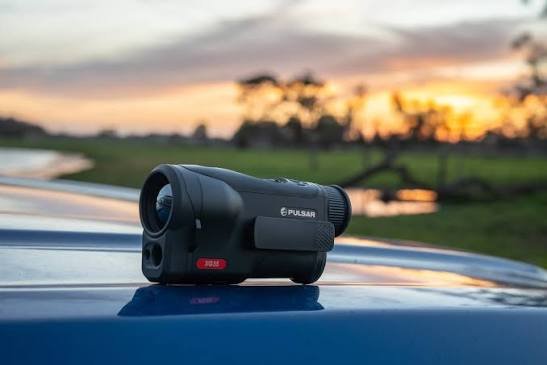
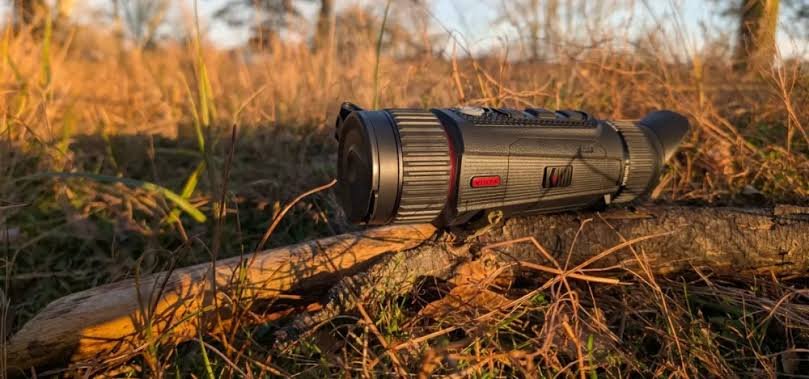
Advertised detection is a best-case figure. Apply the DRI table above to obtain a realistic identification range. Please verify prices and current specifications against the product pages before publishing.
How to read this table: for a first handheld thermal imaging camera, the HIKMICRO Lynx and AGM Sidewinder provide the best value at the entry and mid tiers, while the HIKMICRO Falcon’s sub-15 mK sensitivity leads on image quality. For a dedicated night rifle, the AGM Rattler V2 is the value pick and the ATN ThOR 6 the feature leader. Pulsar commands a premium for its build and software.
How to choose the right thermal imaging camera
Choose by what you hunt, the range you shoot, and your budget, in that order. Set those three, then choose the highest sensor resolution you can afford, and finally select the lens that matches your shooting distance.
Choose based on what you hunt.
- Wild boar and hogs in woodland and field edges: a 384 monocular with a 25 to 35 mm lens handles most situations.
- Coyote, fox, and predators at distance: good resolution and reach matter, so a 384 or 640 with a 35 to 50 mm lens.
- Deer management: a 384 monocular for scanning, paired with a day scope or night vision for the shot.
- Open hill and long range: step up to a 640 sensor for the cleanest image far out.
Choose by sensor and budget.
This is where most buyers go wrong. They spend on magnification and skimp on the sensor, then wonder why a zoomed image looks so blocky. Spend on resolution and NETD first. A 384-core at a sensible price beats a 256-core pushed to high digital zoom every time.
| Budget | What you get | Typical use |
|---|---|---|
| €400-900 / $450-1,000 | Entry 256 or 384 monocular | First thermal, scanning, recovery |
| €1,000-2,000 / $1,100-2,200 | Solid 384 monocular or scope | All-round night hunting |
| €2,000-3,500 / $2,200-3,800 | 640 monocular, scope, or clip-on | Long range and identification |
| €3,500+ / $3,800+ | Flagship 640 with LRF and ballistics | Serious long-range scoped shooting |
See the curated picks in the best thermal monocular for hunting and the thermal pricing guide.
Common mistakes hunters make
- Buying a scope before a monocular. A scope only helps once you have found the animal. Buy the scanner first.
- Paying for magnification over resolution. High digital zoom on a small sensor gives a bigger, blockier picture, not a better one.
- Treating detection range as identification range is a mistake. A 2,000 m detection figure does not mean you can tell a boar from a deer at 2,000 m. Apply DRI.
- Ignoring NETD. Two devices with the same resolution can look completely different in damp weather.
- Forgetting battery type. An internal-only battery cannot be swapped mid-hunt. For long nights, choose removable 18650 cells and carry spares.
- Overlooking the law. Thermal is regulated for hunting in many places and export-controlled for shipping. Check both before you buy.
Thermal imaging for hunting in the field, by quarry
A thermal imaging camera earns its keep on real hunts, and how you use it changes with the quarry.
Hog and wild boar hunting
Thermal is the difference between a blank night and a full cooler on hogs and boar. They move in darkness and hold tight in cover, and their body heat gives them away long before you would see or hear them. Scan field edges and rides with a monocular, pick up the group, then close the distance and take the shot with a thermal scope or a clip-on on your day rifle. Full field guide for thermal wild boar hunting.
Coyote, fox, and predator control
For predator work, a thermal imaging camera lets you find and watch an animal at distance without throwing a lamp that educates it. A coyote or fox appears as a clear hot shape across a stubble field, and a 384 or 640 device provides the range to spot it early and read its behavior. See thermal for fox and predator control.
Deer management and stalking
Thermal speeds up deer management by helping you locate and count animals fast before first light. Use it to find deer and confirm numbers, then switch to a day scope or night vision for the precise identification a cull plan demands. More on using thermal for deer management.
Game recovery and blood tracking
A thermal imaging camera recovers shot game faster and more humanely, because a downed animal stays warmer than its surroundings for some time. Following a heat trail in the dark turns a long, uncertain search into a short one. Details in thermal for recovering game.
The two-optic setup: scan with a monocular, shoot with a scope.
The most effective night-hunting setup is two devices: a handheld monocular to find game and a scope or clip-on to take the shot. You keep the wide, fast-scanning monocular moving to locate animals, then bring the rifle up only when you have a target. This saves battery, saves your arms, and keeps you safe by separating finding from aiming.
Is thermal imaging legal for hunting?
Owning a thermal imaging camera is legal in both the US and most of Europe, but using one to hunt is regulated, and the rules vary widely by location and quarry. This is general information, not legal advice, and rules change every year, so confirm the current position with your state wildlife agency or national hunting authority before you hunt.
United States
There is no federal ban on thermal for hunting, but it is a state-by-state patchwork. The consistent pattern:
- Non-game and nuisance species (feral hogs, coyotes, and other predators) are widely legal to hunt with thermal, often year-round on private land.
- Big game (deer, elk, turkey) is where restrictions bite, especially at night.
Representative examples: Texas is permissive for hogs and coyotes; Florida allows thermal for hogs and coyotes, area-dependent; Georgia is legal but requires a free night-hunting permit; Arizona bans thermal and electronic night optics for taking wildlife; California prohibits thermal for big game outright. Always check your specific state’s current regulations, because they change annually and forum advice is not reliable. Note also that thermal devices are export-controlled under ITAR in the US.
Europe and the UK
The situation is also a patchwork, but one clear pattern emerges: handheld thermal devices for observation (monoculars and binoculars) are broadly permitted, while weapon-mounted thermal devices (scopes and clip-ons) are the restricted category.
- Germany: weapon-mounted thermal riflescopes remain largely prohibited, though certain night-vision and thermal attachments without a reticle are permitted for license holders, and African Swine Fever rules have loosened thermal clip-on use for boar control in some Länder.
- France: handheld thermal spotters are legal for observation; thermal scopes are not permitted for hunting; night hunting needs prefectural authorization.
- Poland, the Baltics, Czechia, Hungary, and Bulgaria: generally more liberal, partly to fight ASF in wild boar.
- UK: Thermal and night vision are generally lawful for pest and predator control on private land, subject to wildlife, firearms, and land law. Scotland restricts taking deer with night vision or thermal.
The safe summary for European buyers: handheld thermal optics are usually fine for observation; for anything mounted on the rifle, check your national and regional law first. Full country details on thermal imaging are legal for hunting in Europe. Thermal optics are also export-controlled, which can affect delivery to some destinations, so ask us if you are unsure.
Setting up and looking after your thermal imaging camera
Zeroing a thermal scope
You zero a thermal scope much like a day scope, using a target that shows a heat contrast so you can see your point of aim and impact. Many scopes offer a one-shot zero that locks the reticle to your shot.
Battery life and spares
Battery type decides how long your night lasts. Devices with removable 18650 cells let you carry spares and swap them in seconds, while internal batteries tie you to a power bank for long sessions. Plan for the length of the hunt you actually do.
Cleaning and storage
Keep the germanium lens clean with a proper lens cloth and never wipe grit across it. Store the device dry, remove the battery for long periods, and charge lithium cells before storage.
Frequently asked questions
What is the best thermal imaging camera for hunting for a beginner?
A 384 thermal monocular is the best first thermal imaging camera for most hunters. It gives enough resolution to detect and begin to identify game at realistic ranges, works for scanning on any rifle setup, and costs far less than a scope. Start with a monocular to find the game and learn how thermal behaves on your ground, then add a scope or clip-on. Buying a scope first is a common and expensive mistake.
How far can a thermal imaging camera actually see?
It depends on what you mean by “see.” A device advertised with a 2,600 m detection range can tell you that something warm is out there at that distance, but realistically it lets you recognize an animal at roughly a quarter of that range and identify it well enough for an ethical shot at roughly an eighth, often a few hundred meters. Rain, fog, and warm nights shorten it further. Never buy based on the detection number alone.
Is thermal imaging legal for hunting?
In the US, there is no federal ban, but it is state-by-state: widely legal for hogs and coyotes, often restricted for big game and at night. In Europe, handheld thermal for observation is broadly permitted, while weapon-mounted thermal is restricted in many countries. Always confirm your state or national rules before hunting, as they change annually. This is general information, not legal advice.
Which is better for hunting: thermal or night vision?
Thermal is better for detection, finding game in total darkness, and seeing through cover. Night vision is better for identification and navigating terrain but needs some light. For a single device to find a game, a thermal imaging camera wins. Many hunters own both and scan with thermal first, then confirm with night vision.
Do I need a 640 sensor, or is 384 enough?
For most hunting, a 384 sensor is sufficient and offers better value. It detects and identifies game well at the ranges where most hogs, coyotes, foxes, and deer are shot. A 640 sensor earns its extra cost on open ground at long range, where identification at distance matters. Spend the difference on a 640 only if your hunting genuinely needs that extra reach.
Will a thermal imaging camera work in rain and fog?
Yes, but heavy rain and dense fog reduce its range, because water absorbs infrared and cuts heat contrast. Light rain and mist are no problem, and thermal still outperforms the naked eye in poor weather. A sensor with low NETD, under 20 mK, holds a usable image better in damp conditions.
Can a thermal imaging camera see through walls or brush?
It sees a warm animal through light cover such as thin brush, long grass, and reeds, because heat radiates through the gaps. It cannot see through solid trunks, dense hedges, walls, or glass, which block the heat entirely. That through-light-cover ability is a major hunting advantage: an animal half-hidden in cover shows clearly as a hot shape.
How much should I spend on a thermal imaging camera for hunting?
Entry monoculars start around €400 to €900 (roughly $450 to $1,000). Most hunters spend €1,000 to €3,000 on a capable 384 or 640 device that lasts years. Flagship 640 scopes with a rangefinder and ballistics run €3,500 and up. Spend on sensor resolution and NETD before magnification.
Why buy your thermal imaging camera from BlackReckon?
We are specialist retailers of thermal imaging optics and night vision, not a single-brand maker, so we recommend the device that fits your hunting rather than the only one we sell. Every optic is checked against its datasheet before it ships, warranties are handled in-house, and orders go out tracked across the EU and worldwide. Weighing two models or unsure which sensor you need? Talk to us first. You will reach someone who uses this kit in the field.
Quick facts: thermal imaging camera for hunting
| What it does | Detects game by body heat in total darkness |
|---|---|
| Detection range | 250 m to 2,600 m depending on sensor and lens |
| Realistic ID range | Roughly an eighth of advertised detection |
| Sensor resolution | 256×192 to 640×512 (384 is the all-round choice) |
| Thermal sensitivity (NETD) | Under 20 mK is the quality bar; under 15 mK is elite |
| Refresh rate | 50 Hz for smooth tracking |
| Main device types | Monocular, riflescope, clip-on, binocular |
| Best first buy | A 384 thermal monocular |
| Price range | €400 to over €5,000 |
| Typical quarry | Hog, boar, coyote, fox, deer, predators |
| Legal status | Owning is legal in the US and most of the EU; hunting use is regulated locally. |
Ready to choose your thermal imaging camera for hunting? Browse thermal monoculars, thermal riflescopes, and brand ranges from HIKMICRO and Pulsar. New to thermal? Start with the thermal monocular buying guide or compare thermal vs night vision.