
What a 1280 sensor actually gives you
Most thermal scopes top out at 640×512. The Evolver runs 1280×1024, which is four times the pixel count of a 640 sensor and roughly twelve times that of a 384.
The obvious benefit is identification distance. Where a 640 sensor gives you posture and outline at 400 m, a 1280 gives you the same read considerably further out, and detail at closer range lets you distinguish individual animals in a group rather than reading them as a mass.
The less obvious benefit is what happens when you zoom. Every thermal scope degrades under digital magnification because you are enlarging pixels rather than adding information. Starting from 1280×1024 means you have pixels to spare. AGM built a specific feature around this: one press of the magnification button crops the sensor to an effective 640 resolution at 5×.
That is not digital zoom in the usual sense. You are using the center of a very high-resolution sensor at native density, so the image at 5× looks like a good 640 scope rather than like a stretched 1280. Predator hunters use this constantly: 2.5× wide to find and track, and one button to 5× to identify and shoot, without the image falling apart in between.
Zoom runs to 20× beyond that, which is past the point of useful identification on any sensor, and is there for confirming a target you have already read.
The 65 mm lens and 3,250 m detection
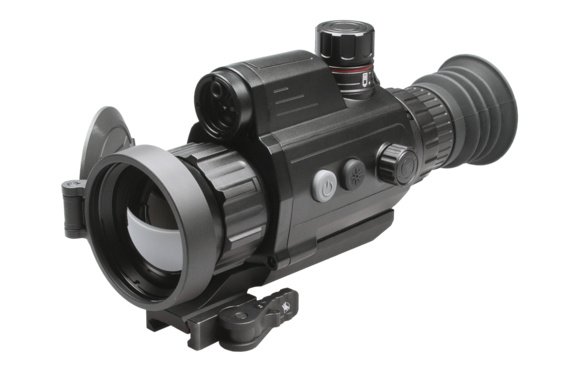
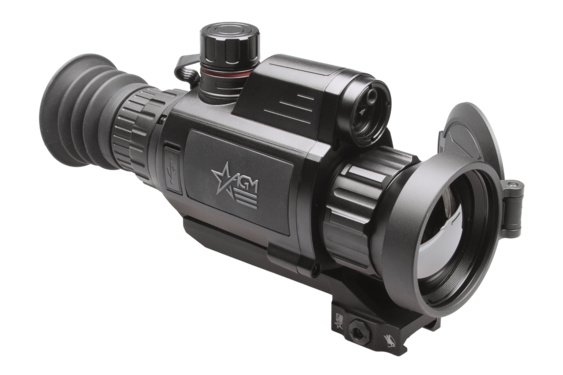
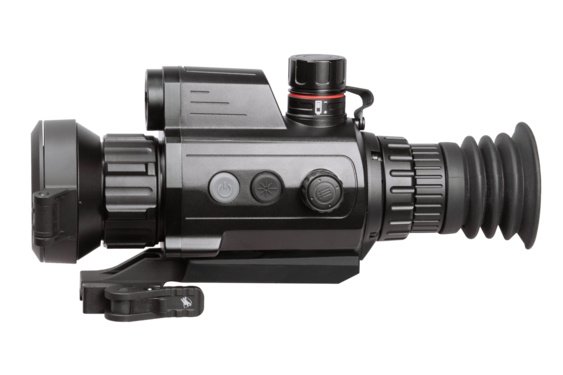
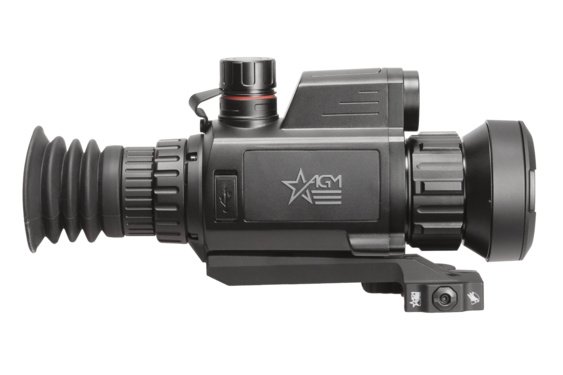
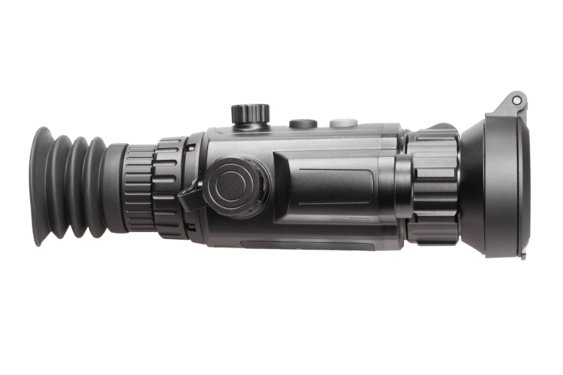
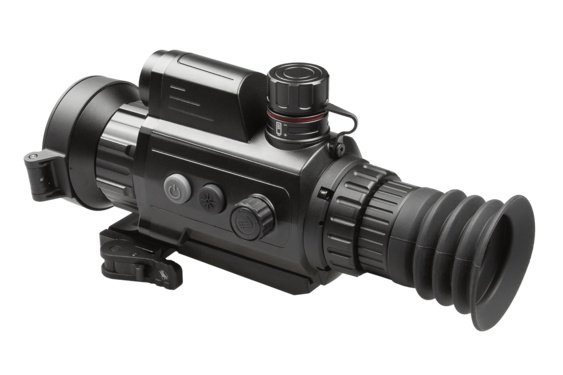
A 65 mm F/1.0 Germanium objective is large for a scope in this housing. AGM built the Evolver around the compact Rattler-style body rather than a 30 mm tube, then fitted a lens considerably bigger than the body suggests.
The result is a detection range of 3,250 m and a 13.5° × 10.8° field of view at 2.5× base magnification. That field is wide for a scope with this much reach, and the 65 mm plus 1280 combination gives you the balance: you are not choosing between finding animals and identifying them.
To be clear about what 3,250 m means: detection is when the scope registers a heat signature. Identification, or knowing what the animal is, occurs at a much closer range. Even on a 1280 sensor, realistic identification runs well under half that figure. AGM’s own dealers note that the detection range is not the ID range. Buy this scope for the identification distance and image quality, not for the headline number.
Sensitivity and the display
Sub-18 mK NETD. That sits between the sub-15 mK of the Rattler V3 and Adder V2 ranges and the sub-20 mK of the Varmint V2 and Clarion ranges.
Worth understanding why the flagship is not the most sensitive scope AGM makes. Packing four times the pixels into a sensor means each pixel is working with less area, which makes holding a very low noise floor harder. Sub-18 mK on a 1280 detector is a considerably harder engineering result than sub-15 mK on a 384.
In practice: in heavy fog a Rattler V3 will hold a readable outline marginally longer. In every other condition, the Evolver produces a substantially better image because resolution is doing work that sensitivity alone cannot.
The 2560×2560 OLED display is AGM’s highest density panel. It needs to be. A 1280×1024 sensor on a 1024×768 display would waste most of what the sensor captured.
Ranging and interface
A 1,000 m integrated laser rangefinder with ±4 m accuracy feeds an onboard ballistic calculator that stores five profiles.
The ±4 m figure is worth noting against the Varmint V2’s ±1 m at 600 m. Longer-reaching lasers trade precision for range. At the distances the Evolver is built for, ±4 m is inside the margin that matters for holdover on any realistic cartridge.
The semi-circular interface displays range, pitch scale, and active zeroing profile around the edge of the view rather than across it. The pitch scale is more important here than on shorter-range scopes: at the distances this optic supports, shooting up or down a slope changes effective drop significantly, and the calculator does not automatically correct for angle.
Power, storage, and build
A removable rechargeable NE-4400 battery, shared with the Rattler V3 range, provides more than 4 hours of runtime. That is the shortest runtime across everything we stock, and it is the honest cost of driving a 1280 sensor and a 2560×2560 display. Carry two spares for a full night, and plan to use external power for static positions, which is supported.
64 GB of eMMC storage with video, audio, image capture, and Shot Activated Recording. Wi-Fi data transmission. Standby mode. Multiple reticle types and colors.
Large buttons designed for gloved operation in cold weather. Waterproof and shockproof. Five-year warranty.
Compare across our full thermal riflescope range, or see how AGM sits against Pulsar, ThermTec, and Hikmicro in our thermal scope buying guide.
Technical specifications
| Feature | Specification |
|---|---|
| Detector | 12 µm, 1280 × 1024 |
| NETD | Sub-18 mK |
| Lens | 65 mm F/1.0 Germanium |
| Base magnification | 2.5× |
| Magnification range | 2.5× to 20× |
| Digital zoom | 1×, 2×, 4×, 8× |
| Field of view | 13.5° × 10.8° |
| Detection range | 3,250 m |
| Display | 2560 × 2560 OLED |
| Interface | Semi-circular, with range, pitch scale, and zeroing profile |
| Laser rangefinder | 1,000 m, ±4 m accuracy |
| Ballistic calculator | Onboard, 5 profiles |
| Storage | 64 GB eMMC |
| Battery | Removable rechargeable NE-4400 |
| Battery life | More than 4 hours |
| External power | Supported |
| Recording | Video with audio, image capture, and shot-activated recording |
| Connectivity | Wi-Fi data transmission |
| Other | Standby mode, multiple reticle types and colors |
| Build | Waterproof, shockproof |
| Warranty | 5 years |
FAQ
What makes the AGM Evolver LRF 1280 different from a 640 thermal scope?
The Evolver uses a 1280×1024 sensor, four times the pixel count of a 640×512. That extends identification distance and lets you distinguish individual animals in a group rather than reading them as a mass. It also enables a specific feature: one press of the magnification button crops the sensor to an effective 640 resolution at 5×, giving a native-density image rather than stretched digital zoom.
How far can the AGM Evolver LRF 1280 detect?
AGM published a detection range of 3,250 m against a six-foot object, the longest in their range. Detection is not identification. Even on a 1280 sensor, realistic identification distance is well under half that figure. The integrated laser rangefinder reaches 1,000 m with ±4 m accuracy, which is a more useful ceiling to plan around.
Why is the Evolver’s NETD higher than the Rattler V3’s?
Packing four times the pixels into a sensor results in each pixel having each pixel less area to work with, which makes a very low noise floor harder to achieve. Sub-18 mK on a 1280×1024 detector is a harder engineering result than sub-15 mK on a 384×288. In heavy fog a Rattler V3 holds an outline marginally longer; in every other condition the Evolver produces the better image.
What is the battery life on the AGM Evolver LRF 1280?
More than 4 hours on a removable rechargeable NE-4400 battery. This is the shortest runtime in our AGM range, and it reflects the direct cost of powering both the 1280 sensor and the 2560×2560 display. Carry two spares for a full night. External power is supported for static positions.
Is the Evolver LRF 1280 a clip-on?
No. It is a standalone riflescope built on a compact housing similar to the Rattler body, fitted with a 65 mm objective. AGM’s clip-on products are the Secutor LRF-C and the Rattler-C V2, which are separate lines designed to convert an existing day scope to thermal.
Reviews
There are no reviews yet.