
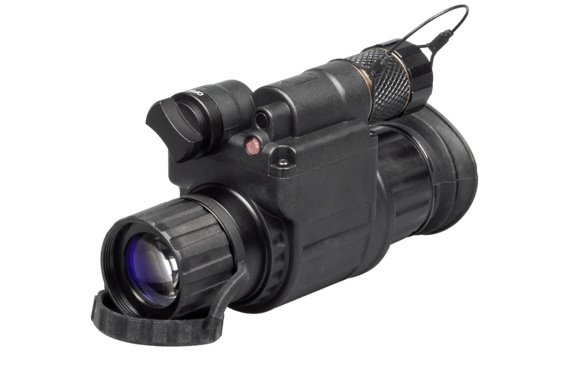
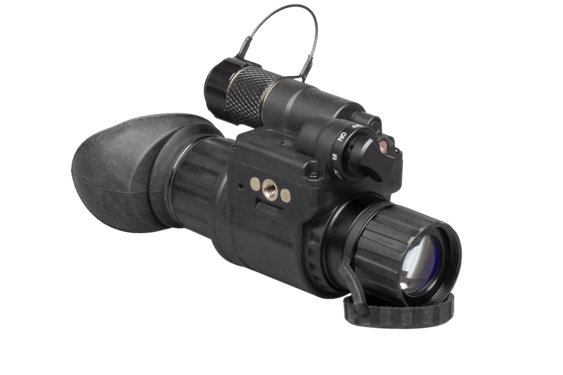
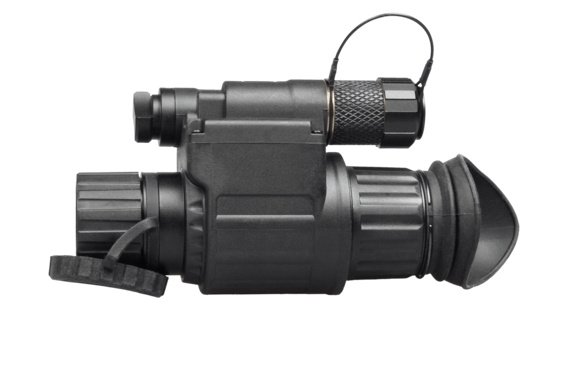
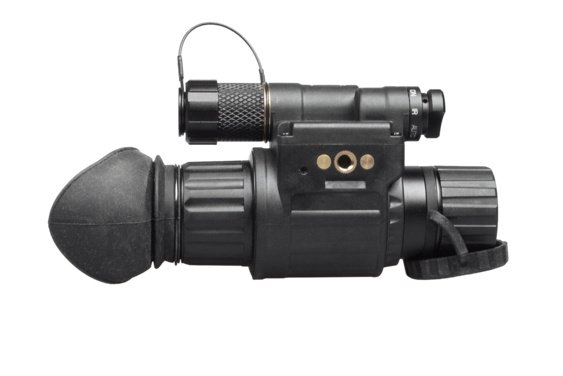
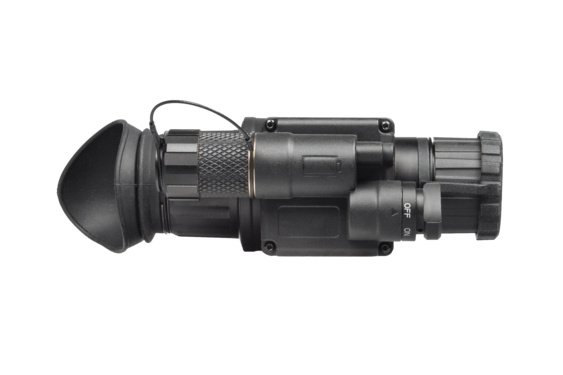
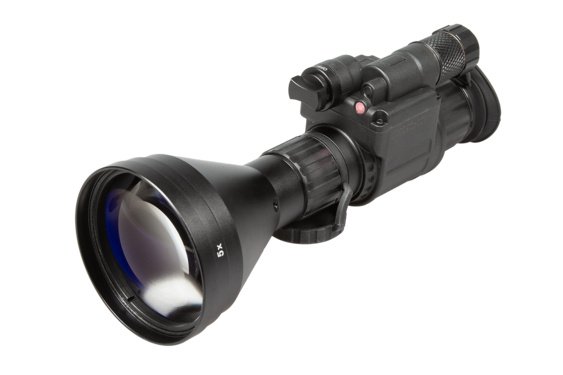
The AGM Wolf-14 NL1 is a single-tube Generation 2+ night vision monocular built around an analog image intensifier rather than a digital sensor. That distinction is the whole point of the device: an intensifier tube draws in ambient photons through a photocathode, multiplies them through a microchannel plate, and paints them onto a phosphor screen in real time, with none of the frame lag, compression artifacts, or light bloom that affect digital night vision. For hunters glassing fields at last light, security staff walking a perimeter, or anyone who needs to move confidently in the dark, that immediacy is what separates a usable image from a frustrating one.
Design and build
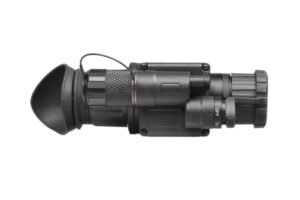
The Wolf-14 housing is AGM’s value-focused alternative to the military PVS-14 form factor. It keeps the features that matter, a single operating knob, a flip-up function for helmet use, bright-light cut-off circuitry, and a built-in infrared illuminator while trimming weight to roughly 450 g so it can hang off a head or helmet mount through a long sit without fatigue.
The 25 mm F/1.2 objective is a fast lens: the low f-number gathers as much of the available light as possible, which is precisely what you want feeding an intensifier tube on a dark night. Focus runs from 0.25 m to infinity, eye relief is 21.5 mm, and the diopter adjusts from -5 to +5, so spectacle wearers can set it once to their eyesight. A single CR123A lithium cell drives it for around 40 hours; an AA adapter is included for field resupply.
Understanding the tube: green phosphor, level 1, and FOM
The ‘NL1’ in the name encodes the two things that determine image quality. ‘N-L’ marks a green-phosphor (P43) tube, and ‘1’ marks AGM’s Level 1 grade, their cleaner, higher-resolution selection with very few cosmetic spots in the critical center (Zone 1) of the image. Green phosphor is the traditional night vision look; the human eye is most sensitive to green, so a green tube can provide excellent perceived contrast in very low light and is typically the more affordable phosphor.
Two numbers describe a tube’s real performance: resolution, measured in line pairs per millimeter (lp/mm), and the Figure of Merit (FOM), which multiplies resolution by signal-to-noise ratio. Higher is better for both. The Wolf-14’s Level 1 tube is selected for strong resolution in its class; if you need the very highest FOM bands AGM offers, those live in the PVS-14 line below. Because tubes are graded individually, confirm the exact resolution and FOM of the specific unit before purchase.
Real-world applications
Hunting and wildlife: at true 1x the image is life-size, so you can walk, glass, and judge distance naturally. Mounted ahead of a daytime optic or used handheld, it lets you confirm quarry and watch behavior without throwing white light that spooks game.
Security and property: helmet-mounted, it frees both hands for patrolling outbuildings, fence lines, and yards. The built-in IR illuminator lights up sheds, barns, and dense canopies where no ambient light reaches, but keep in mind that IR is visible to anyone else wearing night vision.
Recreation and navigation: Caving, night hiking, and boating all benefit from a passive, lag-free image. Because the Wolf-14 can be stowed flipped up on a head mount without being removed, you can drop into night vision and back to natural sight in a second.
How it compares
Against digital night vision, the Wolf-14 NL1 wins on response time, low-light reach, and the absence of a recording screen’s glow; digital units win on price and the ability to record video. Against AGM’s PVS-14, the Wolf-14 trades the MIL-STD-810G magnesium housing and the highest Photonis FOM tubes for a lower price and lighter weight, a sensible swap for hunting and recreation rather than professional duty. Against the white-phosphor Wolf-14 NW1, this green model is the more economical choice; the NW1 renders the scene in natural greyscale that many users find easier on the eyes over long sessions.
Technical specifications
| Specification | Detail |
|---|---|
| Image intensifier | Gen 2+ image intensifier tube (IIT) |
| Phosphor | P43 green phosphor |
| Tube grade | AGM Level 1 |
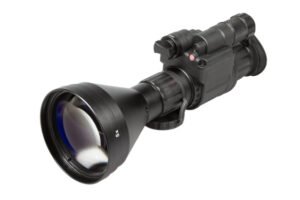
| Magnification | 1x (3x and 5x afocal lenses optional) |
| Objective lens | 25 mm, F/1.2 |
| Field of view | Approx. 40 degrees |
| Focus range | 0.25 m to infinity |
| Eye relief / diopter | 21.5 mm / -5 to +5 |
| IR illuminator | Built-in spot/flood IR |
| Bright-light protection | Automatic bright-source cut-off |
| Battery | 1x CR123A (3V); AA adapter included |
| Battery life | Up to ~40 hours |
| Operating temperature | -40 C to +50 C |
| Weight | Approx. 450 g |
| Mounting | Handheld, head/helmet, weapon; J-arm and Rhino mount |
What’s in the box
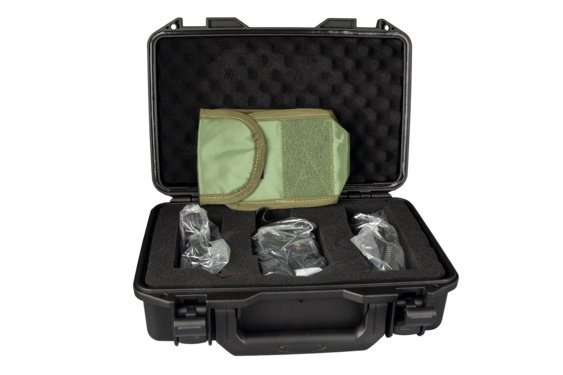
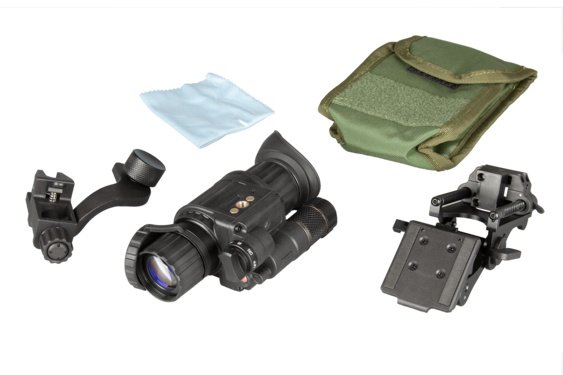
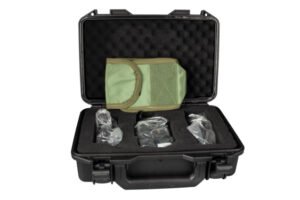
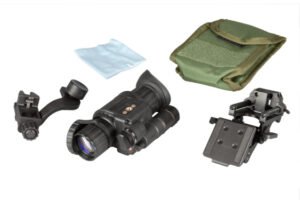
The box includes a night vision monocular, a Rhino mount, a J-arm, a soft carrying bag, lens paper, a hard/safety case, one CR123A battery, an AA battery adapter, and a user manual.
Pairs well with
- If you want the natural white-phosphor image: AGM Wolf-14 NW1 Night Vision Monocular
- If you want the military-standard PVS-14 housing: AGM PVS-14 NL1 Night Vision Monocular
- If you are choosing between thermal and night vision: night vision buying guide
FAQ
- Is the AGM Wolf-14 NL1 true night vision or digital? It is true analog night vision: a Gen 2+ image intensifier tube that amplifies existing light in real time, with no screen, no lag, and no video recording.
- What is the difference between NL1 (green) and NW1 (white)? NL1 uses a green-phosphor (P43) tube; NW1 uses a white-phosphor (P45) tube that shows the scene in natural greyscale, which many users find clearer and less tiring. NW1 usually costs a little more.
- Can I mount the Wolf-14 on a helmet or a rifle? Yes. It ships with a J-arm and Rhino mount for head or helmet use, and a specialized mount allows passive weapon use; it can also sit in front of a day optic or camera.
- Does it work in total darkness? Yes, the built-in IR illuminator lights the scene with infrared light that the tube can detect. Note that other night vision users can see IR light.
Reviews
There are no reviews yet.