
Cooled vs Uncooled Marine Thermal Cameras Explained
The cooled vs uncooled thermal camera question comes down to how far you need to see and how much you are prepared to spend to see it. Uncooled cameras are what nearly every boat carries: affordable, instant-on, maintenance-free, and entirely adequate to several hundred meters. Cooled cameras can see several times farther, cost several times more, and have a limited service life for the cooling unit itself. This guide explains both in plain terms so you can tell which your vessel actually needs, without paying for capabilities you will never use.
New to marine night vision? Start with our guide to choosing a marine night vision camera, or browse the range of marine cameras.
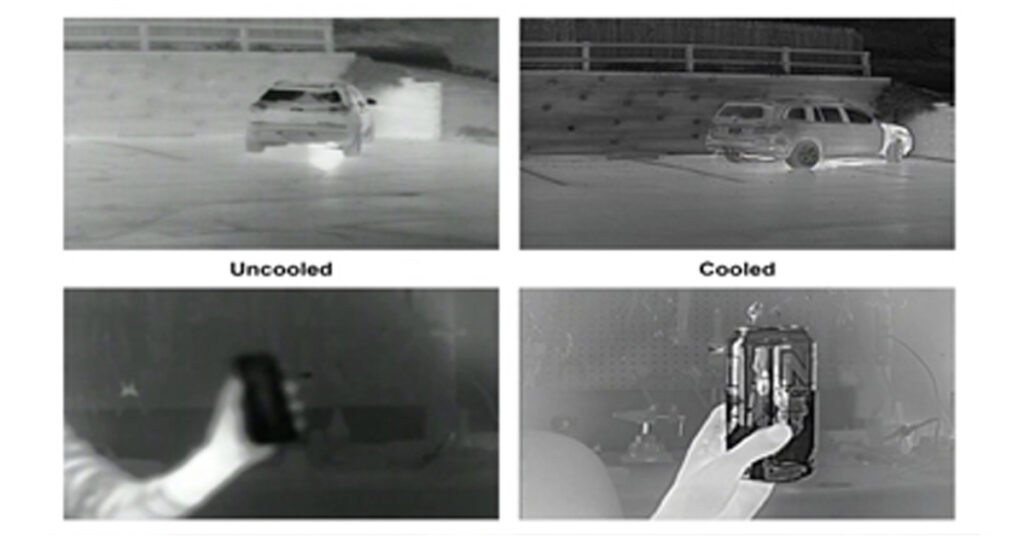
How uncooled thermal cameras work
An uncooled camera uses a microbolometer, a detector array that sits at the temperature of the surrounding air and measures long-wave infrared by the tiny resistance change heat produces in each element. Nothing inside needs chilling.
That simplicity delivers everything owners actually value day to day. The camera switches on and produces an image within seconds. There are no cooling components to wear out, so it runs maintenance-free for years in a salt atmosphere. It is compact enough for a small turret or a handheld body, and it costs a fraction of the alternative.
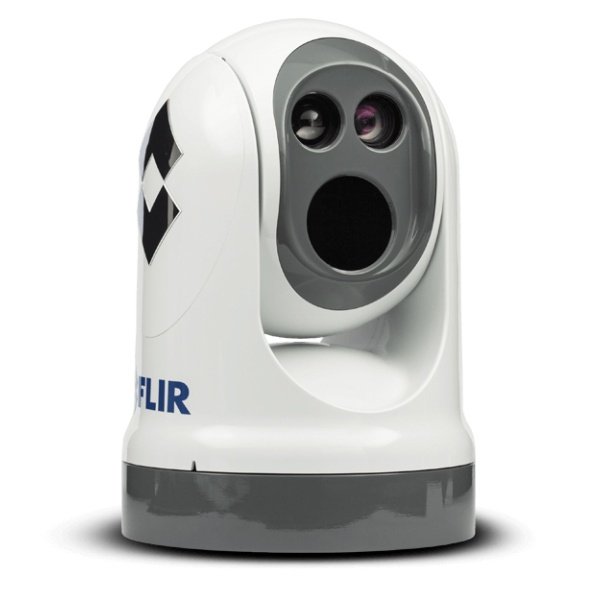
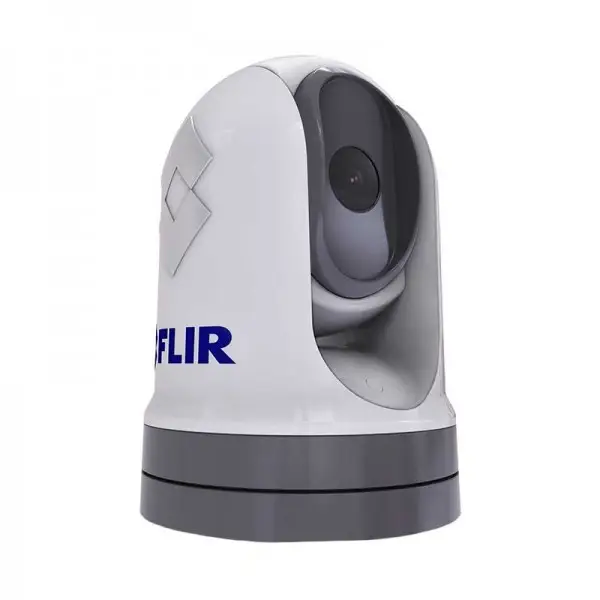
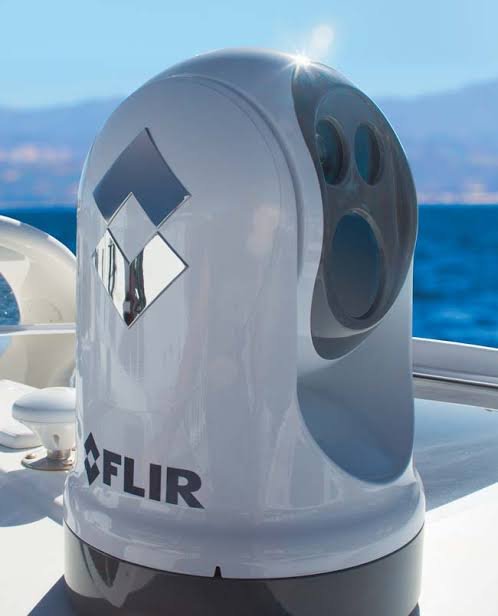
The trade-off is sensitivity, which in turn affects range. An uncooled detector performs strongly at close and mid distances, which in practical marine terms covers docking, harbor work, river and inshore running, and offshore hazard and man-overboard detection at the ranges where you can actually do something about what you have found. Almost the entire recreational market is uncooled, including the Ocean Scout handhelds, the fixed MD Series, the M-Series pan-and-tilt cameras, and the multi-spectrum M364C.
How cooled thermal cameras work
A cooled camera holds its detector at cryogenic temperature using an integrated cryocooler, typically a Stirling-cycle unit, and reads mid-wave rather than long-wave infrared.
Chilling the detector strips out the thermal noise the sensor generates about itself. What remains is a dramatic gain in sensitivity: a cooled system resolves far smaller temperature differences and, paired with long focal length optics, detects targets several times further away than an uncooled camera of comparable resolution. On the water, this means being able to detect a small vessel or a person while they are still a considerable distance away.
Four costs come with it. Price, which is usually an order of magnitude higher. Size and weight, since the cooler and its optics need a substantially larger turret. Start-up time, because the detector has to reach operating temperature before the image stabilizes. And service life: a cryocooler is a precision mechanism with a finite number of running hours, and it is a maintenance item rather than a fit-and-forget component. FLIR’s Elite systems, the M500 and M560, sit in this category, aimed at large yachts, patrol vessels, and commercial operations.
Products by Category
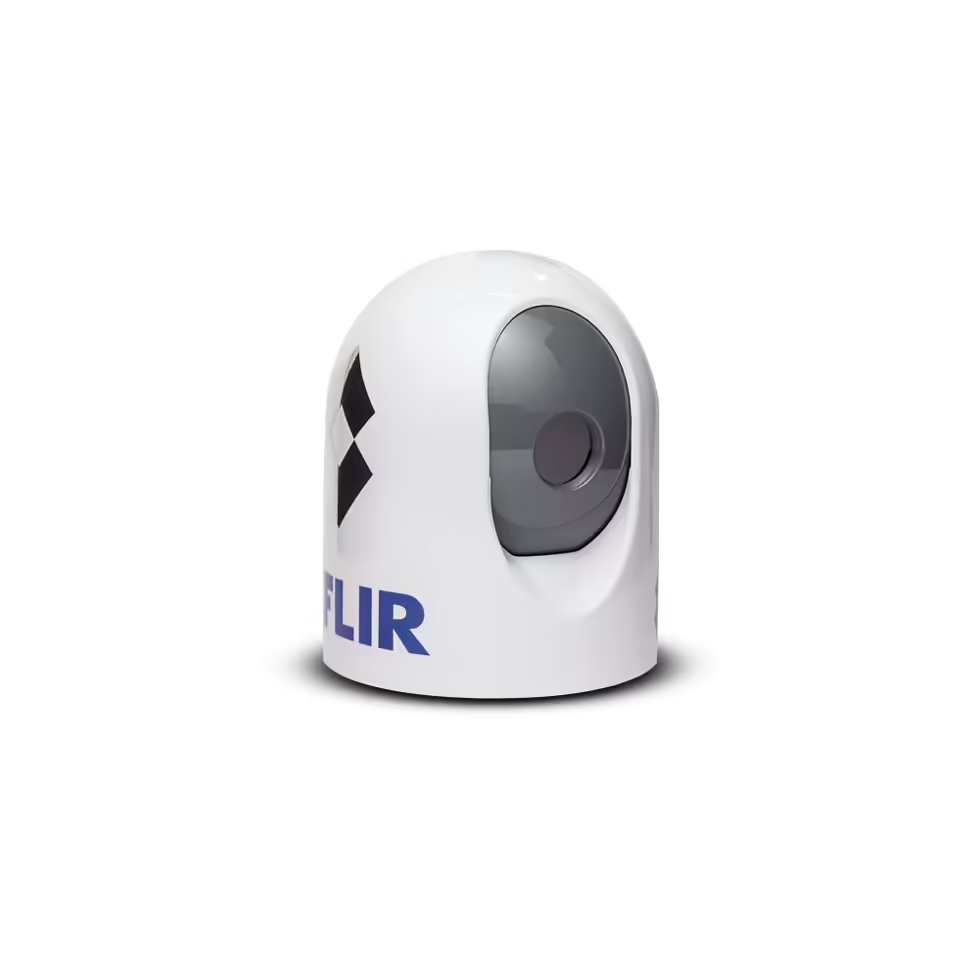
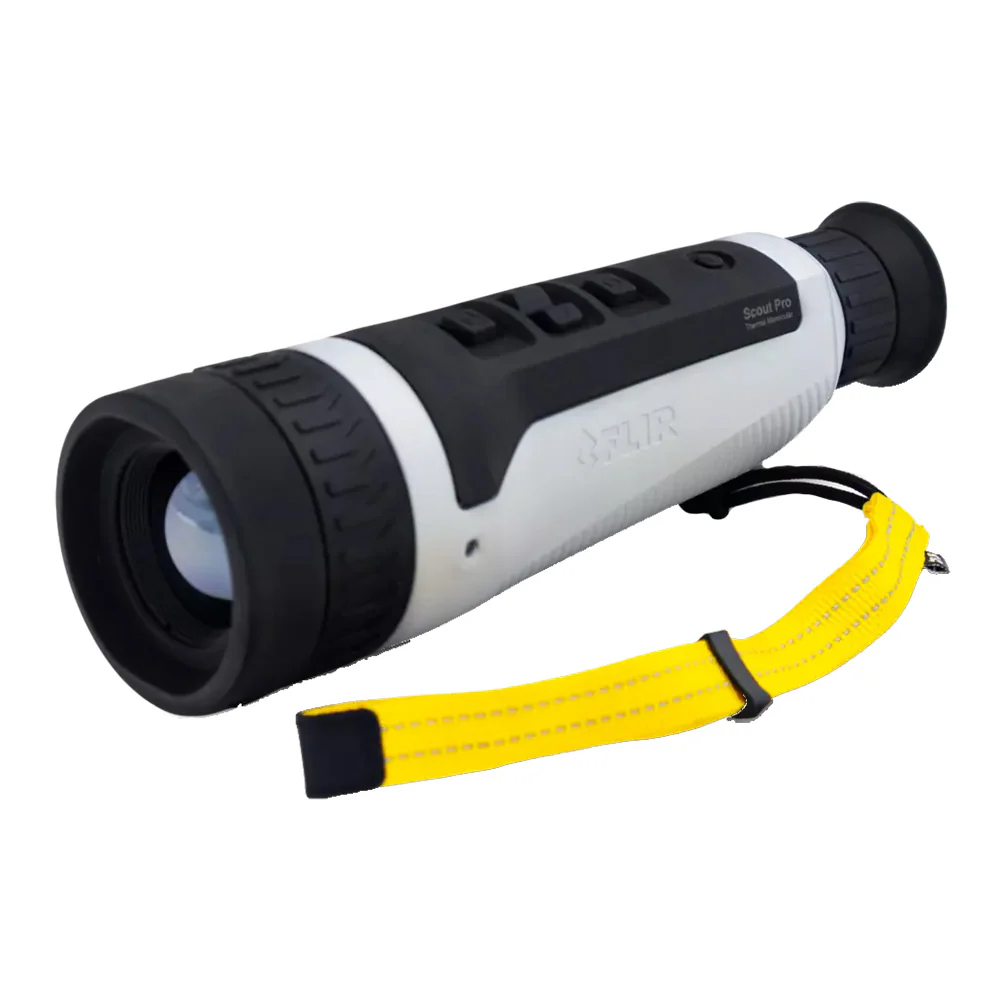
Cooled vs uncooled thermal camera: side by side
| Uncooled | Cooled | |
|---|---|---|
| Detector | Microbolometer, ambient | Cryogenically cooled |
| Waveband | Long-wave infrared | Mid-wave infrared |
| Detection range | Close to mid | Several times further |
| Start-up | Seconds | Cool-down period |
| Maintenance | None | Cooler has a finite life. |
| Size | Compact | Large turret |
| Cost | €1,500-14,500 | Typically POA, far higher |
| Typical vessel | Most recreational boats | Superyacht, patrol, commercial |
Sensitivity, NETD, and what the numbers mean
Two specifications carry most of the weight in the cooled vs uncooled thermal camera comparison, and both get quoted without explanation.
NETD is noise-equivalent temperature difference, measured in millikelvins, and it describes the smallest temperature difference a sensor can distinguish from its noise. Lower is better. Uncooled marine detectors typically uncooled marine detectors sit in the tens of millikelvins; cooled detectors go substantially lower, which is a large part of why they resolve distant, low-contrast targets that an uncooled camera renders as nothing at all.
Waveband is the other half. Uncooled microbolometers read long-wave infrared, roughly 8 to 14 micrometers, which performs well in humid marine air and handles haze respectably. Cooled marine detectors read mid-wave infrared, which pairs with long focal length optics more efficiently and contributes much of the range advantage.
What neither number tells you is what your night looks like. A cooled camera’s sensitivity is transformative at four kilometers and irrelevant at four hundred meters, where an uncooled sensor already produces a clear, usable picture of everything you need to avoid.
Ownership cost over ten years
The purchase price is the most visible number, but it is not the only factor in the comparison.
An uncooled marine thermal camera is effectively a fit-and-forget item. Barring physical damage or water ingress, there is no scheduled maintenance, no consumable component and no service interval. Over a decade of ownership the running cost is close to zero.
A cooled system carries the cryocooler, which is a mechanical assembly rated in operating hours. Depending on how much you actually run the camera, that may or may not become a live issue within your ownership, but it is a foreseeable cost rather than a remote risk, and cooler service or replacement is not inexpensive. Factor it in alongside the purchase price, and the gap between cooled and uncooled widens further than the sticker suggests.
There is also resale to consider. An uncooled camera with no service history is straightforward to sell with the boat. A cooled system with unknown cooler hours invites questions.
Which do you actually need?
For almost every recreational boater, uncooled is the correct answer, and it is not a compromise. It handles docking, inshore and offshore navigation, hazard detection, and man-overboard search at ranges where the information is still actionable. Detecting a contact at extreme distance is only useful if you can do something with that knowledge, and on a boat making eight knots, a contact detected at two kilometers and one detected at six lead to much the same decision.
Spend the difference on the specifications you will notice nightly instead. Higher resolution improves every image you see. Gyro-stabilization transforms usability in any sea. Proper chartplotter integration determines whether you use the camera at all, which our compatibility guide covers in detail. All three improve your night more reliably than raw range.
Cooled becomes the right answer when long-range detection is the job rather than a bonus: security and patrol work, search and rescue over open water, commercial operations that must classify contacts early, and large yachts where the budget is not the constraint. If you are in that group, you already know the ranges you need. If you are not sure whether you are, you are not.
Where the budget is better spent
If you have a figure in mind and are wondering whether to stretch toward a cooled system, the honest ranking for most boats runs resolution first, stabilization second, chartplotter integration third, and range last. A stabilized 640 camera such as the M364, plus a handheld Ocean Scout Pro at the helm, is a better-balanced setup on most vessels than any single more exotic camera. Where identification matters more than distance, the case for multi-spectrum is stronger than the case for cooled, as our thermal versus low-light guide explains.
Frequently asked questions
What is the difference between cooled and uncooled thermal cameras?
An uncooled camera uses a microbolometer at ambient temperature: affordable, instant-on, maintenance-free, compact, and strong at close to mid-range. A cooled camera uses a cryogenically chilled detector that reads mid-wave infrared, greatly increasing sensitivity and detection range at much higher cost, in a larger housing, with a cool-down period and a cooler that has a finite service life.
Do I need a cooled thermal camera on my boat?
Almost certainly not. Uncooled cameras cover the ranges recreational boating actually needs, including offshore navigation and man-overboard search. Cooled systems are for large yachts, patrol vessels, and commercial operators who must detect and classify small contacts at long distance.
Are cooled thermal cameras worth the extra cost?
Only when long-range detection is genuinely the requirement. For most owners, the additional cost, bulk, start-up time, and maintenance provide no benefit on a normal night, and the money would produce more visible improvement if spent on resolution and stabilization.
Which FLIR marine cameras are cooled?
The long-range Elite systems, the M500 and M560, are cooled. The Ocean Scout handhelds, MD Series, M-Series, and the multi-spectrum M364C are all uncooled, which covers the requirements of nearly all recreational and most professional users.
How long does a cooled thermal camera last?
The camera itself is built for a long service life, but the cryocooler is a mechanical component rated for a finite number of operating hours and is treated as a serviceable item. Plan for eventual cooler maintenance or replacement as part of the ownership cost, which is one more reason uncooled suits owners who want to fit a camera and forget about it.
Is a cooled camera faster to start up?
The opposite. An uncooled camera produces a usable image within seconds of switching on, while a cooled system needs its detector to reach operating temperature first, which introduces a cool-down delay before the picture stabilizes. For a boat where you may want the camera immediately, that difference is worth knowing.
Does “cooled” mean better image quality?
Not automatically. Cooled systems offer far greater sensitivity and range, but at short distances a good uncooled camera produces an entirely comparable picture. The advantage appears at long range, which is precisely the situation most recreational boats never encounter.
Return to the main marine night vision camera guide, read about thermal versus low-light or chartplotter compatibility, or browse the marine camera range and the FLIR Marine brand page.