
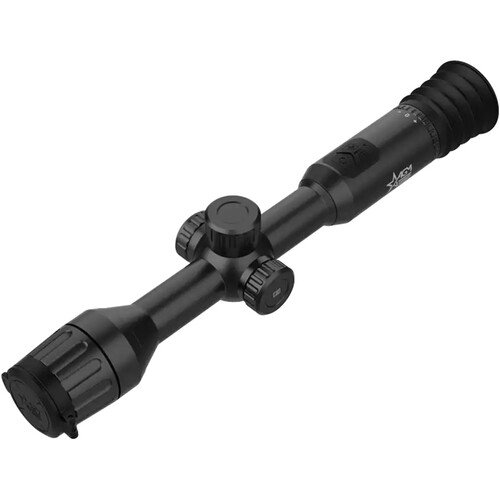
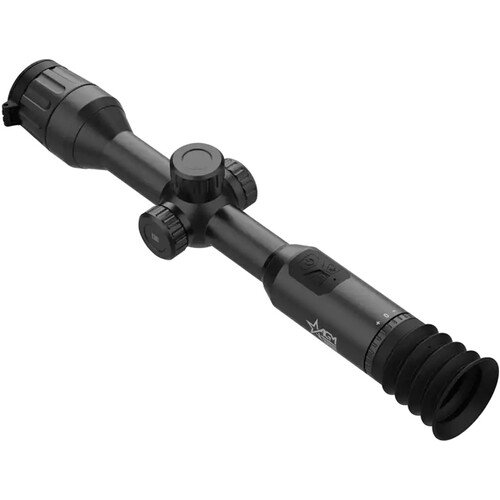
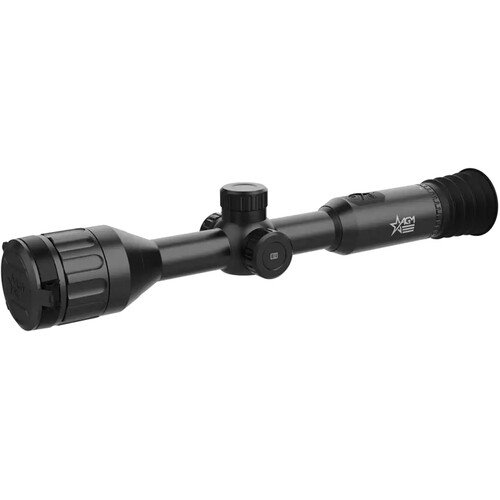
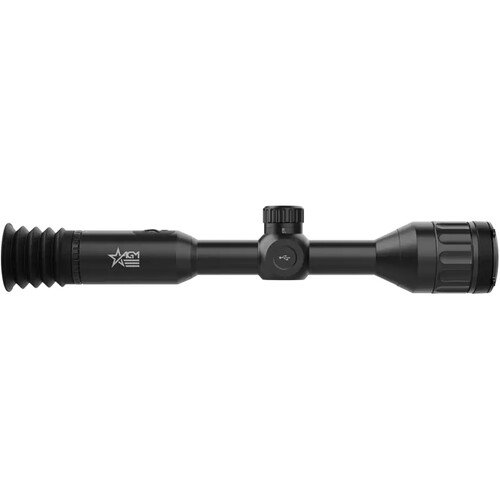
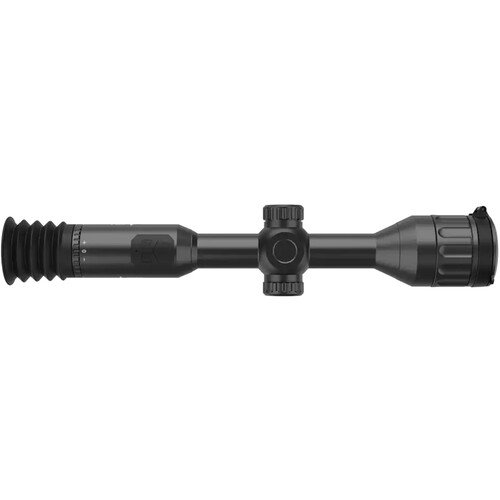
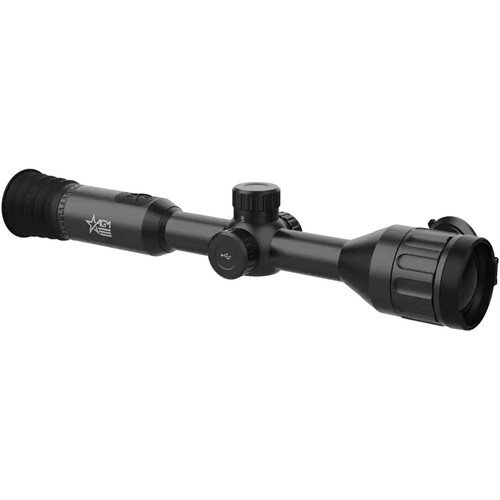
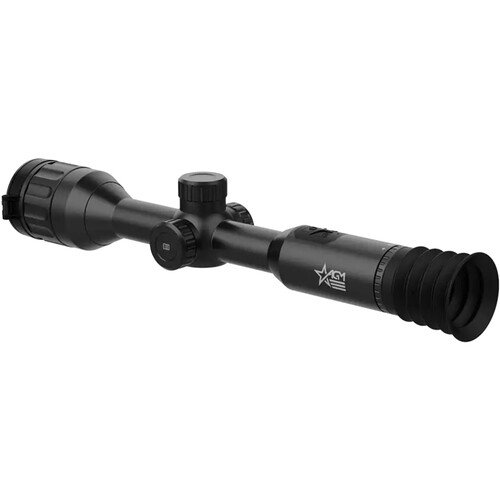
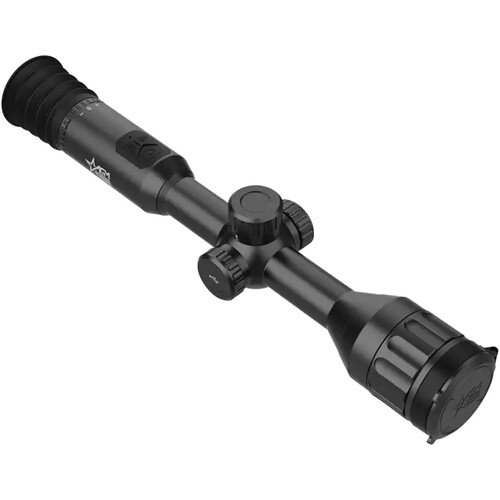
What the 50 mm lens buys
AGM offered the adder with two objective sizes. The 35 mm models were designed for medium-range shooting; the 50 mm models were designed for long range.
A larger objective gathers more infrared energy, which does two things. It extends the distance at which the sensor produces a usable image, and it improves image quality at any given distance by giving the detector more signal to work with. On a 640×512 sensor, that combination pushes the identification distance out furthest in the Gen 1 range.
The trade-off is between field of view and weight. A 50 mm assembly narrows what you see at once and adds mass to the front of the scope. If your shooting is in cover under 250 m, the TS35-640 at €3,650.00 gives you a wider field for less money.
The generation question, honestly.
This is Gen 1 hardware at €3,900.00. Our Adder V2 LRF 50-640 is €4,400.00, has the same 640×512 sensor and 50 mm lens size, and differs as follows.
The V2 runs at sub-15 mK, while this one runs at sub-35 mK. It has a 2560×2560 display against 1024×768. It has a 1,000-yard in-lens rangefinder and a five-profile ballistic calculator, which this scope does not have. It has shutterless NUC, so no calibration freeze and no shutter click.
This scope’s advantage is runtime and price. The dual power system with a replaceable CR123A backup runs substantially longer than the V2’s 9 hours, and it costs €500 less.
If you shoot in wet European conditions and your distances vary, the €500 goes to the V2, and it is not close. If you shoot dry country at known distances and need to stay out for days, the V2 is the better tool.
Display, recording, and power
The display is a 1024×768 OLED panel with five internal reticle options. 64 GB eMMC storage with Shot Activated Recording captures video around the shot without you having to touch a button. Wi-Fi supports live streaming and app-side recording.
Power comes from two built-in 18650 rechargeable cells plus one replaceable CR123A lithium. The CR123A is the useful part: a cheap spare that needs no charging and no planning. USB-C accepts a 5V power bank.
Build and mount
This scope features a conventional 30 mm tube, which is mounted in standard 30 mm rings. Built for round-the-clock operation across weather conditions.
See the full Adder range, the Rattler V3 range if you do not need a tube form factor, or our thermal scope buying guide.
Technical specifications
| Feature | Specification |
|---|---|
| Thermal resolution | 640×512 |
| Pixel pitch | 12 micron |
| NETD | Sub-35 mK |
| Lens size | 50 mm |
| Base magnification | |
| Field of view | |
| Detection range | |
| Display | 1024×768 OLED |
| Reticles | 5 internal options |
| Laser rangefinder | Not fitted |
| Storage | 64 GB eMMC |
| Battery | Two built-in 18650 rechargeable plus one replaceable CR123A lithium |
| Runtime | |
| External power | USB-C, 5V power bank |
| Housing | 30 mm tube |
| Recording | Video, Shot Activated Recording |
| Connectivity | Wi-Fi live streaming and app recording |
FAQ
What is the difference between the Adder TS50-640 and TS35-640?
Lens size. The TS50-640 uses a 50 mm objective designed for long-range work; the TS35-640 uses 35 mm for medium range. Both use the same 640×512 sub-35 mK sensor and a 1024×768 display. The 50 mm gathers more infrared energy for a longer identification distance, at the cost of a narrower field of view and more weight at the front.
Does the Adder TS50-640 have a laser rangefinder?
No. No first-generation Adder TS model has one. Rangefinding arrived with the Adder V2, where a 1,000-yard laser is built into the front lens assembly alongside a five-profile ballistic calculator. Our Adder V2 LRF 50-640 is the same lens and sensor size with that capability.
Is the Adder TS50-640 worth €500 less than the Adder V2 LRF 50-640?
It depends on your conditions. The V2 has less than half the noise floor (sub-15 mK against sub-35 mK), a much sharper display, and a rangefinder and shutterless calibration. The TS runs considerably longer on a charge and costs less. In wet European conditions, the V2 is worth the extra cost. In dry country at known distances, the TS is the better value.
Can I use the Adder TS50-640 in rain and fog?
It will work, but a sub-35 mK sensor loses more image quality in low thermal contrast than a sub-15 mK sensor does. If a large share of your hunting happens in fog, drizzle, or high humidity, the sensitivity difference is the specification to prioritize, and a current-generation scope will serve you better.
What batteries does the Adder TS50-640 use?
Two built-in 18650 rechargeable cells plus one replaceable CR123A lithium battery. The CR123A is a standard cell you can carry as a spare without needing to charge it, which is a practical advantage on multi-day trips. USB-C supports a 5V external power bank.
Jimmy H –
WOW. Got this scope in 3 days…. great scope and fast turn around. Happy happy!!!