
Thermal Monocular vs Scope vs Clip-On: Which Do You Need?
A thermal monocular is for scanning and finding game, a thermal riflescope is for aiming and shooting, and a thermal clip-on turns your existing day scope into a thermal sight. Most hunters should buy a monocular first, then add a scope or clip-on once they know how they hunt. Choosing between a thermal monocular vs scope vs clip-on comes down to one question: do you need to find game, shoot it, or keep your current rifle setup?
This guide breaks down each type, what it is best at, and how they work together. It sits within our complete guide to thermal imaging for hunting.
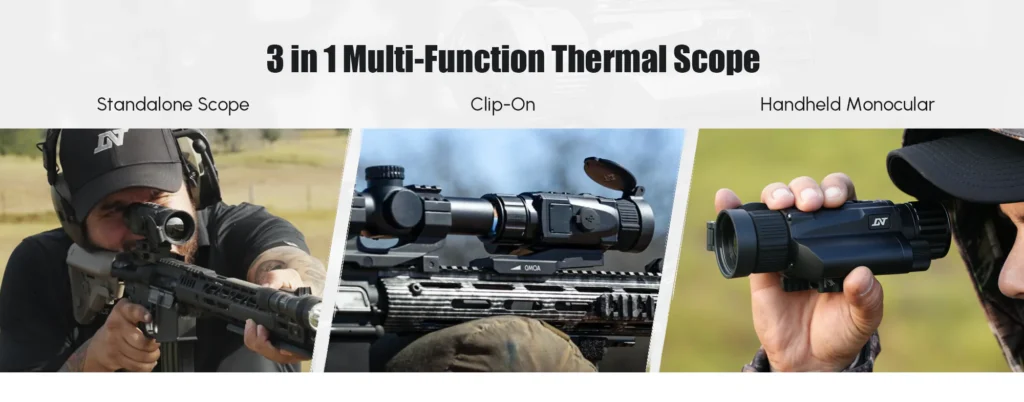
Thermal monocular vs scope vs clip-on: the quick answer
| Device | Mounts on a rifle? | Main job | Best for |
|---|---|---|---|
| Monocular | No, handheld | Scanning and finding game | Your first thermal; every hunter |
| Riflescope | Yes, replaces day scope | Aiming and shooting at night | A dedicated night rifle |
| Clip-on | Yes, in front of day scope | Converting a day scope, keeps zero | One rifle for day and night |
Thermal monoculars: for scanning
A thermal monocular is a handheld scanner, and it is the device most hunters should own first. You use it to scan the ground, find heat, and confirm what is out there before moving, but you do not aim a rifle with it. Because it does one job well and costs less than a scope, it is the most useful single thermal device you can buy.
Monoculars range from entry-level models like the AGM Asp-Micro TM-160 to long-range 640 units like the AGM Sidewinder TM50-640. If you hunt with a day scope and want to start seeing game at night, a monocular is where to begin. See the full range of thermal monoculars.
Thermal riflescopes: for aiming
A thermal riflescope mounts on your rifle and is what you aim and shoot with in the dark. It replaces your day scope for night work and has its own reticle and zero, so you sight through the thermal directly. This gives the most integrated night setup, but it means a separate rifle or swapping scopes between day and night.
Models range from the AGM Rattler TS35-384 to the long-range ThermTec Ares 650 LRF, which adds a built-in laser rangefinder. A dedicated thermal scope suits hunters who do most of their shooting at night and want a rifle set up for it. Browse thermal riflescopes.
Thermal clip-ons: keep your day scope
A thermal clip-on mounts in front of your existing day scope and turns it into a thermal sight, keeping your normal reticle and zero. You get thermal at night without giving up your familiar day optics, and you can remove it in seconds for daytime use. This is the most flexible option if you want one rifle for both day and night.
The trade-off is that image quality depends partly on the day scope behind it, and a clip-on adds weight and length up front. The AGM Rattler TC series and PixFra Chiron clip-ons are popular here. We compare the two paths in detail in thermal clip-on vs dedicated scope.
Which should you buy first?
Buy a monocular first. It solves the hardest part of night hunting, which is finding the animal, and it works with any rifle and any day scope you already own. A scope or clip-on only helps once you have located your target, so it makes sense to start with the device that does the finding.
Our common advice to new buyers is simple. Get a 384 monocular; learn how thermal behaves on your ground, and you will quickly understand whether you want a dedicated scope or a clip-on next. Buying a scope first, before you have ever scanned with thermal, is the most common and most expensive mistake we see.
The best setup: combine them
The most effective night-hunting setup uses two devices: a monocular to find game and a scope or clip-on to take the shot. You keep the wide, fast monocular moving to locate animals, then bring the rifle up only when you have a target. This saves battery, saves your arms, and keeps finding and aiming as separate, safer steps. We walk through it in the two-optic night setup.
How much does each cost?
Price often decides the order you buy in, so here is the rough lie of the land. Thermal monoculars start from around €420 for an entry unit and run to roughly €3,000 for a long-range 640. Thermal riflescopes start higher, from around €1,000, and reach over €5,000 for a flagship with a built-in rangefinder. Clip-ons sit broadly alongside scopes, from around €1,000 upward, since they are a similar piece of kit in a different format. Because a capable monocular costs less than most scopes and clip-ons, starting with one spreads the cost while giving you the most useful device first.
Frequently asked questions
Can I use a thermal monocular as a rifle scope?
No, a standard thermal monocular is built for handheld scanning, not aiming. It has no reticle designed for shooting and no recoil-rated mount. Some monoculars can be configured as a front clip-on, but for taking shots, you want a dedicated thermal riflescope or a clip-on that preserves your day scope’s zero. The reliable approach is to scan with a monocular and shoot with a scope.
Is a thermal clip-on as effective as a dedicated thermal scope?
A good clip-on comes close, but a dedicated scope usually gives a slightly cleaner, more integrated image because it is a complete sighting system. The clip-on’s strength is flexibility: it keeps your day scope at zero and converts your existing rifle for night use. Choose a clip-on if you want one rifle for day and night and a dedicated scope if you want the best night image on a rifle set up for it.
Will a thermal clip-on change my rifle’s zero?
Mounted correctly on a stable, repeatable mount, a quality clip-on preserves your day scope’s existing zero because it works through your normal reticle. Poor alignment or a flimsy mount can shift your point of impact, so the mount matters. Many hunters move a single clip-on between rifles once they have confirmed it holds zero.
Do I need all three?
No. Most hunters are well served by a monocular plus either a scope or a clip-on. Start with the monocular for scanning, then add the aiming device that fits your rifle and budget. You only need all three if you run several rifles or hunt in very different ways.
Quick facts: thermal monocular vs scope vs clip-on
| Monocular | Handheld, for scanning and finding game |
|---|---|
| Riflescope | Replaces day scope, for aiming at night |
| Clip-on | Front-of-day scope, keeps zero, day and night |
| Buy first | A 384 monocular |
| Best setup | Monocular to find, scope or clip-on to shoot |
| Need all three? | No, most hunters use two |