
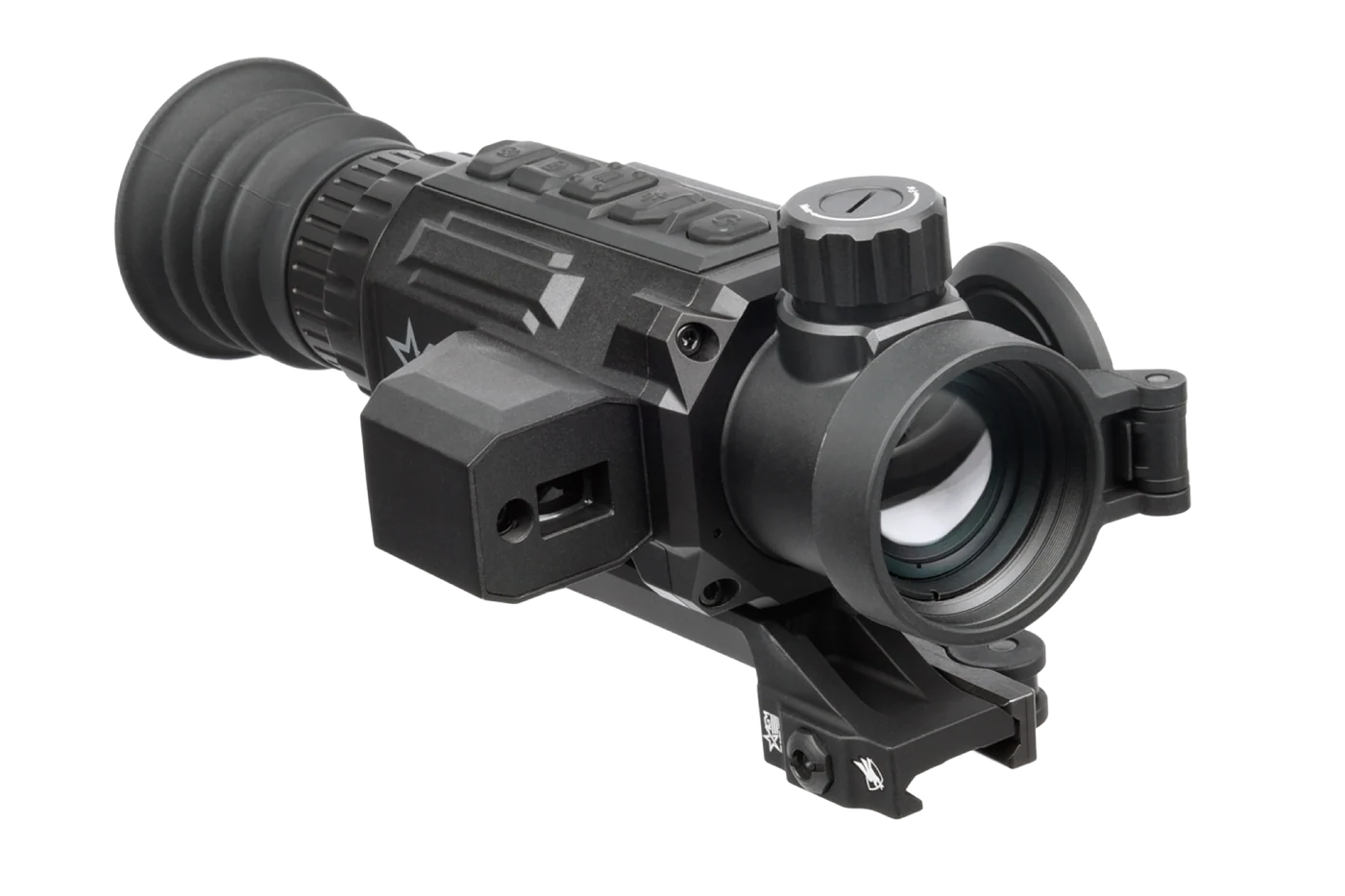
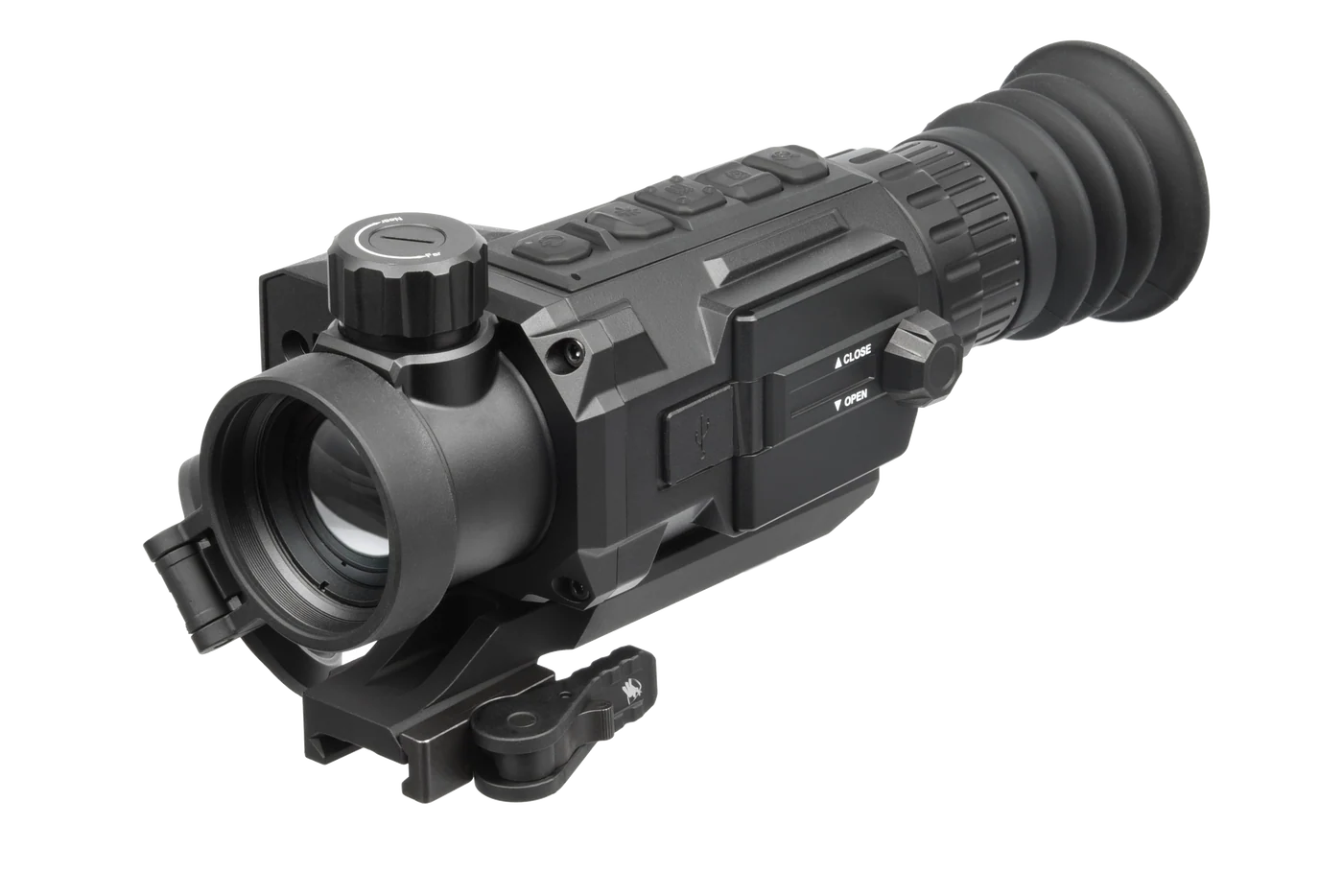
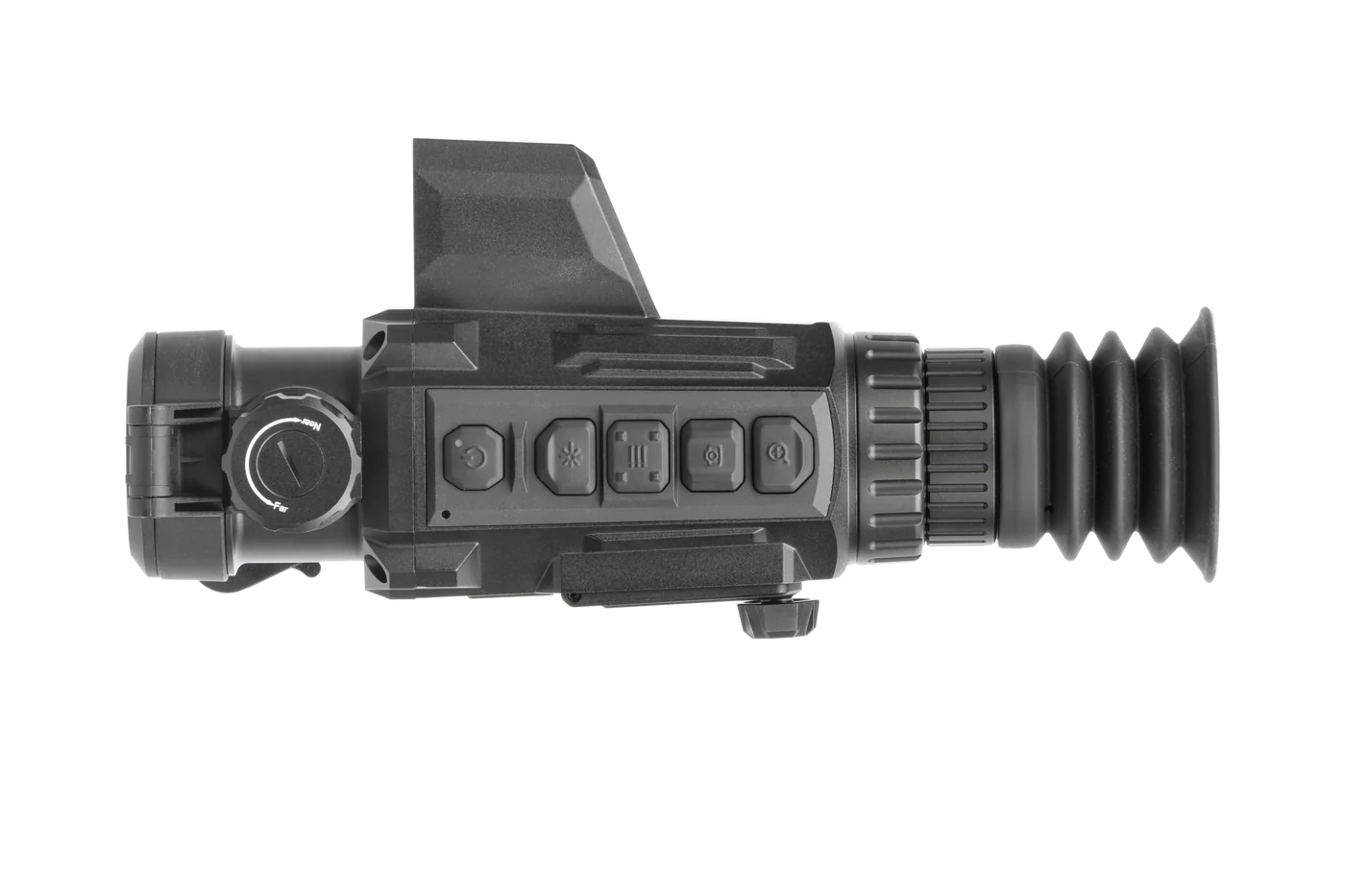
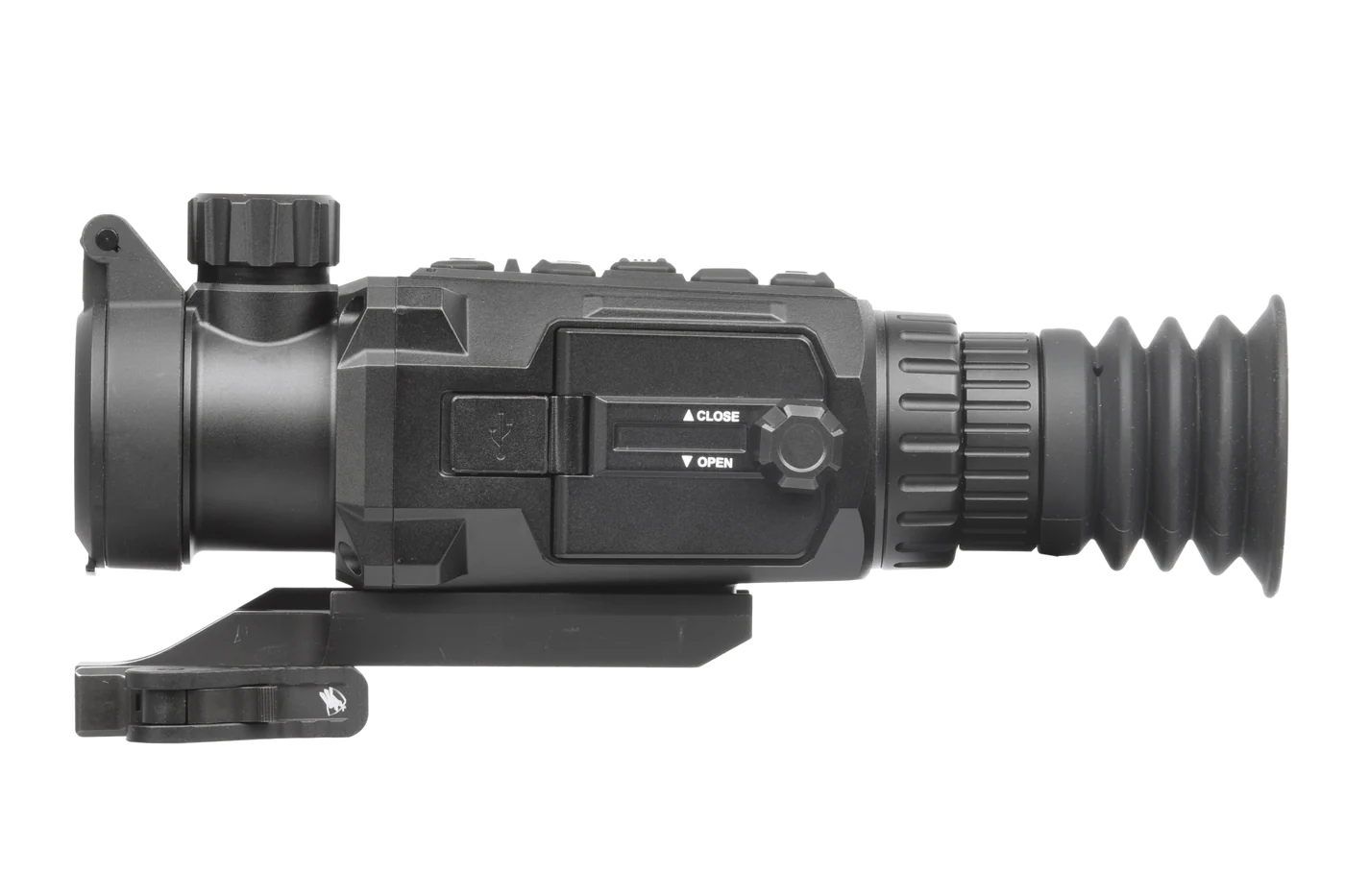
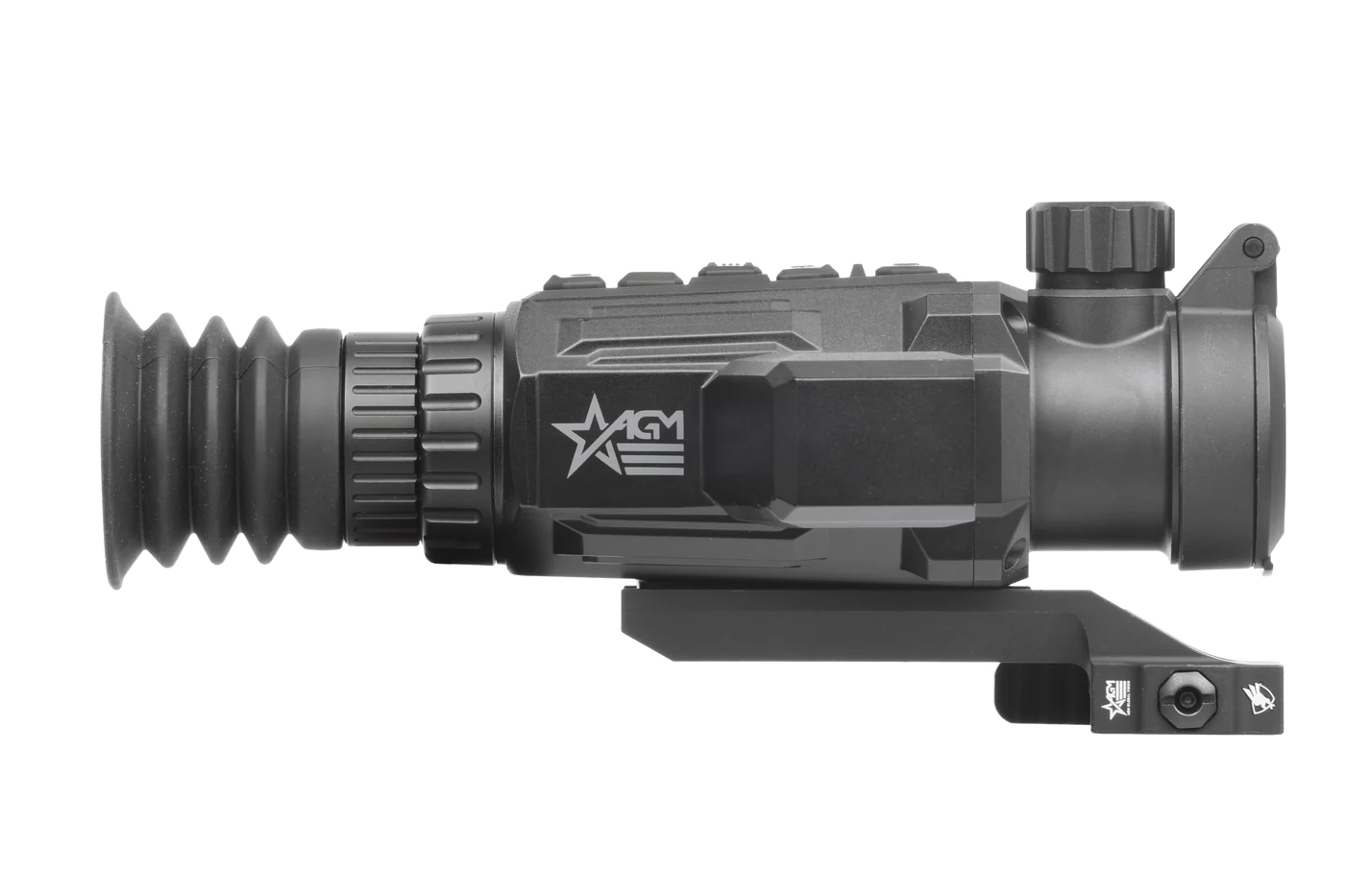
The highest base magnification AGM makes
Most thermal riflescopes sit between 2× and 3.5× base magnification. The Rattler V3 50-640 runs 3.5×. The Evolver LRF 1280 runs 2.5×. The Adder V2 LRF 35-384 runs 4×, and that is the closest anything else gets.
The Secutor LRF 75-640 starts at 4× and runs to 32× from a 75 mm objective on a 640×512 sensor.
Why that matters comes down to how thermal magnification works. Digital zoom does not add information; it enlarges the pixels you already have, and image quality falls as you push it. A scope starting at 2× and digitally zoomed to 8× is showing you a heavily interpolated image. This scope reaches 8× effective magnification at only 2× digital, which means the image at that setting is holding together in a way lower-base scopes cannot manage.
For long-range predator work, that is the entire argument. You are identifying at distances where a 2.5× base scope has already run out of usable resolution.
The trade you are making
Two things become worse in exchange, and you should know both before you buy.
The field of view is 5.9° × 4.7°. That is the narrowest in our AGM range. The Clarion 640 has a 12.5° field of view in wide mode. The Evolver gives 13.5°. You are looking through a considerably smaller window, which makes finding an animal slower and tracking a moving one harder.
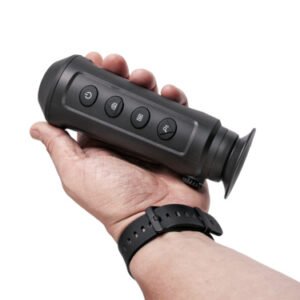
Pair the scope with a thermal monocular. Scan with the monocular, then shoot with the scope. That is correct practice with any rifle-mounted optic, and with a 5.9° field, it is no longer optional.
The lens is F/1.2, not F/1.0. Most of AGM’s objectives are F/1.0. A faster lens transmits more infrared energy to the detector, which helps in poor thermal contrast. Building a 75 mm objective at F/1.0 would make the scope substantially larger and heavier, so AGM went to F/1.2.
Combined with the sub-20 mK sensor rather than the sub-15 mK used in the Rattler V3 and Adder V2 ranges, that means this model is not the scope to buy if heavy fog and drizzle are your normal conditions. It is the scope to buy if distance is your main concern.
The digital compass, and why it is here
The Secutor LRF is the only AGM range with an integrated digital compass. Nothing in the Rattler, Adder, Varmint, or Clarion lines has one.
For most hunting, it is a curiosity. For anything involving coordinating with another person, reporting a position, or working on ground you do not know well in the dark, it is the difference between “there is something in the treeline” and a bearing you can communicate.
AGM is direct about who the device is for: the Secutor LRF series is aimed at law enforcement and defense applications, with long-range predator hunters as the commercial overlap. The compass, the CR123A power system, and the 1,000 m rangefinder are all decisions made for that user.
Ranging at 1,000 m
The integrated laser reaches 1,000 m with ±4 m accuracy.
That ±4 m figure is worth putting into context. Our Varmint V2 LRF 35-384 ranges to 600 m at ±1 m. Longer-reaching lasers trade precision for distance, and the same ±4 m applies to the Evolver LRF 1280.
At the distances this scope is built for, ±4 m sits well inside the margin that affects holdover on any realistic cartridge. At 600 m, a 4 m range error moves your point of impact by a fraction of the group size you would accept at that distance anyway.
Firmware supports both single-shot and 15-second continuous ranging modes, and the distance reading holds for 10 seconds after measurement rather than clearing immediately, which matters when you are ranging and then settling into the shot.
Power: four CR123A cells
No proprietary battery pack. No charger. Four CR123A lithium cells give up to 6 hours, and USB-C external power extends that.
CR123A is a standard cell stocked by every outdoor and hardware supplier. Spares cost a few euros; they hold charge in storage for years, and availability does not depend on AGM continuing to manufacture a specific pack. For anyone operating away from power or holding equipment in reserve for long periods, that is a deliberate advantage rather than a compromise.
The cost is that four cells are more to carry and more to replace than a single 18650, and CR123A is a primary cell rather than rechargeable unless you use RCR123 rechargeables.
Build, recording, and mounting
The magnesium alloy housing is rated IP67 and weighs 1.55 lb (703 g). Light for a 75 mm thermal scope.
A 1024×768 OLED display at 50 Hz refresh. Multiple color palettes and reticle types in four colors. Picture-in-picture holds the main view while showing a zoomed inset. Standby mode.
16 GB of onboard eMMC storage with video and audio recording, image capture, and Shot Activated Recording, which captures the seconds around the trigger break without you touching a button. Wi-Fi and USB-C for export.
An American Defense Manufacturing quick-detach mount is included. Five-year warranty.
Recent firmware adds pitch scale algorithm compensation, which factors the shooting angle into the ballistic result rather than leaving you to correct for incline yourself. Sharpness controls sit alongside brightness, contrast, and PIP in the sub-menu.
Is the ATN X-Sight 4K Pro the right scope for you?
Buy it if: you shoot past 400 m regularly, you need a bearing as well as a range, you operate away from reliable power, or you want the highest base magnification available on a 640 sensor.
Do not buy it if: Most of your shooting is inside 250 m; you hunt in heavy fog and drizzle, or this scope is your only thermal optic and you have no monocular to scan with. In those cases the Rattler V3 LRF 50-640 or Adder V2 LRF 50-640 will serve you better, both with sub-15 mK sensors.
Tell us your typical distance, terrain, and platform, and we will confirm which fits. See our full thermal riflescope range or the thermal scope buying guide.
TECHNICAL SPECIFICATIONS
| Feature | Specification |
|---|---|
| Manufacturer part number | SECU75-640-LRF |
| Detector type | 12 µm VOx uncooled focal plane array |
| Resolution | 640 × 512 |
| NETD | Less than 20 mK |
| Refresh rate | 50 Hz |
| Lens system | 75 mm, F/1.2 Germanium |
| Base magnification | 4× |
| Magnification range | 4× to 32× |
| Digital zoom | Up to 8× |
| Field of view | 5.9° × 4.7° |
| Display | 1024 × 768 OLED |
| Laser rangefinder | Up to 1,000 m (1,093 yd), ±4 m accuracy |
| Ranging modes | Single, 15-second continuous |
| Digital compass | Yes. |
| Picture-in-picture | Yes. |
| Standby mode | Yes. |
| Reticles | Multiple types, 4 colors |
| Palettes | Multiple |
| Storage | 16 GB eMMC |
| Recording | Video with audio, image capture, and shot-activated recording |
| Connectivity | Wi-Fi, USB-C |
| Battery | Four CR123A |
| Battery life | Up to 6 hours |
| External power | USB-C |
| Housing | Magnesium alloy |
| Degree of protection | IP67 |
| Weight | 1.55 lb (703 g) |
| Mount | American Defense Manufacturing quick-detach, included |
| Warranty | 5 years |
FAQ
What is the magnification of the AGM Secutor LRF 75-640?
It runs from 4× to 32×, with 4× as the base optical magnification from the 75 mm lens and up to 8× digital zoom on top. That 4× base is the highest in AGM’s range, and it matters because digital zoom enlarges existing pixels rather than adding detail. Starting higher means the image holds together at effective magnifications where lower-base scopes have already degraded.
How accurate is the Secutor LRF 75-640 rangefinder?
The integrated laser reaches up to 1,000 m (1,093 yd) with ±4 m accuracy. Longer-reaching lasers trade precision for range, so this model is less precise than the ±1 m at 600 m offered by the Varmint V2 range. At the distances this scope is built for, a 4 m range error affects the point of impact by less than the group size that most shooters would accept.
Does the AGM Secutor LRF 75-640 have a compass?
Yes. The Secutor LRF series is the only AGM range with an integrated digital compass. It gives a bearing alongside range, which matters when coordinating with another person, reporting a position, or working unfamiliar ground in the dark. No Rattler, Adder, Varmint, or Clarion model is included.
What batteries does the Secutor LRF 75-640 use?
Four CR123A lithium cells, giving up to 6 hours, with USB-C external power to extend runtime. CR123A is a standard non-proprietary cell available from any outdoor or hardware supplier, holds charge in storage for years, and does not depend on AGM continuing to make a specific battery pack. RCR123 rechargeables can be used instead.
Is the Secutor LRF 75-640 good for close-range hunting?
No. The field of view is 5.9° × 4.7°, the narrowest in AGM’s range, and the 4× base magnification is high for close work. It is built for engagements past 400 m. For shooting inside 250 m, a wider-field scope, such as the Rattler V3 25-384 or the Clarion 640 in wide mode, will serve you considerably better.
Should I pair the Secutor LRF 75-640 with a thermal monocular?
Yes, and with this scope it is not optional. A 5.9° field of view makes finding and tracking animals through the scope slow, and scanning with a rifle-mounted optic means pointing a loaded rifle at everything you want to identify. Scan with a thermal monocular, then use the scope once you have identified the target.
Reviews
There are no reviews yet.