
Thermal Vision Monocular: What It Is, How It Works & What to Buy (2026)
A thermal vision monocular is a handheld device that builds a picture from heat rather than light, letting you see animals and people in total darkness, through fog, and in cover. It is not night vision, although the two are often confused, and understanding the difference will help you decide which one to buy.
This guide explains what thermal vision is, how it differs from night vision, whether devices that do both exist, and how to choose. If you already understand the technology and just want models compared, our complete thermal monocular guide covers every brand.
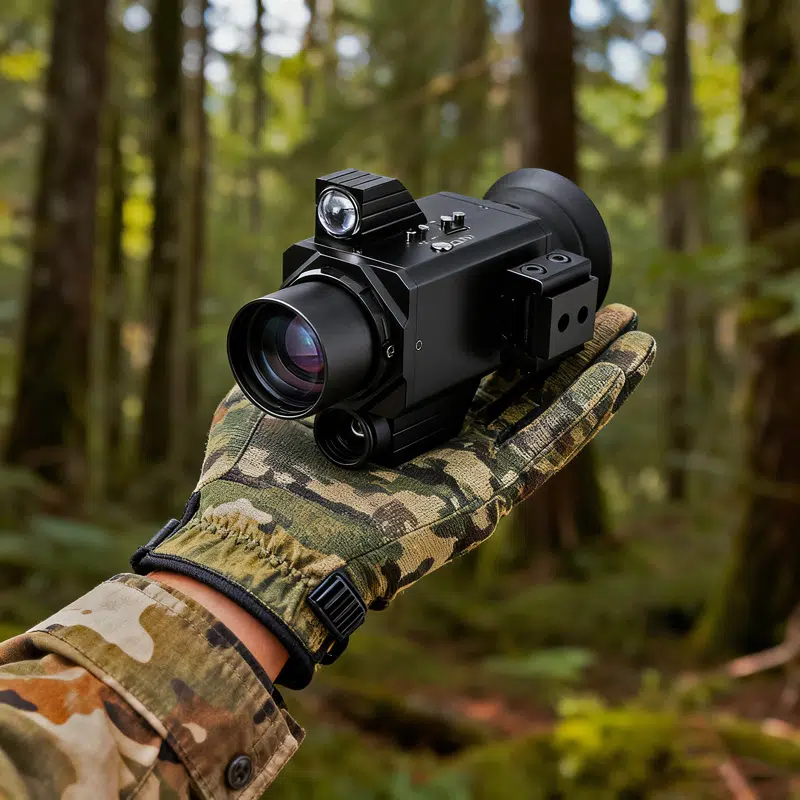
What does the term “thermal vision” mean?
Thermal vision means seeing with infrared radiation instead of visible light.
Everything above absolute zero radiates energy in the infrared part of the spectrum, and how much it radiates depends on how warm it is. Your eyes cannot detect those wavelengths. A thermal camera can, and it converts what it detects into a visible image where brightness represents temperature.
The practical consequence is simple, and it is quite difficult to overstate the first time you use one. A living animal runs considerably warmer than the grass, soil, rock, and trees around it. On a black night, a monocular with thermal vision turns an invisible field into a map of every warm body in it.
You will notice that the term is used in two different ways. Some manufacturers, including HIKMICRO and FLIR, put “thermal vision monocular” directly in product names. Others simply call the same device a thermal monocular or a thermal imaging monocular. They are the same category of device. The naming is marketing, not a technical distinction.
Thermal vision versus night vision
This is the confusion worth clearing up, because it decides which device solves your problem.
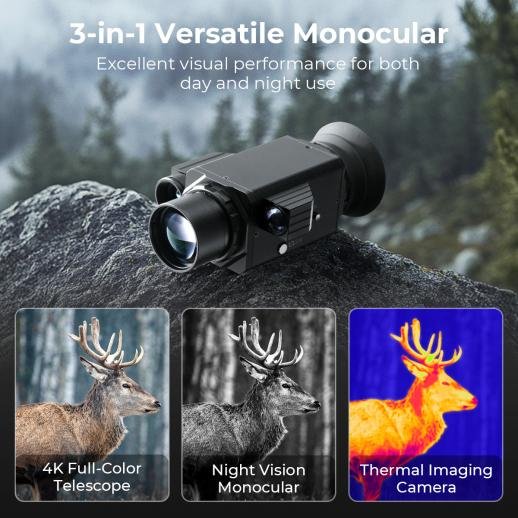
Night vision amplifies light. A traditional night vision device takes the small amount of visible and near-infrared light already present from the moon, stars, or distant buildings and multiplies it until an image becomes visible. Digital night vision does the same job with a sensitive camera sensor.
Thermal vision amplifies nothing. It reads emitted heat directly and needs no light at all.
| Thermal vision monocular | Night vision monocular | |
|---|---|---|
| What it detects | Emitted heat | Reflected light |
| Works in total darkness | Yes. | No, it needs some light. |
| Blinded by bright lights | No | Yes. |
| Sees through haze and light fog | Well, | Poorly |
| Finds a hidden animal in cover | Often | Rarely |
| Shows color and fine detail | No | Yes. |
| Reads markings, faces, tags | No | Yes. |
| Works in daylight | Yes. | No, it can be damaged. |
| Typical price | €329-2,900 | €200-2,000 |
Where each one wins
Thermal wins at finding things. If your problem is “there’s an animal somewhere in this field, and I can’t see it,” thermal solves it, while night vision does not. Thermal also ignores glare, works in daylight, and penetrates haze. This is why thermal has almost entirely replaced night vision for hunting and land management.
Night vision wins at recognizing things. If your problem is “I can see something, and I need to know exactly what it is,” night vision shows detail, texture, and color that thermal simply cannot produce. Thermal gives you heat and shape. It will not read a number on an ear tag or tell you the color of a coat.
For most people buying a first device for outdoor use at night, thermal is the correct answer. If you’re still unsure, you can check out our full comparison of thermal and night vision, which goes deeper.
Is there such a thing as a thermal night vision monocular?
People search for these devices constantly, and the answer is yes, with a caveat.
A multi-spectrum device combines a thermal channel with a separate visible-light or digital night vision channel in one body. You detect a warm target on the thermal channel, then switch to the optical channel to identify it properly. Some add infrared illumination to help the optical channel work in complete darkness.
These exist mostly in binocular form rather than monocular, because two channels and their optics need space. Examples include the ThermTec Ventus and HIKMICRO’s Habrok range, both of which pair a 640 thermal sensor with a 4K day and night camera, a laser rangefinder, and dual-band infrared. Our thermal binocular guide compares them.
In handheld monocular form, genuine dual-channel devices are rarer and usually expensive. If your budget is limited, the honest advice is to buy one good thermal vision monocular rather than a cheap device claiming to do both poorly.
What a “thermal night vision monocular” is not: it is not a thermal device that somehow shows you color and detail. Thermal physics does not permit that. Any listing that promises both color and detail from a single sensor is describing a palette setting, not a second imaging channel.
How a thermal vision monocular works
Four components matter, and understanding them makes every specification meaningful.
The sensor. A microbolometer is a grid of elements that each change electrical resistance when infrared energy lands on them. The device reads those changes and builds an image. “640×512” or “384×288” describes how many elements are in the grid.
Pixel pitch. The physical spacing between elements is in micrometers. Current devices use 12 µm; some use 17 µm. This detail matters more than people realize, and not in the direction you would expect. A larger 17µm pixel collects more energy per element, which often produces better sensitivity even though the sensor has fewer pixels overall.
The lens. Ordinary glass blocks infrared, so thermal lenses are made from germanium. It is expensive, which is why a 50mm thermal lens costs so much more than a 25mm one.
The display. The processed image appears on a small OLED or AMOLED screen. A superb sensor behind a poor display is wasted, which is a genuine weak point on several otherwise competent devices.
What thermal vision cannot do
Setting expectations properly prevents most disappointment.
It cannot see through walls. Thermal readings surface temperature. A wall blocks it completely. You may see a warm patch where something has leaned against a wall, which is not the same thing.
It cannot see through glass. Glass is opaque at thermal wavelengths. Point a thermal vision monocular at a window, and you see a reflection of yourself, not the room behind.
It cannot see through dense foliage. It sees heat escaping through gaps in cover, which is why animals in hedges often show up. Solid vegetation blocks it like a wall.
It cannot show detail. No color, no markings, no faces, no antler counting at a distance.
It will not identify anything at the advertised detection range. Detection means knowing something warm is there. Identification means knowing what it is, and that happens at roughly a quarter to a third of the detection distance.
How to choose a thermal vision monocular
Six specifications, in the order they affect your night.
Thermal sensitivity (NETD)
This is the most important specification, yet it is the least advertised. NETD is measured in millikelvins and describes the smallest temperature difference the sensor can separate from its noise. Lower is better.
- Under 15 mK: professional grade
- Under 20 mK: strong
- 20 to 40 mK: fine in cold, dry, high-contrast conditions
- Above 40 mK: struggles in damp weather
On a wet night, a deer’s soaked flank may be barely warmer than the wet bracken behind it. Sensitivity is what sets them apart. In most of Europe, that describes half the season.
Sensor resolution
The sensor has a certain number of heat-sensing elements. 256×192 is entry-level and fine for close work. 384×288 handles most practical hunting and land management. 640×512 roughly doubles the linear detail of a 384 and is what you want for open country. Our explainer on 384 versus 640 covers the trade.
Read the resolution and NETD together. Neither alone tells you how a device performs.
Lens size and field of view
A short 19 to 25mm lens gives a wide view for quick scanning at closer range. A 50mm lens reaches much further with a narrow view. Woodland and close cover want width; open fields and hill ground want reach. Do not automatically buy the biggest lens, because a narrow field genuinely makes finding and following animals harder.
Detection range
Treat manufacturer figures as a way to compare two devices, never as a prediction. They assume large, warm targets in clear, cold conditions. Rain, humidity, and warm ground all reduce their effectiveness. See how far thermal really goes.
Display and refresh rate
Look for at least 1024×768 and a 50Hz refresh rate. Refresh matters when tracking a moving animal, where a slow update makes the picture smear.
Battery and build
Replaceable batteries matter more than headline runtime, because you can swap them in the field. Look for magnesium alloy housing and an IP67 or IPX7 rating.
Shop thermal vision monoculars by model
Most people searching for a thermal vision monocular are looking for a specific model. Here are the models we get the most questions about, across the brands we carry, with an honest note on who each suits. Prices and exact specs are on each product page.
AGM thermal vision monoculars
AGM dominates this category for a reason: a wide model range at competitive prices, with a five-year warranty that is the longest in the class.
- AGM Taipan V2 is the value workhorse, sold in several sensor and lens combinations (256 and 384 cores, 19 mm and 35 mm lenses). The 384 versions are the sweet spot for hunting; the 256 versions suit closer-range observation on a tighter budget. A removable 18650 battery and a tilt sensor that blanks the display to save power make it practical for long sessions.
- AGM Sidewinder TM35-640 steps up to a 640 sensor with a 35 mm lens and NETD at or below 20 mK, for hunters who want long-range identification and the cleanest image AGM offers in a monocular.
- AGM Rattler TC35-384 is a compact 384 option with a 35 mm lens, offering a good balance of reach and price for general night hunting.
- AGM StingIR 640 and AGM Fuzion LRF TM35-384 cover the higher end, with the Fuzion adding a built-in laser rangefinder for hunters who also range before a shot.
If you are cross-shopping AGM models, check the generation carefully, since older and current versions can sit side by side at similar prices. Our AGM thermal monocular guide breaks down the range in full.
HIKMICRO thermal vision monoculars
HIKMICRO covers the widest span of prices of any brand, from budget to pro-grade, which makes it the first place to look if value or choice matters most.
- HIKMICRO Falcon FQ35 2.0 pairs a 640 sensor with a class-leading NETD below 15 mK and a 35 mm lens, one of the most sensitive monoculars at its price.
- The HIKMICRO Falcon FQ50 2.0 builds on this model with a 50 mm lens, providing greater reach on open ground.
- The broader HIKMICRO range runs from the budget Lynx line to the long-range Condor LRF, so there is a Falcon, Lynx, or Condor to suit most budgets and distances.
Pulsar, ThermTec, and ATN
- Pulsar Axion 2 monoculars lead in build quality and software, with the best thermal app and the strongest resale value.
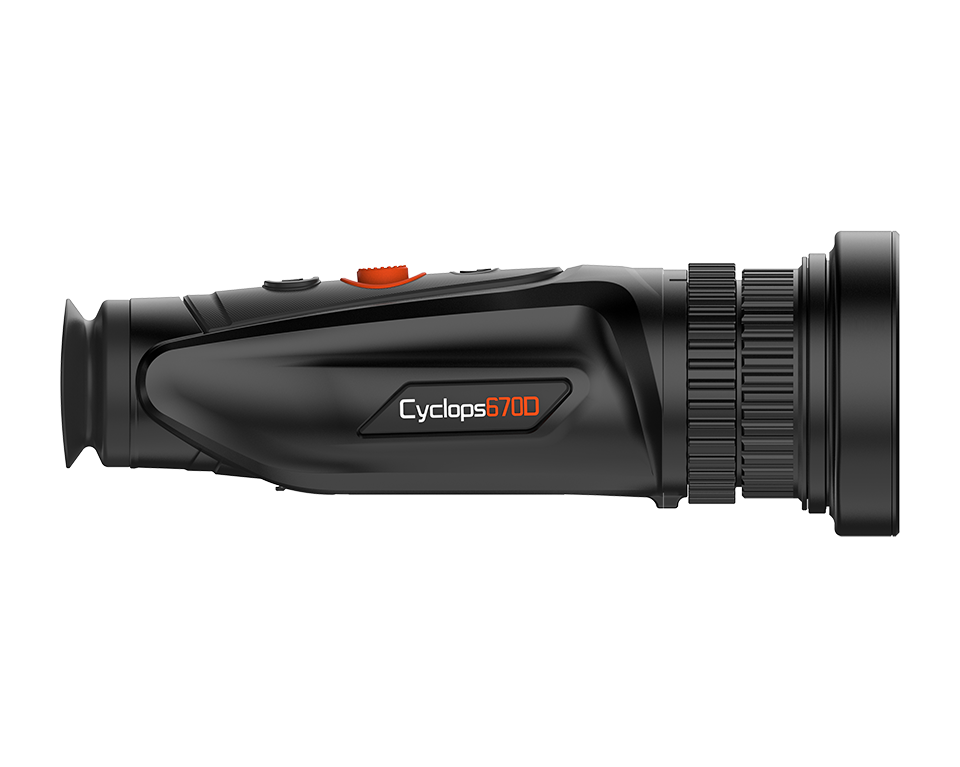
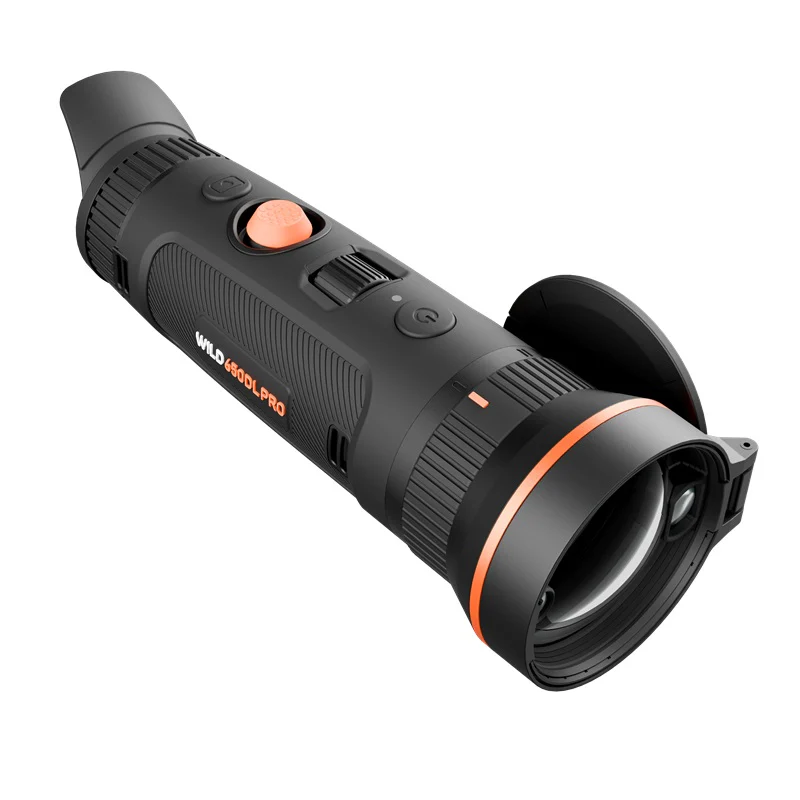
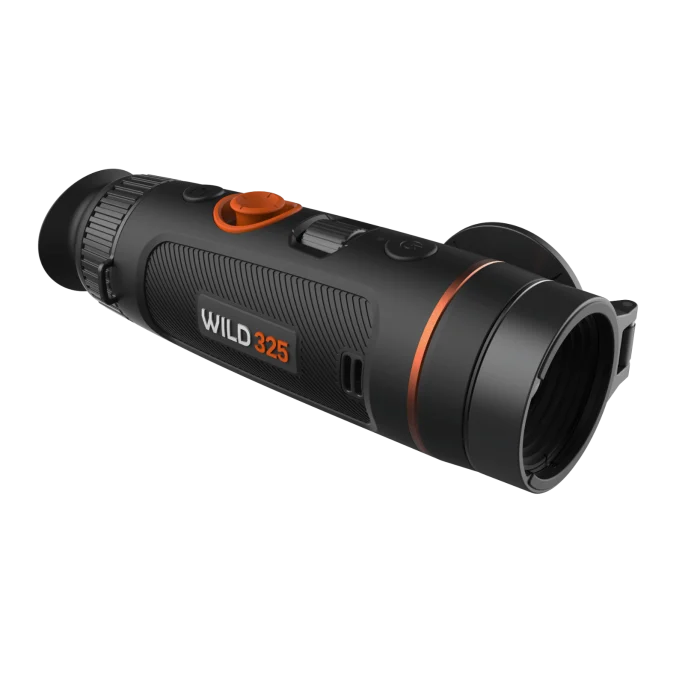
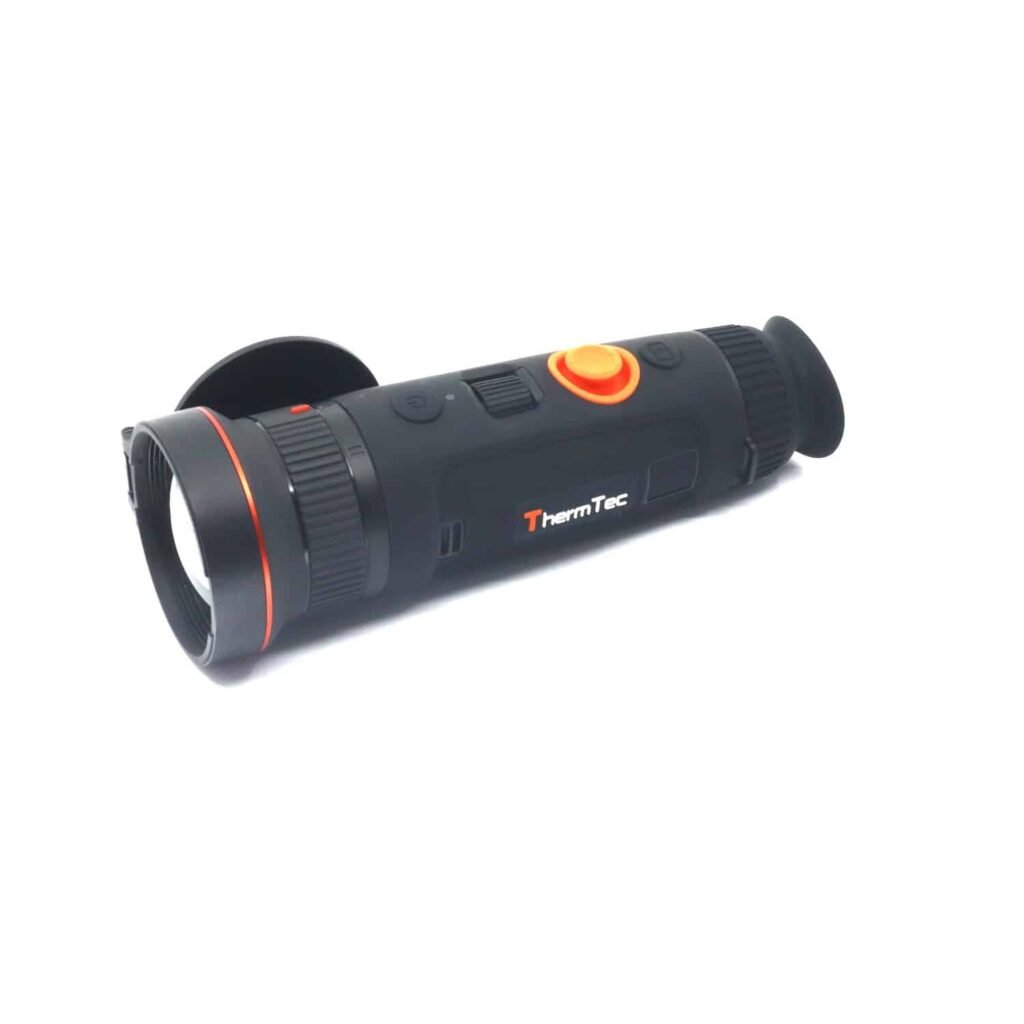
- The ThermTec Cyclops and Wild series lead on sensitivity per euro, with several offering a dual field of view that switches between wide scanning and zoomed identification.
- ATN packs in features like Wi-Fi, video recording, and ballistic tools at competitive prices.
Not sure which model fits? Tell us your budget, quarry, and typical distance, and we’ll shortlist options from every brand we carry, not just one make. That cross-brand honesty is something a single manufacturer’s site cannot give you.
Thermal vision monoculars compared
We stock every brand below, so this is not a pitch for one.
| Model | Sensor | NETD | Detection | LRF | Standout |
|---|---|---|---|---|---|
| HIKMICRO Lynx 3.0 | 256 / 384 | Varies | Short | No | From €329, the cheapest genuine option |
| ThermTec Cyclone | 640 12 µm | <20 mK | Short | No | 255 g, 20 h battery, €899 |
| ThermTec Cyclops 3.0 | 640 12 µm | ≤25 mK | 2,500 m | No | AI calibration, all-rounder |
| ThermTec Wild Pro | 640 12 µm | <15 mK | Long | 1,000 m | Most sensitive here |
| Pulsar Axion XQ30 Pro | 384 17 µm | <25 mK | ~1,050 m | No | Best-balanced compact |
| Pulsar Telos LRF XP50 | 640 17 µm | <18 mK | 1,800 m | 1,000 m | Modular, best software |
| AGM Sidewinder | 384 12 µm | ≤20 mK | Mid | No | 64 GB, five-year warranty |
| HIKMICRO Falcon 2.0 | 384 / 640 | Varies | Mid | No | Wide model ladder |
Best on a tight budget. HIKMICRO’s Lynx line from around €329 is the cheapest genuinely usable thermal vision monocular we are willing to sell.
Best value overall. The ThermTec Cyclone, priced at €899, features a 640 sensor with a sensitivity of under 20 mK, housed in a 255 g body and offering roughly 20 hours of battery life.
Best image quality. The ThermTec Wild Pro is under 15 mK, or Pulsar’s Telos LRF XP50 is under 18 mK if build quality and software matter as much as the sensor.
Products by Category
Thermal vision monocular, binocular, or scope?
Format matters as much as sensor, and choosing the wrong one is the most expensive mistake in thermal.
| Monocular | Binocular | Riflescope | Clip-on | |
|---|---|---|---|---|
| Job | Find and identify | Long observation | Take the shot. | Convert a day sscope. |
| Eyes used | One | Two | One | One |
| Rifle mounted | No | No | Yes. | Yes. |
| Typical price | €329-2,900 | €2,990-3,690 | €1,690-3,690 | €1,490-2,690 |
A monocular is the right first purchase for almost everyone. It is the lightest, cheapest, and most versatile thermal device, and it is what you will actually carry.
A binocular becomes worth the premium when you gaze for hours rather than minutes, because two-eye viewing removes the fatigue a monocular builds up.
A thermal scope is for aiming, not searching. Scanning with a rifle-mounted device means pointing a firearm at everything you want to identify, which is unacceptable regardless of the optic. Buy the monocular first.
A clip-on converts a day scope you already own without re-zeroing, and several models double as handheld monoculars when removed.
Mistakes worth avoiding
Confusing thermal with night vision. They solve different problems. If you want to find warm animals in the dark, buy thermal. When you need to read in detail in low light, night vision is the best choice.
Buying on detection range. The most quoted figure is also the least useful, because identification happens at much closer range.
Ignoring NETD. Two devices at the same resolution can perform completely differently in damp weather.
Buying too many lenses. A narrow field is genuinely harder to use, and most people scan more than they reach.
Believing a single sensor does both. No thermal sensor produces night vision detail. Dual capability requires a second imaging channel.
What people use thermal vision for
Hunting and land management. Finding, identifying, tracking, and recovering the game. See our dedicated guide on the thermal monocular for hunting.
Wildlife observation. Locating nocturnal mammals, active sets, and roosting birds without a torch and without disturbance.
Security and property. Checking a yard, perimeter, or outbuilding at night, where thermal remains effective in darkness and is not blinded by security lighting.
Livestock and farming. Finding a ewe lambing in a far corner or a calf separated from the herd.
Search and rescue. A person lying still in cover is nearly invisible to a torch and obvious on thermal.
Building inspection. It can detect heat loss and overheating electrical systems. A hunting device is not a calibrated inspection tool, but it will show an obvious problem.
Is a thermal vision monocular legal?
Rules vary across Europe and change periodically. The general pattern is that handheld thermal devices used for observation are widely permitted and treated far more permissively than thermal devices mounted on a firearm. Several countries that restrict rifle-mounted thermal place no restriction on carrying a handheld device.
We sell optics, not legal advice. Confirm the current position with your national or regional hunting authority before ordering, and check separately if you plan to travel across a border with the device.
Frequently asked questions
What is a thermal vision monocular?
A handheld, single-eyepiece device that creates an image from heat rather than light. It detects infrared radiation from anything warmer than its surroundings, which lets it find animals and people in complete darkness, through fog, and in cover. It is the same category of device as a thermal monocular or thermal imaging monocular; the names are interchangeable.
What is the difference between thermal vision and night vision?
Thermal detects emitted heat and needs no light at all. Night vision amplifies existing light and fails when there is none. Thermal is far better at finding warm bodies, works in daylight, and is not blinded by glare. Night vision shows color and detail that thermal cannot. For finding animals at night, thermal wins decisively.
Is there a thermal night vision monocular that does both?
Multi-spectrum devices that combine a thermal sensor with a separate optical or digital night vision channel do exist, mostly in binocular form, such as the ThermTec Ventus or HIKMICRO Habrok. True dual-channel handheld monoculars are rarer and expensive. A single thermal sensor cannot produce night vision detail regardless of what a listing claims.
Can a thermal vision monocular see through walls?
No. Thermal reads surface temperature, and a wall blocks it entirely. The same applies to glass, which is opaque at thermal wavelengths. You will see your reflection in a window, not the room behind it.
Can you use a thermal vision monocular in daylight?
Yes. It reads heat rather than light, so daylight causes no damage, unlike an image-intensifier night vision tube. Contrast is often lower in bright sun because ground and vegetation warm up, so early morning, dusk, and overcast conditions give the best daytime results.
How far can a thermal vision monocular see?
Entry devices detect large warm animals to roughly 800 to 1,300 m and mid-range models to about 1,800 to 2,500 m. Those are detection figures. Identifying what an animal actually is happens at roughly a quarter to a third of that distance, and rain and humidity reduce both.
What is a good NETD?
Under 20 mK is strong, while under 15 mK is considered professional grade. Between 20 and 40 mK is effective in cold, dry conditions. Above 40 mK, the image noticeably degrades in damp weather. NETD often matters more than resolution in European conditions.
What is the best thermal vision monocular?
It depends on budget. For value, the ThermTec Cyclone is priced at €899 and features a 640 sensor with a sensitivity of under 20 mK. For image quality, the ThermTec Wild Pro is under 15 mK, or Pulsar’s Telos LRF XP50 is under 18 mK. On a tight budget, HIKMICRO’s Lynx is around €329.
Is a cheap thermal vision monocular any good?
From a real manufacturer, yes. Below roughly €300 you tend to get a small sensor, weak sensitivity, and a poor display, and the result disappoints in exactly the damp conditions you bought it for. Around €329, a HIKMICRO Lynx is a genuine device.
Does rain affect thermal vision?
Yes. Heavy rain and dense fog degrade every thermal device, and a wet animal reads cooler than a dry one because evaporation cools its surface. Thermal still outperforms your eyes and a torch in these conditions, and low NETD helps more than any other specification.
Can thermal vision see through fog?
Thermal vision performs better than visible light in fog because it uses longer wavelengths that penetrate haze more effectively. Light fog and haze are handled well. Dense fog reduces performance significantly. No optical technology sees through thick fog.
Do I need a rangefinder?
Only if you need the exact distance. For scanning, finding, and tracking, it is a luxury that adds several hundred euros. If you also shoot or want to judge whether a stalk is worth starting, models with LRF in the name earn their cost.
What is the difference between thermal and infrared?
They are related but not the same. All thermal imaging is a form of infrared, because heat is infrared radiation, but “infrared night vision” usually means a camera with an infrared illuminator that lights a scene with near-infrared light the sensor can see. That kind of infrared needs its illuminator and shows a lit image; thermal reads emitted heat directly and needs no light at all. When a product says “infrared thermal,” it means the true heat-reading kind.
Is a thermal vision monocular worth it?
For anyone who hunts, manages land, or searches in the dark, yes. It finds warm animals and people that are invisible to the eye or a lamp, tracks wounded game, and speeds up recovery, jobs nothing else does as well. The entry price has fallen far enough that a genuinely useful thermal vision monocular is now within reach of most buyers, and most who buy one wonder how they managed without it.
Browse the full thermal monocular range across ThermTec, Pulsar, HIKMICRO, and AGM. Related reading: the complete thermal monocular guide, Pulsar thermal monoculars compared, handheld thermal monoculars, and thermal versus night vision.