
Pulsar Thermal Monocular: Every Model Compared (2026)
A Pulsar thermal monocular is a handheld heat-imaging device from the Lithuanian manufacturer that most people in thermal imaging treat as the benchmark. Pulsar builds three monocular families, and the differences between them are larger than the model names suggest. This guide decodes the naming, compares every current model, and tells you honestly where Pulsar is worth its premium and where it is not.
We sell Pulsar alongside every other major brand, so we have no reason to oversell it. Browse the Pulsar range or the full thermal monocular category for current stock.
Why Pulsar has the reputation it does
Pulsar is made by Yukon Advanced Optics Worldwide in Lithuania, which makes it one of very few European manufacturers in a category dominated by Chinese and American production. Four things help sustain that reputation.
Build quality. Magnesium alloy housings, IPX7 sealing, and a general sense that people who use the device designed it. Pulsar units survive being dropped in wet grass and left in a cold vehicle for a season.
Stream Vision 2. The companion app is the best thermal software anyone has ever written. Firmware updates, live streaming to a phone, remote control, and cloud storage for footage. Competitors have apps; Pulsar has an ecosystem.
Battery systems. Quick-swap APS5 packs on the Axion line and the newer LPS 7i on Telos, which supports USB-C and wireless charging. Swapping a battery takes seconds, so a Pulsar monocular never ends your night.
Resale value. This model is the one buyers underestimate. A three-year-old Pulsar sells for meaningfully more than a three-year-old competitor. If you upgrade every few seasons, the effective cost of ownership is lower than the sticker suggests.
Decoding Pulsar model names
Pulsar’s naming looks cryptic and is actually consistent once you know the pattern. This single table answers most of the questions we get.
| Code | Meaning |
|---|---|
| Axion | Compact, pocket-sized monocular family |
| Telos | Flagship full-size modular monocular family |
| Helion | Previous flagship family, now discontinued and replaced by Telos |
| XQ | 384×288 sensor at 17 µm |
| XG | 640×480 sensor at 12 µm |
| XP | 640×480 sensor at 17 µm |
| XL | HD sensor, 1024×768 or 1280×1024 at 12 µm |
| Number | Objective lens in millimeters: 19, 30, 35, or 50 |
| LRF | Built-in laser rangefinder |
| Pro | Upgraded sensor within the same body |
| 2 | Second generation |
So an Axion 2 LRF XG35 is a second-generation compact with a 640×480 12 µm sensor, a 35 mm lens, and a rangefinder. A Telos LRF XP50 is a flagship with a 640×480 17 µm sensor, a 50 mm lens and a rangefinder.
The Pulsar Axion range compared
Axion is the compact family. These are genuinely pocket-sized devices in magnesium housings, and they are what most people mean when they search for a Pulsar thermal monocular.
| Model | Sensor | NETD | Lens | Detection | Magnification | LRF | Battery |
|---|---|---|---|---|---|---|---|
| Axion XQ19 | 384×288 17 µm | Low | 19 mm | ~750 m | 1.5-6x | No | APS5 |
| Axion XQ30 Pro | 384×288 17 µm | <25 mK | 30 mm | ~1,050 m | 2-8x | No | APS5 |
| Axion 2 XQ35 Pro | 384×288 17 µm | <25 mK | 35 mm | ~1,300 m | 2-8x | Optional | ~11 h |
| Axion 2 XG35 | 640×480 12 µm | <40 mK | 35 mm F1.0 | ~1,750 m | 2.5-20x | Optional | ~7 h |
Pulsar Axion XQ19
It’s the smallest and cheapest way to get into the brand. A 384×288 17 µm sensor behind a short 19 mm lens gives a wide field of view and detection to roughly 750 m. That short lens is the point: for scanning brush, timber, and tight ground where you need to find animals fast rather than reach across a valley, a wide field beats magnification.
It genuinely fits in a jacket pocket. No rangefinder. If you want one Pulsar to carry everywhere and you hunt close range, this is it.
Pulsar Axion XQ30 Pro
The middle compact. It has the same 384 sensors, a 30 mm lens, and detection that extends to roughly 1,050 m with 2-8x magnification. NETD under 25 mK is a genuinely good figure. No rangefinder on the standard model.
This model is the Axion most people should look at first, because the 30mm lens balances reach against field of view better than either the 19mm or the 35mm.
Pulsar Axion 2 XQ35 Pro
A 35mm lens pushes detection to 1,300 m while keeping the sensitive 384 17 µm sensor below 25 mK, with up to 11 hours of use from the APS5 battery. Weighs about 270g.
The known weak point is the display. Reviewers have consistently flagged the 640×400 screen as the limiting factor on an otherwise excellent device, and it is a fair criticism: a good sensor deserves a better display than this one.
Pulsar Axion 2 XG35
The high-resolution compact. It features a 640×480 12 µm Lynred sensor, a fast F35/1.0 germanium lens, detection to roughly 1,750 m, a proper 1024×768 AMOLED display, and 2.5-20x magnification, all in a 380 g body. The LRF version adds 1,000 m of range.
Read the next section before you buy it.
The Pulsar Telos range
Telos replaced the long-running Helion family and introduced something genuinely unusual: a modular design whose components can be upgraded after purchase rather than replaced wholesale.
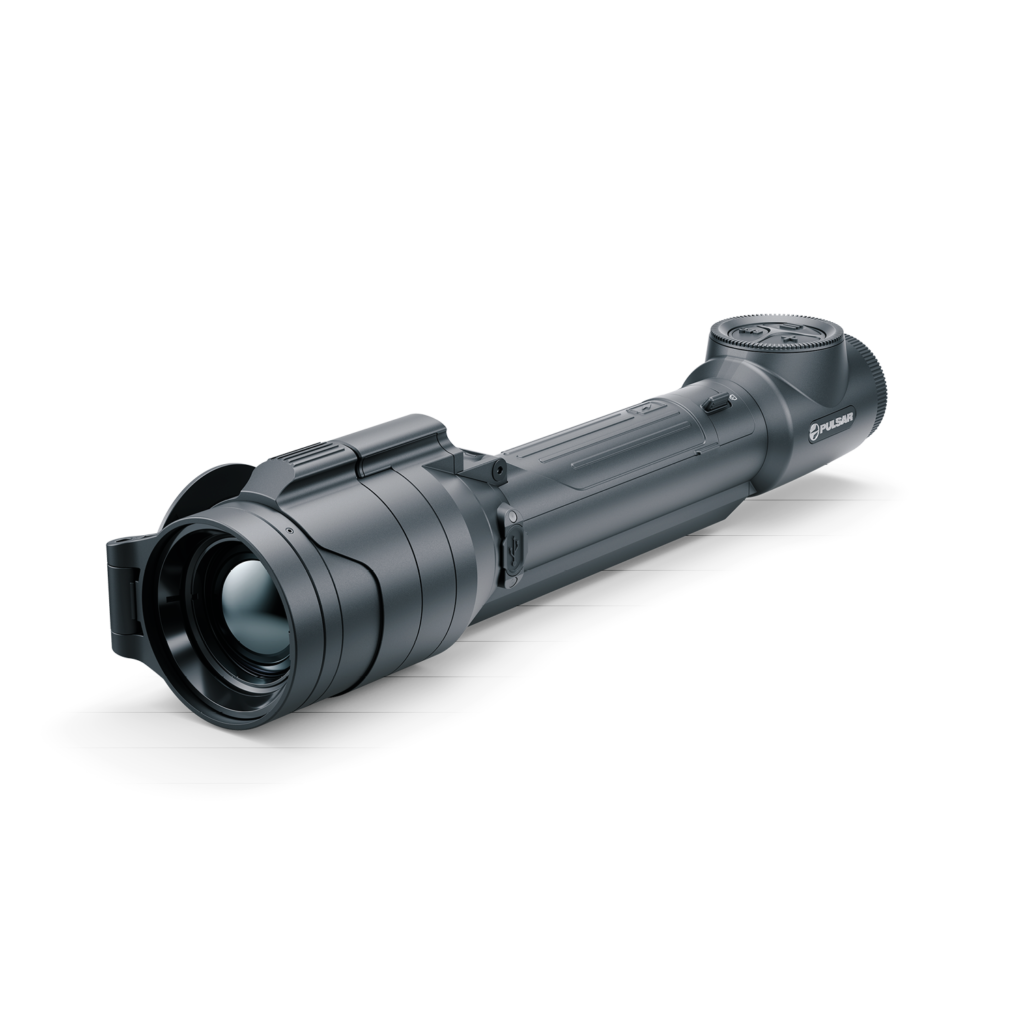
Pulsar Telos LRF XP50
This is the model that professional thermal reviewers have called the best thermal monocular on the market, and the specifications support that claim.
Products by Category
-
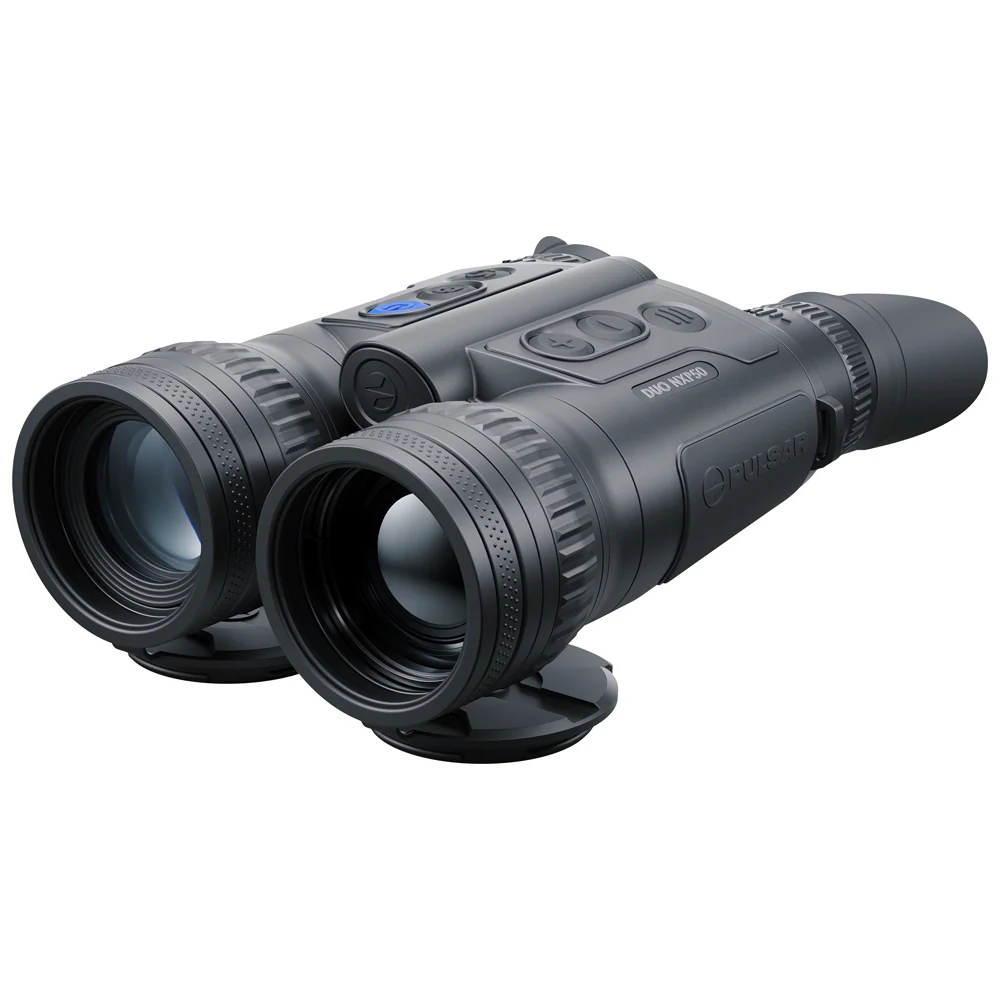
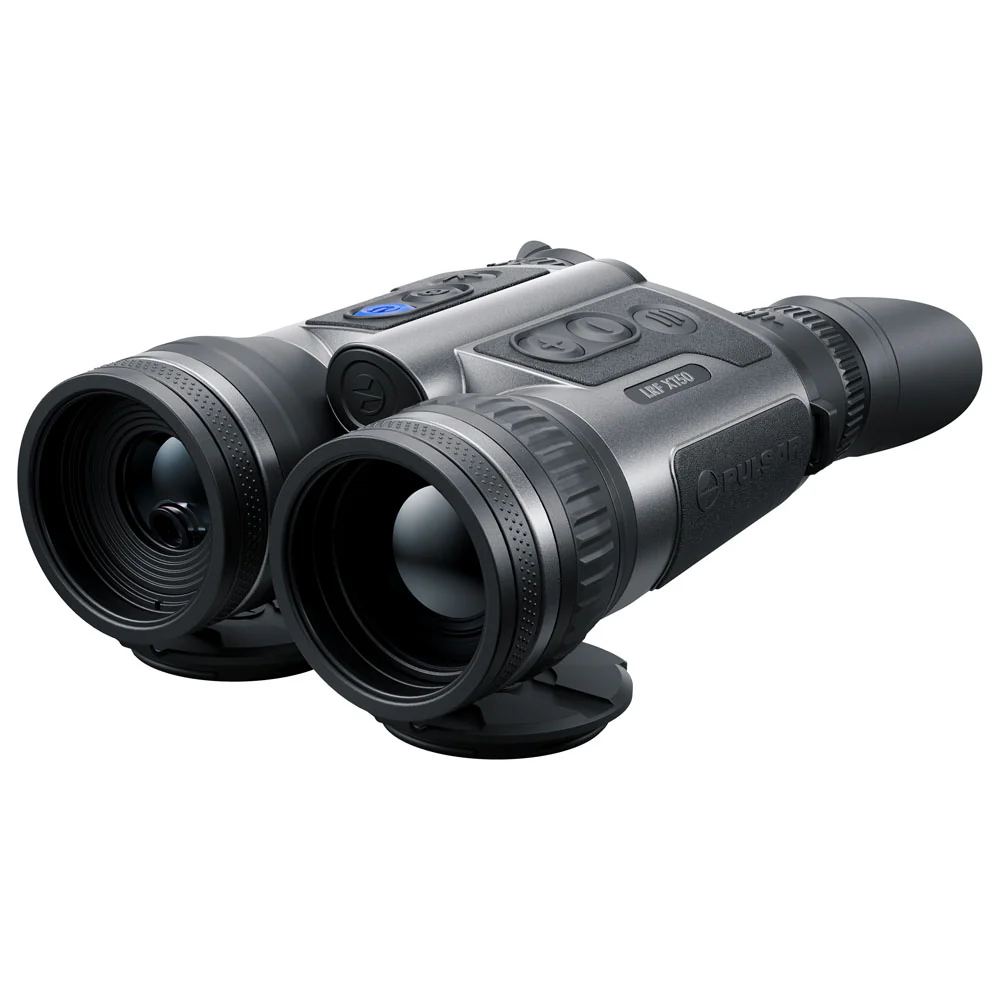
Pulsar Merger Duo NXP50 Multispectral Thermal & Night Vision Binocular
-
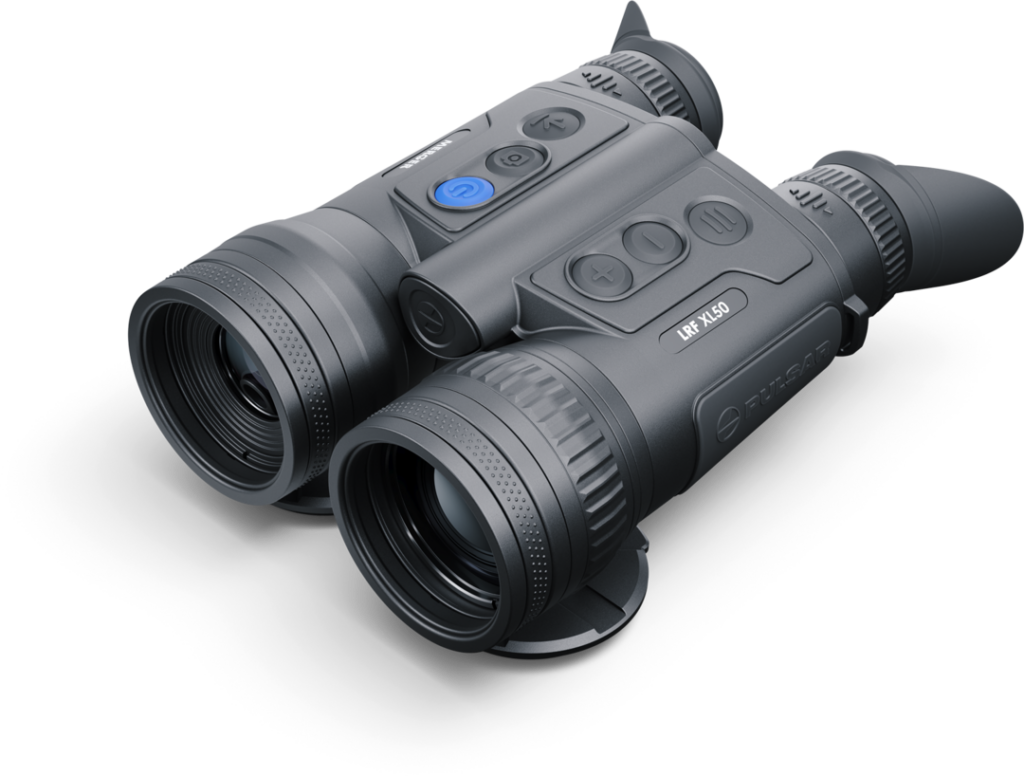
Pulsar Merger LRF XL50 Thermal Imaging Binocular
-
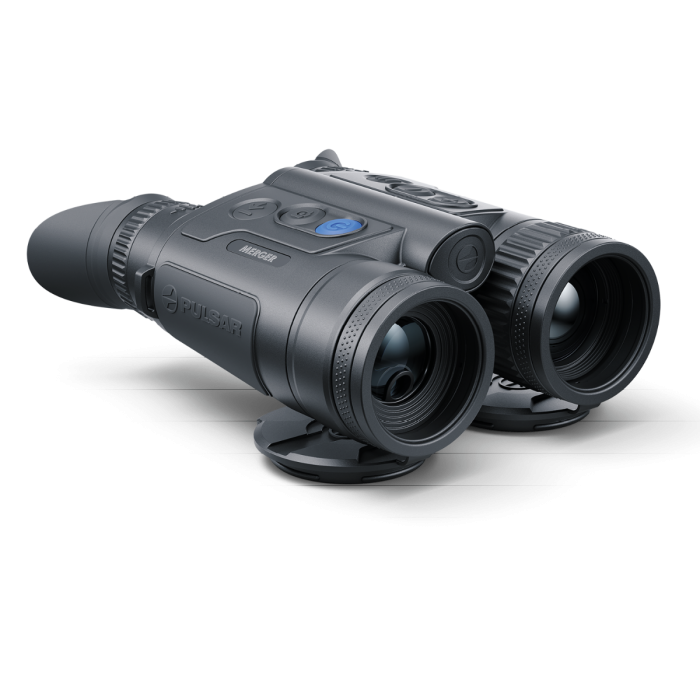
Pulsar Merger LRF XP35 Thermal Imaging Binocular
-
Pulsar Merger LRF XT50 Thermal Imaging Binocular
-
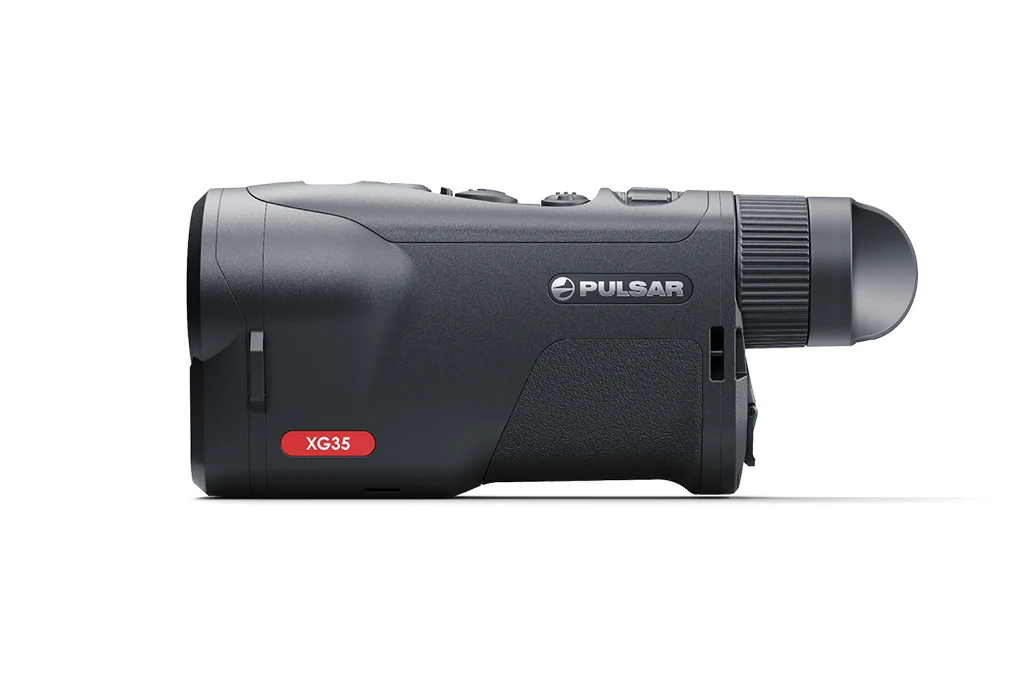
Pulsar Oryx LRF XG35 Thermal Imaging Monocular
-
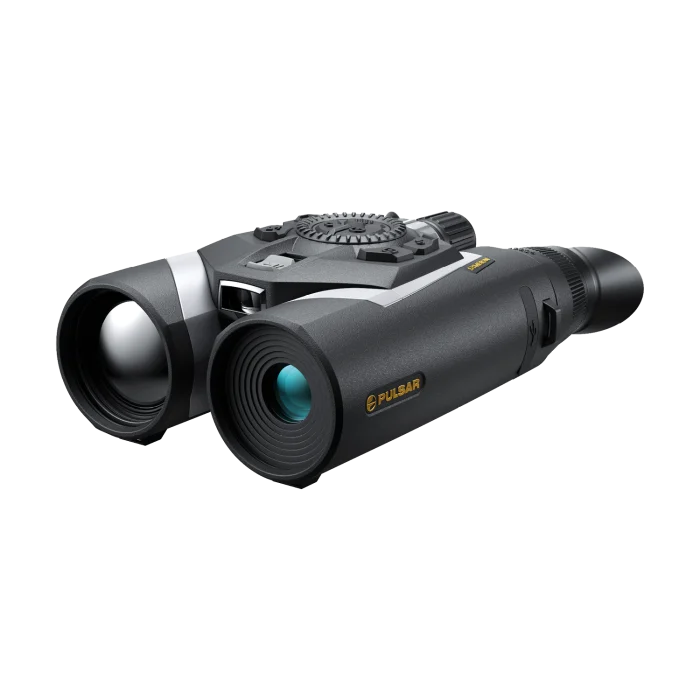
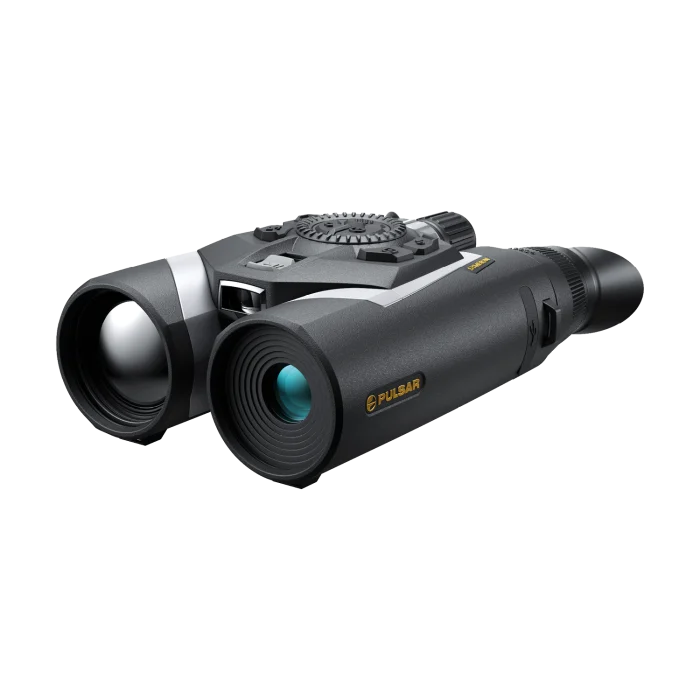
Pulsar Symbion LRF DXR50 Multispectral Thermal Binocular
-
Pulsar Symbion LRF DXT50 Multispectral Thermal Binocular
-
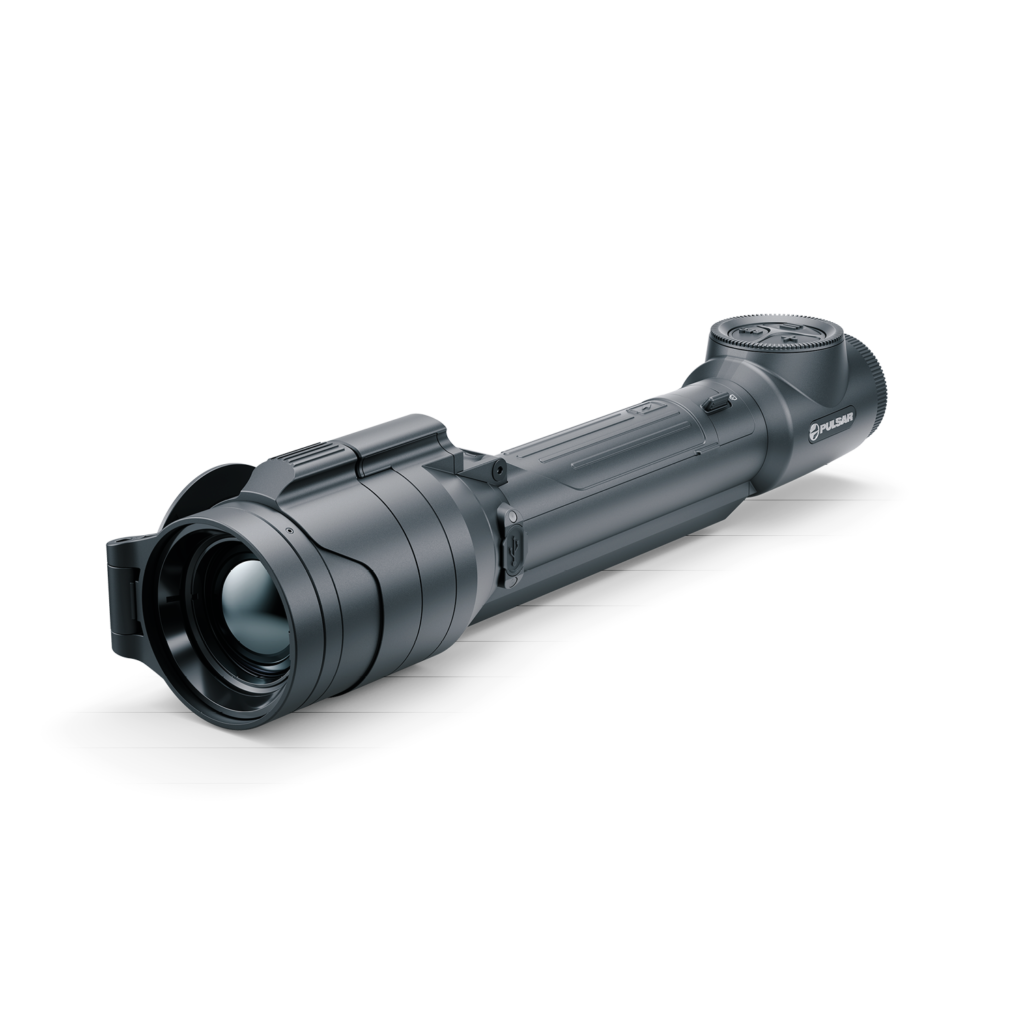
Pulsar Talion XG35 Thermal Imaging Riflescope
-
Pulsar Talion XQ35 Pro Thermal Imaging Riflescope
| Specification | Value |
|---|---|
| Sensor | 640×480 at 17 µm, Lynred (France) |
| NETD | <18 mK |
| Lens | 50 mm F1.0 germanium |
| Detection | ~1,800 m |
| Display | 1024×768 Super AMOLED |
| Magnification | 2.5-10x |
| Rangefinder | 1,000 m, ±1 m, continuous scan mode |
| Memory | 64 GB |
| Battery | LPS 7i, 8+ hours, USB-C, and wireless charging |
| Design | Modular, user-upgradeable |
An NETD of under 18mK is exceptional. Reviewers have noted that the sensitivity is of a kind normally found in professional and industrial thermal equipment costing many times more, and it is what makes the Telos hold a usable image in rain, fog, and the cold, low-contrast mornings that defeat lesser devices. Pulsar’s Image Boost processing handles low-contrast scenes such as grass, water, and sky particularly well.
The Telos LRF XL50 sits above it with a 1280×1024 HD sensor and detection beyond 2,300 m, for buyers who want maximum resolution and digital zoom headroom.
The Pulsar specification most buyers miss
The single most useful specification on this page, which Pulsar does not advertise, is the sensitivity of its sensors.
Pulsar’s sensors fall into two groups, and sensitivity does not follow resolution the way you would expect:
| Model | Sensor | Pixel pitch | NETD |
|---|---|---|---|
| Telos LRF XP50 | 640×480 | 17 µm | <18 mK |
| Axion 2 XQ35 Pro | 384×288 | 17 µm | <25 mK |
| Axion 2 XG35 | 640×480 | 12 µm | <40 mK |
| Merger LRF XL50 | 1024×768 | 12 µm | <40 mK |
| Krypton 2 FXG50 | 640×480 | 12 µm | <40 mK |
The pattern is consistent: Pulsar’s 17µm sensors are far more sensitive than their 12µm sensors.
There is real physics behind it. A 17µm pixel is larger than a 12µm one, so it collects more infrared energy per element. More energy per pixel means a stronger signal against the sensor’s own noise, which is precisely what NETD measures. Smaller 12µm pixels let manufacturers fit more resolution behind a smaller, cheaper lens, but each pixel receives less.
What this means in practice. The Axion 2 XG35 has more pixels than the Telos XP50. The Telos has better sensitivity. On a cold, dry night, the XG35’s extra resolution shows more detail. On a wet, low-contrast night the Telos will be clearly better, and owners who have used both report exactly that: the Axion struggles in damp conditions where the Telos holds its picture.
So when you compare a Pulsar thermal monocular against another Pulsar, do not assume the higher resolution model is the better device. Ask what your typical night looks like.
Why People Regret Buying the XG35
On paper, the XG35 looks like the obvious winner because it packs a 640×480 resolution sensor compared to the XQ35 Pro’s 384×288. People drop extra money thinking “higher resolution means better overall image quality,” only to be disappointed in the field for two big reasons:
1. Terrible Performance in Humid, Foggy, or Cold Weather
The XG35 uses a 12-micron sensor, but its thermal sensitivity (NETD) isn’t as tight as the Pro line. When you hit heavy fog, high humidity, dew, or rain, the XG35’s image turns into a flat, gray wash. You lose background detail completely.
2. Low Base Magnification
Because the XG35 fits a 640 sensor behind a small 35mm lens, its base optical magnification is lower (around 2x).
- To identify a coyote or hog at 150+ yards, you have to digitally zoom in.
- As soon as you zoom in digitally, you lose that crisp 640 advantage, and the image pixelates.
The XG35 Buyer Regret Quote:
“I paid an extra thousand bucks for a 640 sensor, but as soon as the humidity spikes or I zoom in past base magnification, my buddy’s cheaper XQ35 Pro looks clearer than mine.”
Why People Rarely Regret the XQ35 Pro
The XQ35 Pro might only have a 384×288 sensor, but it carries a sub-25 mK NETD thermal sensitivity rating.
1. It Cuts Through Bad Weather
The “Pro” sensor is hyper-sensitive to tiny temperature differences. In wet, cold, or high-humidity conditions, the XQ35 Pro still draws clear outlines of trees, grass, and animal features.
2. Higher Native Optical Zoom
With a 2.5x base optical magnification, you get a clear, optical view of target identification before you ever touch a digital zoom button.
The Verdict
- Buy the XQ35 Pro if you want the best value, hunt in humid/rainy/foggy environments, and want solid native optical zoom without overspending.
- Only get the XG35 if you hunt in wide-open, dry/arid landscapes (like Texas brush or desert) where you need a wide field of view for scanning close-range targets on base power.
Pulsar versus the competition
We stock the alternatives, so here is the honest comparison.
| Model | Sensor | NETD | Detection | Notable |
|---|---|---|---|---|
| Pulsar Telos LRF XP50 | 640 17 µm | <18 mK | 1,800 m | Best software, modular, 1,000 m LRF |
| Pulsar Axion 2 XG35 | 640 12 µm | <40 mK | 1,750 m | Compact, 1024×768 display |
| ThermTec Wild Pro | 640 12 µm | <15 mK | Long | 1600×1200 display, 1,000 m LRF |
| ThermTec Cyclone | 640 12 µm | <20 mK | Short | 255 g, 20 h battery, €899 |
| AGM Sidewinder | 384 12 µm | ≤20 mK | Mid | 64 GB, five-year warranty |
| HIKMICRO Lynx 3.0 | 256 / 384 | Varies | Short | From €329 |
Where Pulsar wins. Build quality, software, battery systems, resale value, and, at the top of the range, genuine sensitivity leadership with the Telos. Nobody else offers a modular, upgradeable device.
Where Pulsar loses. Price and the sensitivity of its 12 µm compacts. A ThermTec Cyclone at €899 gives you a 640 sensor at under 20 mK and 20 hours of battery, which on paper beats the Axion 2 XG35 on both sensitivity and endurance for less money. HIKMICRO owns the budget end outright, starting from around €329.
The honest summary. If you want the best image in bad weather and the best long-term ownership experience, the Telos LRF XP50 is difficult to beat and deserves its reputation. If you want the most capability per euro, look at ThermTec. For your first thermal, especially if you’re on a tight budget, HIKMICRO is worth considering. Our full thermal monocular guide compares every brand in detail.
Pulsar’s other thermal lines
If you are researching a Pulsar thermal monocular, it is worth knowing what else the brand makes, because the right answer is sometimes not a monocular at all.
Merger is the thermal binocular line. The Merger binoculars have two eyepieces, which means much less eye strain over a long session, and they also use the same Stream Vision 2 ecosystem. The Merger LRF XP50 uses a 640×480 17 µm sensor at under 25 mK; the XL50 moves to a 1024×768 HD sensor but, following the same pattern described above, drops to under 40 mK. If you sit and watch the ground for hours rather than scanning in bursts, compare against our thermal binocular guide.
Krypton is the clip-on line that mounts in front of an existing day scope, converting it for night use without re-zeroing. The Krypton 2 FXG50 runs a 640×480 12 µm sensor at under 40 mK with a fast F50/1.0 lens, and like several ThermTec clip-ons, it doubles as a handheld monocular. See our thermal clip on guide for the cross-brand comparison.
Thermion is the riflescope line for when the monocular has found the animal and you need to take the shot. Compared in our thermal scope guide.
The standard setup for most hunters is a monocular for finding and a scope or clip-on for shooting. Never scan with a rifle-mounted device.
Using a Pulsar monocular in the field
A few things specific to these devices are worth knowing before your first outing.
Set the diopter properly. The eyepiece adjusts to your eye. Most people never touch it and then wonder why the image looks soft. Focus on the on-screen graphics first using the dioptre ring, then use the lens focus for the scene.
Learn Image Boost. Pulsar’s processing genuinely helps with low-contrast scenes, such as wet grass, water, and open sky. It is worth understanding what it does rather than leaving everything on default.
Use two palettes. White-hot finds animals fastest because your eye catches bright shapes quickly. Black-hot often shows more detail once you have found something. Most experienced users scan with one setting and identify with the other.
Carry the spare battery already charged. This is obvious, yet it remains the most common complaint we hear.
Let it settle. Bringing a warm device from a heated vehicle into cold night air degrades the image until temperatures equalize. Please allow a few minutes before making a judgment.
Common mistakes when buying a Pulsar
Assuming higher resolution means a better image. As the sensitivity table above shows, this assumption is often wrong within Pulsar’s own range.
Buying too many lenses. A 50mm lens narrows the field of view considerably. Finding a moving fox through a tight field is genuinely harder than through a wide one, and most people scan more than they reach.
You will be paying for a rangefinder that you will not use. If you scan and then shoot with a scope that has its own ranging, the monocular’s LRF is a duplicated cost.
Comparing a Pulsar to a competitor on price alone. Factor in resale value. A Pulsar costs 30 percent more but sells for 50 percent more three years later, making it the less expensive device.
Overlooking the display. A superb sensor behind a modest screen is a real limitation, and it is the known weakness of the XQ35 Pro.
Which Pulsar thermal monocular should you buy?
Buy the Axion XQ19 if you want something genuinely pocketable for close, brushy ground and you value a wide field over reach.
Buy the Axion XQ30 Pro if you want the best-balanced compact. The 30mm lens is the sweet spot of the Axion range.
Buy the Axion 2 XQ35 Pro if you want more reach while keeping the sensitive 17 µm sensor and you can live with a modest display.
Buy the Axion 2 XG35 if you hunt open ground in mostly dry, cold conditions and want maximum resolution in a compact body.
Buy the Telos LRF XP50 if image quality in challenging weather matters more than size or price. It is the best device Pulsar makes and one of the best handheld thermals anyone makes.
Add LRF versions only if you actually need distance readings. If you scan and then shoot with a separate optic, the rangefinder earns its cost. If you only scan, it will skip.

Pulsar accessories and batteries
APS5 powers the Axion line and swaps in seconds. Carry a spare, and battery life becomes a non-issue.
LPS 7i powers Telos, gives 8 or more hours, charges over USB-C from any phone charger or power bank, and supports wireless charging.
Stream Vision 2 handles firmware updates, live streaming, remote control, and cloud storage. Registered users get cloud space for footage.
Buy at least one spare battery with any Pulsar monocular. It is the single most useful accessory, and it costs a fraction of the device.
Frequently asked questions
Which Pulsar thermal monocular is best?
The Telos LRF XP50 is the best Pulsar makes, with a 640×480 17 µm sensor at under 18 mK, a 50 mm F1.0 lens, 1,800 m detection, and a 1,000 m rangefinder. For a compact device, the Axion XQ30 Pro offers the best balance of reach, field of view, and sensitivity.
What do XQ, XG, and XP mean on a Pulsar?
They describe the sensor. XQ is 384×288 at 17µm, XG is 640×480 at 12µm, XP is 640×480 at 17µm, and XL is an HD sensor at 12µm. The number after the letters is the objective lens in millimeters, and LRF means a built-in laser rangefinder.
Is the Pulsar Axion 2 XG35 better than the XQ35 Pro?
Not automatically, and the result surprises people. The XG35 has a higher-resolution 640 sensor, but its NETD is under 40 mK, while the XQ35 Pro has a NETD of under 25 mK. The XG35 shows more detail in good conditions; the XQ35 Pro holds a cleaner image in rain and fog. Choose by your typical weather, not by the pixel count.
How far can a Pulsar thermal monocular see?
Detection ranges run from roughly 750m on the compact Axion XQ19 to about 1,800m on the Telos LRF XP50 and beyond 2,300m on the Telos LRF XL50. Those are detection figures for a large warm target. Identifying what an animal actually is happens at a fraction of that distance.
Is Pulsar worth the extra money?
At the top of the range, yes. The sensitivity of the Telos LRF XP50, which is below 18 mK, is genuinely class-leading, and Pulsar’s build, software, and resale value are real advantages that no specification sheet captures. In the mid-range, the case is weaker, since ThermTec and AGM offer better sensitivity per euro. Decide whether you are buying capability or ownership experience.
What is the cheapest Pulsar thermal monocular?
The Axion XQ19 is the entry point, with a 384×288 17 µm sensor, a wide 19 mm lens, and a detection range of roughly 750 m. If your budget is below Pulsar’s entry level, a HIKMICRO Lynx from around €329 is the honest alternative rather than stretching.
Do Pulsar thermal monoculars have a rangefinder?
Some do. The Telos LRF models and the LRF versions of the Axion 2 include a 1,000 m laser rangefinder with accuracy around one meter and a continuous scan mode. The standard Axion XQ19 and XQ30 Pro do not have a laser rangefinder.
Can a Pulsar thermal monocular be used in daylight?
Yes. Thermal reads heat rather than light, so it works in full sun, shade, and total darkness, and daylight will not damage it the way it would damage an image-intensifier night vision tube. Contrast is often lower in bright sun because the ground warms up.
What is the difference between Telos and Helion?
Telos replaced the Helion 2 family as Pulsar’s flagship monocular line. The major change is modularity: Telos components can be upgraded after purchase rather than requiring a whole new device. Image quality is broadly comparable to the Helion 2 XP50 Pro it replaced.
How long does a Pulsar thermal monocular battery last?
Roughly 7 hours on the Axion 2 XG35, around 11 hours on the XQ35 Pro, and 8 or more hours on the Telos. All use quick-swap packs, so carrying one spare effectively removes the limit.
Is Pulsar better than ThermTec?
They win on different things. Pulsar leads on build, software, resale, and, in the Telos, sensitivity. ThermTec leads on specifications per euro, with the Wild Pro at under 15 mK and the Cyclone offering a 640 sensor at €899. Compare the specific models rather than the badges.
Where is Pulsar made?
Pulsar devices are made by Yukon Advanced Optics Worldwide in Lithuania, which makes them one of the few genuinely European-manufactured options in thermal. The sensors in several models come from Lynred in France.
Browse the Pulsar range, compare it against ThermTec, HIKMICRO, and AGM, or read our complete thermal monocular guide. Also see thermal scopes, clip-ons, and thermal binoculars. Not sure which Pulsar is best for your hunting ground? Tell us where and what you hunt, and we will advise across every brand we carry.