
Best Thermal Scope for Coyote Hunting: 2026 Buyer’s Guide
The best thermal scope for coyote hunting is one with a 384 or 640 sensor, thermal sensitivity below 20 mK, and enough magnification and range to identify a coyote across open ground at night. Coyotes are shot at distance, often on the move, and frequently against low-contrast winter backgrounds, so the scope that suits them is not always the one that suits close-cover hog hunting.
This guide shows you how to choose the right one, with picks by budget and an honest comparison across every brand we carry. We stock them all, so unlike the manufacturer guides you will compare these models against; we have no reason to push one make.
New to thermal entirely? Start with our complete guide to thermal imaging for hunting, or if you are still choosing a device type, read thermal monocular vs scope vs clip-on. Browse the full thermal riflescope range any time.
Quick answer: best thermal scope for coyote hunting
Short on time? Here is the shortlist.
- Best all-round: a 384 or 640 scope with a rangefinder, such as the Pulsar Thermion 2 LRF.
- Best long-range flagship: a 640 sensor with LRF and ballistics, like the ThermTec Ares 650 LRF.
- Best budget entry: the AGM Rattler line gives real capability under most budgets.
- The spec that matters most for coyotes: thermal sensitivity (NETD). A coyote against cold winter ground is low-contrast, so aim for under 20 mK.
- Range you actually need: most coyotes are shot inside 300 yards; identification, not detection, is the limit.
- Pair it with a monocular. Scan and find with a thermal monocular, then shoot with the scope.
Now the full guide.
Why coyote hunting demands a specific thermal scope
Coyotes are one of the more demanding quads for a thermal scope, and understanding why helps you choose the right specs.
They are shot at a distance. Unlike hogs, which often appear in or near cover at moderate range, coyotes are commonly called and shot across open fields and pastures, frequently out past 150 to 300 yards. That puts a premium on resolution and useful magnification, because you need to identify the animal and place a precise shot far out.
They are often low-contrast. A coyote’s coat against frosted winter stubble or cold pasture can give a weaker heat signature than a hog’s bare skin against warm ground. That is precisely where thermal sensitivity (NETD) earns its keep: a sub-20 mK sensor separates a coyote from cold ground where a less sensitive scope shows a vague blur.
They move, and they are wary. Called coyotes often come in fast, circle downwind, and rarely stand still for long. A smooth 50 Hz image and a scope you can get on target quickly matter more than they do for a stationary hog.
They are frequently shot in cold weather. Coyote season peaks in winter, when cold, damp air and long sessions test both the sensor and the battery. Rugged build and real battery life matter.
Put together, the best thermal scope for coyote hunting leans toward good resolution, low NETD, useful magnification for distance, and a rangefinder more than a close-cover hog scope does.
What makes a great thermal scope for coyotes?
A great coyote thermal scope gets five things right.
Sensor resolution. The sensor resolution is 256, 384, or 640, and it determines how far you can identify a coyote rather than just detect heat. For coyotes at typical calling distances, a 384 sensor is the practical choice, and a 640 sensor is worth the extra cost on genuinely open ground. See 384 vs 640 thermal.
Thermal sensitivity (NETD). Below 20 mK keeps the image clear in the damp, low-contrast winter conditions that coyote hunters most often face. This matters more for coyotes than for almost any other quarry.
Detection and identification range. More on the honest math below, but you want enough real identification range for the distances you actually shoot, not the biggest advertised detection number.
A smooth image and quick handling. A 50 Hz refresh rate keeps a moving, circling coyote sharp, and a scope you can get on target fast turns a passing shot into a taken one.
It has a rugged, weatherproof build and a recoil rating that matches your caliber. It has to hold zero on your rifle and keep working through a cold, wet night.
A built-in laser rangefinder and ballistic calculator, as on the Pulsar Thermion 2 LRF, turn a good coyote scope into a confident long-range tool, because knowing the exact distance to a coyote at 250 yards is the difference between a clean shot and a guess.
Detection range vs. identification: the coyote truth
Here is the thing every spec sheet glosses over, and it matters more for coyotes than most quarry. The advertised detection range is not how far you can tell it is a coyote.
Detection means “something warm is there.” Identification, telling a coyote from a fox, a dog, or a deer, and placing an ethical shot, happens at roughly an eighth of the detection figure in the conservative reading, and cold, damp air shortens it further.
| Advertised detection | Realistic recognition (~25%) | Realistic identification (~12.5%) |
|---|---|---|
| 1,800 m | ~450 m | ~225 m |
| 2,400 m | ~600 m | ~300 m |
| 2,600 m | ~650 m | ~325 m |
Since most coyotes are shot inside 300 yards, a scope with a genuine 2,000 m plus detection figure gives you a comfortable identification range for real coyote distances. Do not overpay for a detection number you will never use, and do not assume a big detection figure means a long identification range. Sensor resolution and NETD drive real identification distance. More on how far thermal really sees.
Best thermal scope for coyote hunting by budget
We carry every brand, so these picks are honest across the price range, not just one make.
| Category | Pick | Sensor | Notes |
|---|---|---|---|
| Best all-round with a rangefinder | Pulsar Thermion 2 LRF | up to HD | 800m LRF + ballistics, best software |
| Best value, no LRF | Pulsar Thermion 2 | 384/640 | Same handling, lower price |
| Best long-range flagship | ThermTec Ares 650 LRF | 640 | 1,000 m LRF, open-country reach |
| Best budget entry | AGM Rattler TS35-384 | 384 | Real capability, lowest spend |
Compare the full range on the thermal riflescopes page.
Best budget thermal scope for coyote hunting
If money is tight, the AGM Rattler line gives genuine coyote capability at the lowest sensible spend, with a 384 sensor and a 35 mm lens that suits calling distances. It won’t match a flagship for reach or software, but for a hunter shooting coyotes within 250 yards, it does the job.
Best thermal scope for coyote hunting under $1000
Under $1,000 you are in entry-scope territory, where a compact 384 scope with a shorter lens is the realistic choice. Expect solid performance at the typical calling range and less reach on wide-open ground. If you can stretch the budget, the jump to a mid-384 or 640 scope with better NETD is the single biggest upgrade for coyote work, as sensitivity is what separates coyotes from cold ground.
Best thermal scope with rangefinder for coyote hunting
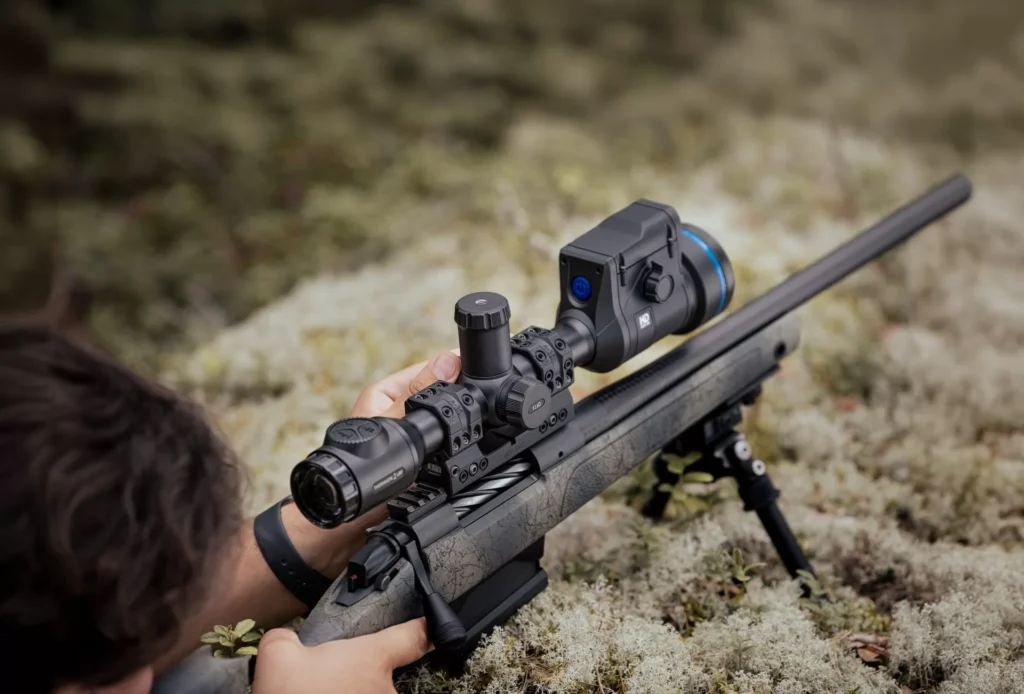
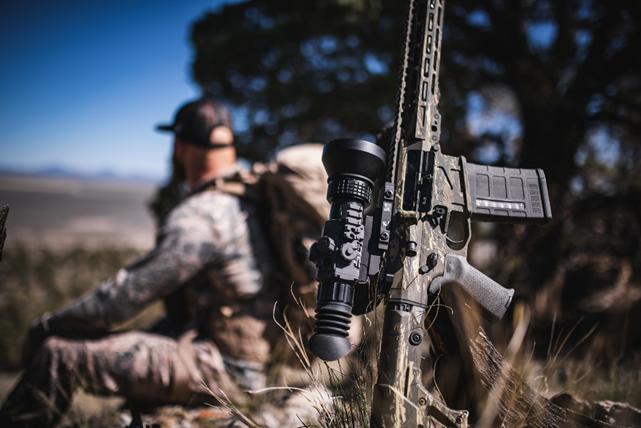
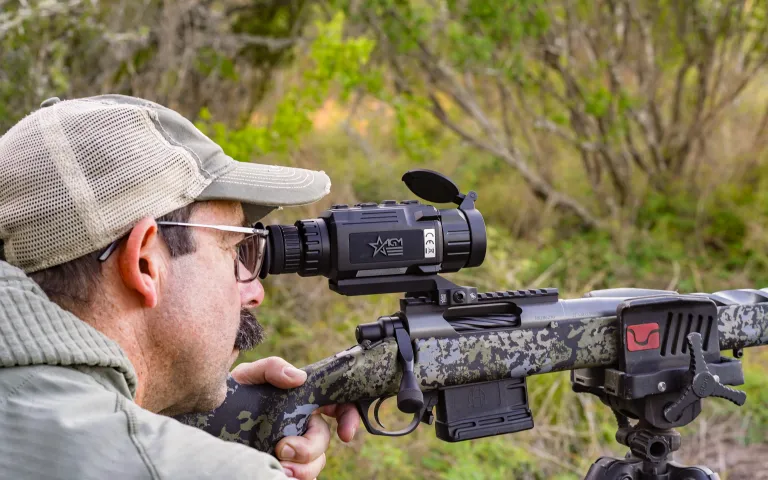
For coyotes shot at distance, a built-in rangefinder is genuinely worth it. The Pulsar Thermion 2 LRF pairs a rangefinder with a ballistic calculator, so you range a coyote at 250 yards and get a corrected aiming point rather than guessing holdover. On open ground, that is the difference between a clean shot and a miss.
Cross-brand comparison
We carry every major thermal brand, so here is the honest cross-brand view for coyote-capable scopes.
| Brand | Coyote-relevant strength | Watch for |
|---|---|---|
| Pulsar | Best software, LRF + ballistics, resale | Premium price |
| AGM | Value entry, 5-year warranty | Older generations sit alongside new |
| ThermTec | Sensitivity per euro, long-range LRF models | Less brand recognition |
| HIKMICRO | Wide range, strong value | Fewer flagship halo models |
| ATN | Feature-rich, ballistics, video | Optical quality per dollar varies. |
The pattern that matters for coyotes: check NETD and sensor resolution together on any brand, because those two drive real identification range on a low-contrast coyote far more than the headline detection figure or the magnification number.
Best thermal scope by use case (all quarry)
Coyotes are the focus here, but the same scope often has to cover other quarry too. Match the scope to your main hunting.
| You hunt. | Look for | Sensor |
|---|---|---|
| Coyotes and predators at a distance | Higher resolution, longer lens, rangefinder, low NETD | 384 or 640 |
| Boar in woodland and field edges | Wide field of view, mid magnification | 384 |
| Deer management | Clear identification, moderate range | 384 |
| Open hill and long range | 640 sensors, LRF, ballistic calculator | 640 |
| Tight budget, close range | Compact 384 scope, shorter lens | 384 |
For hog-specific advice, the best thermal scope for hog hunting leans toward a wide field of view and a 384 sensor at moderate range, since hogs are larger, warmer, and often shot closer than coyotes. For deer, prioritize clean identification over reach.
Dedicated scope or clip-on for coyotes?
Before you buy a dedicated coyote scope, decide whether a clip-on suits you better. A thermal clip-on mounts in front of your day scope and keeps its zero, so one rifle works day and night, which suits a hunter who also shoots coyotes in daylight. A dedicated thermal scope gives a slightly cleaner, more integrated night image and is the choice for a rifle set up primarily for night predator work. We compare them fully in thermal monocular vs scope vs clip-on.
Pair your scope with a monocular.
The most effective coyote setup is two devices: a thermal monocular to scan and find and the scope to take the shot. You keep the wide, fast monocular moving to pick up an incoming coyote, then bring the rifle up only when you have identified it. Scanning with the scope alone means sweeping a loaded rifle across the field, which is both slower and unsafe. This is why experienced predator hunters almost always carry both.
How to choose your coyote thermal scope
Work in this order. Set your maximum realistic shooting range and your budget first. Then choose the highest sensor resolution you can afford, because image quality matters more than magnification. Then pick the lens for your distance: a shorter lens for coyotes at a closer range and a longer one for open-country shots. Finally, decide whether you want a built-in rangefinder and ballistic calculator, which for coyotes at a distance are genuinely worth it. Tell us how and where you hunt coyotes, and we will match a scope to it.
Is thermal legal for coyote hunting?
In much of the US, coyotes are classed as non-game or nuisance predators, which is precisely the category where thermal is most often permitted, frequently year-round and at night on private land. That makes coyotes one of the most widely thermal-legal quarries in the country. But rules still vary by state; some require a night-hunting permit or restrict thermal to private land, and a few limit it further, so confirm your state’s current regulations before you hunt.
In Europe, coyotes are not a quarry, but the same principle applies to predator and fox control: handheld thermal for observation is broadly permitted, while weapon-mounted thermal scopes are the restricted category in many countries. We sell optics, not legal advice, so check your national and regional rules first.
Common mistakes Coyote hunters make
- Buying on detection range. A 2,600 m detection figure does not mean you identify a coyote at 2,600 m. Use the DRI math to determine the real identification range for your purchase.
- Skimping on NETD. A coyote against cold winter ground is low-contrast. Sensitivity, not resolution, is what pulls it out of the background.
- Over-magnifying. High digital zoom on a small sensor enlarges pixels, not detail. Choose sensor and lens first.
- Scanning with the scope. Sweeping a loaded rifle to locate coyotes is slow and unsafe. Scan with a monocular.
- Ignoring battery life. Coyote sessions run long in the cold. Choose removable batteries and carry spares.
- Forgetting the rangefinder. For coyotes shot past 150 yards, an LRF and ballistics turn a guess into a corrected aiming point.
Frequently asked questions
What is the best thermal scope for coyote hunting?
The best thermal scope for coyote hunting has a 384 or 640 sensor, a NETD below 20 mK, useful magnification for distance, and ideally a rangefinder. For an all-rounder, choose the Pulsar Thermion 2 LRF; for long-range open ground, go with a 640 flagship like the ThermTec Ares 650 LRF; and if you’re on a budget, consider the AGM Rattler line. The best choice matches your typical shooting range and budget, and sensitivity matters most because coyotes are low-contrast against cold ground.
What is the best budget thermal scope for coyote hunting?
The AGM Rattler line offers genuine coyote capability at the lowest sensible spend, with a 384 sensor and a lens suited to calling distances. It won’t match a flagship for reach or software, but for coyotes shot within about 250 yards, it does the job well. If you can stretch the budget, a better NETD is the upgrade that helps the most with low-contrast coyotes.
What is the best thermal scope for coyote hunting under $1000?
Under $1,000 you are in entry-scope territory, where a compact 384 scope with a shorter lens is realistic. Expect solid performance at the typical calling range and less reach on wide-open ground. The biggest available upgrade in this bracket is better thermal sensitivity, since that is what separates a coyote from cold ground.
What magnification do I need for coyote hunting?
Less than you might think, and base optical magnification matters more than digital zoom. For called coyotes at a moderate range, a base magnification around 2x to 4x with a wide field of view lets you find and follow an incoming animal. For open-ground shots at a distance, a higher base magnification and a longer lens help you identify far out. Choose the sensor and lens first, and let the useful magnification follow rather than chasing the biggest zoom number.
Do I need a 640 scope for coyotes, or is 384 enough?
For most coyote hunting, a 384 scope is enough and better value, identifying coyotes well at typical calling distances. A 640 scope is worth the extra cost only on genuinely open ground, where you shoot coyotes at long distances and need to identify them from far away. Spend on a 640 only if your coyote hunting really needs that extra reach.
What caliber pairs with a thermal scope for coyotes?
Common coyote calibers such as .223, .22-250, and 6.5 Grendel pair well with thermal scopes, and what matters for the optic is that its recoil rating suits your caliber so it holds zero. Any current hunting-grade thermal scope handles standard coyote calibers, but always check the recoil rating if you run something heavier.
Do I need a rangefinder for coyote hunting?
For coyotes shot past about 150 yards, yes, a built-in rangefinder is worth it. Ranging a coyote at 250 yards and getting a corrected aiming point from a ballistic calculator is far more reliable than guessing holdover. For close-called coyotes inside 100 yards, it matters less. Models like the Pulsar Thermion 2 LRF build both in.
How far can you shoot a coyote with a thermal scope?
Realistically, you can shoot a coyote as far as you can identify it and place an ethical shot, which for most setups is inside 300 yards and depends much more on your sensor, NETD, and magnification than on the advertised detection range. The identification range is roughly an eighth of the advertised detection figure, and cold, damp air shortens it. Be sure to match the scope to the distances you actually shoot.
Is thermal legal for coyote hunting?
In much of the US, yes, because coyotes are usually classed as non-game predators, the category where thermal is most often permitted, frequently at night on private land. Rules still vary by state, and some require permits. This material is for your state’s current regulations first. This material is general information, not legal advice.
Quick facts: best thermal scope for coyote hunting
| Best all-round sensor | 384 for most coyote work; 640 for open ground |
|---|---|
| Most important spec | NETD below 20 mK (coyotes are low-contrast) |
| Ideal refresh rate | 50 Hz for moving coyotes |
| Worth having | Built-in rangefinder and ballistic calculator |
| Real shooting range | Most coyotes shot inside 300 yards. |
| Typical spend | €1,500 to €3,000; entry from ~€1,000 |
| Best paired with | A thermal monocular for scanning |
| Legal status | Widely legal for coyotes in the US; check your state. |
Ready to choose your coyote scope? Browse thermal riflescopes across Pulsar, AGM, and HIKMICRO, or pair one with a thermal monocular for hunting. New to thermal? Start with the complete thermal imaging for the hunting guide, and see how much a thermal scope costs. Not sure what suits your ground? Please let us know your budget and typical range, and we will shortlist options from every brand we carry.