
Night Vision Binoculars: What Magnification Actually Buys You
A night vision binocular uses two independent optical channels to deliver a magnified, stereoscopic image in low light. Two things separate it from every other night vision format: magnification, which no goggle offers, and genuine depth perception, which no monocular can produce. Together, these features make it the right tool for one specific job: identifying something at a distance from a fixed position.
They also make it the wrong tool for almost everything else, and this is where buyers lose money. Magnification narrows your field of view and amplifies every tremor in your hands. It does not, contrary to almost everything written about these devices, let you see further into the dark. If your problem is finding things rather than examining them, a binocular is not what you need.
This guide gives you the numbers that matter. You will finish knowing why detection range and identification range respond differently to magnification, how to recognize a consumer digital device with a military generation label, what a genuine image intensifier binocular costs and why, and whether your use case calls for a binocular at all. Everything referenced ships from our Berlin warehouse.
Products by Category
-
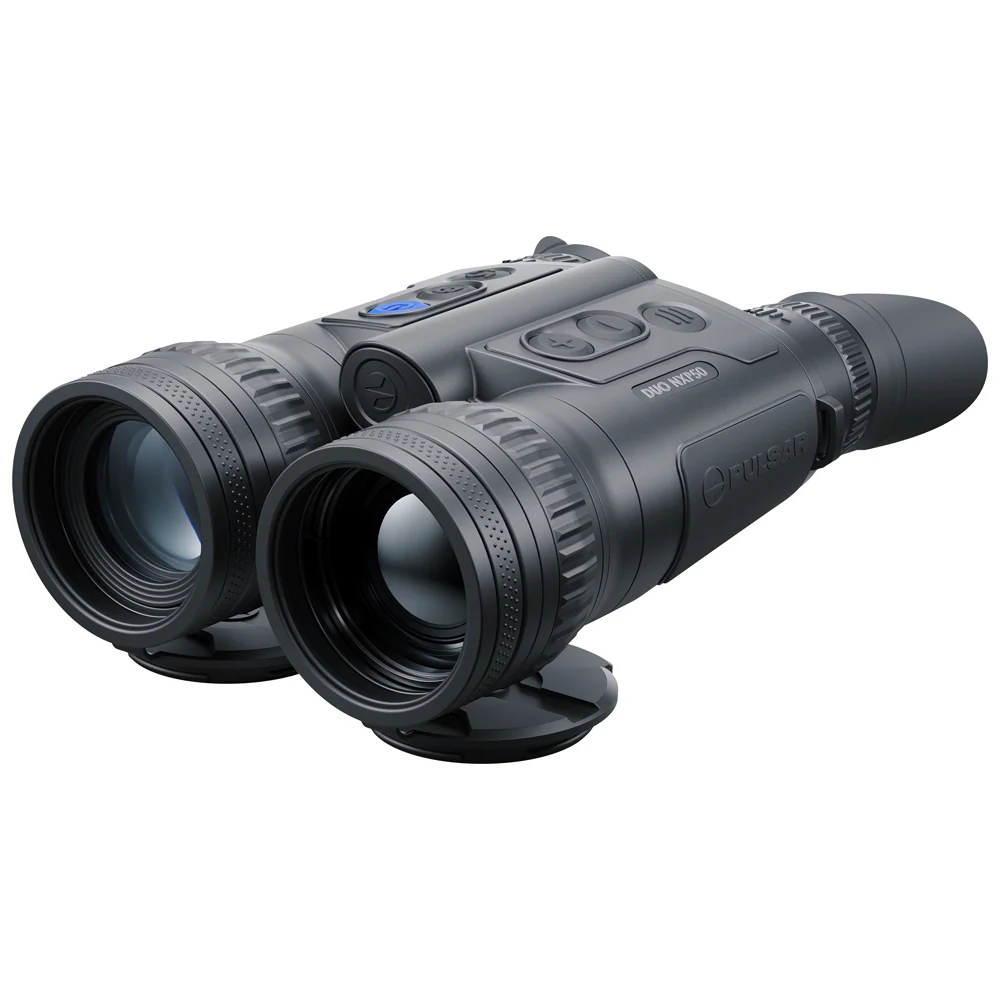
Pulsar Merger Duo NXP50 Multispectral Thermal & Night Vision Binocular
-
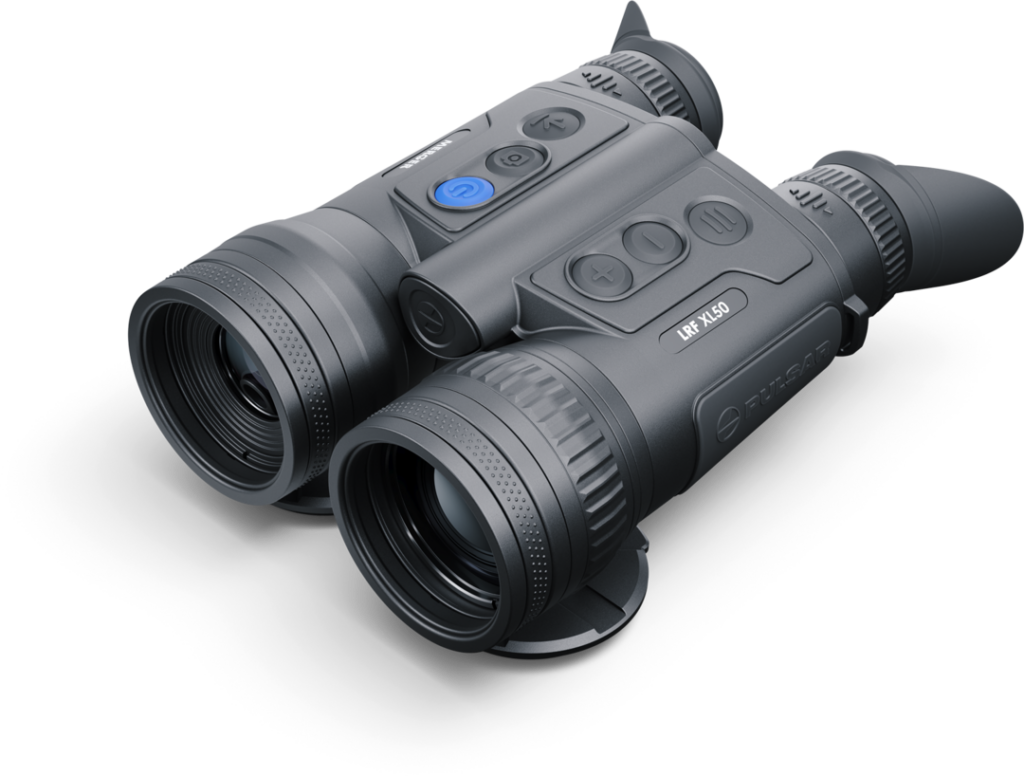
Pulsar Merger LRF XL50 Thermal Imaging Binocular
-
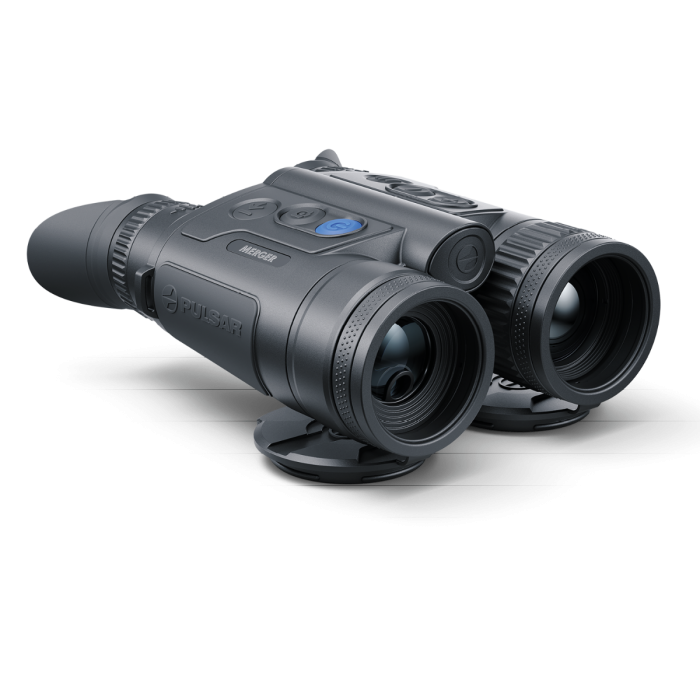
Pulsar Merger LRF XP35 Thermal Imaging Binocular
-
Pulsar Merger LRF XT50 Thermal Imaging Binocular
-
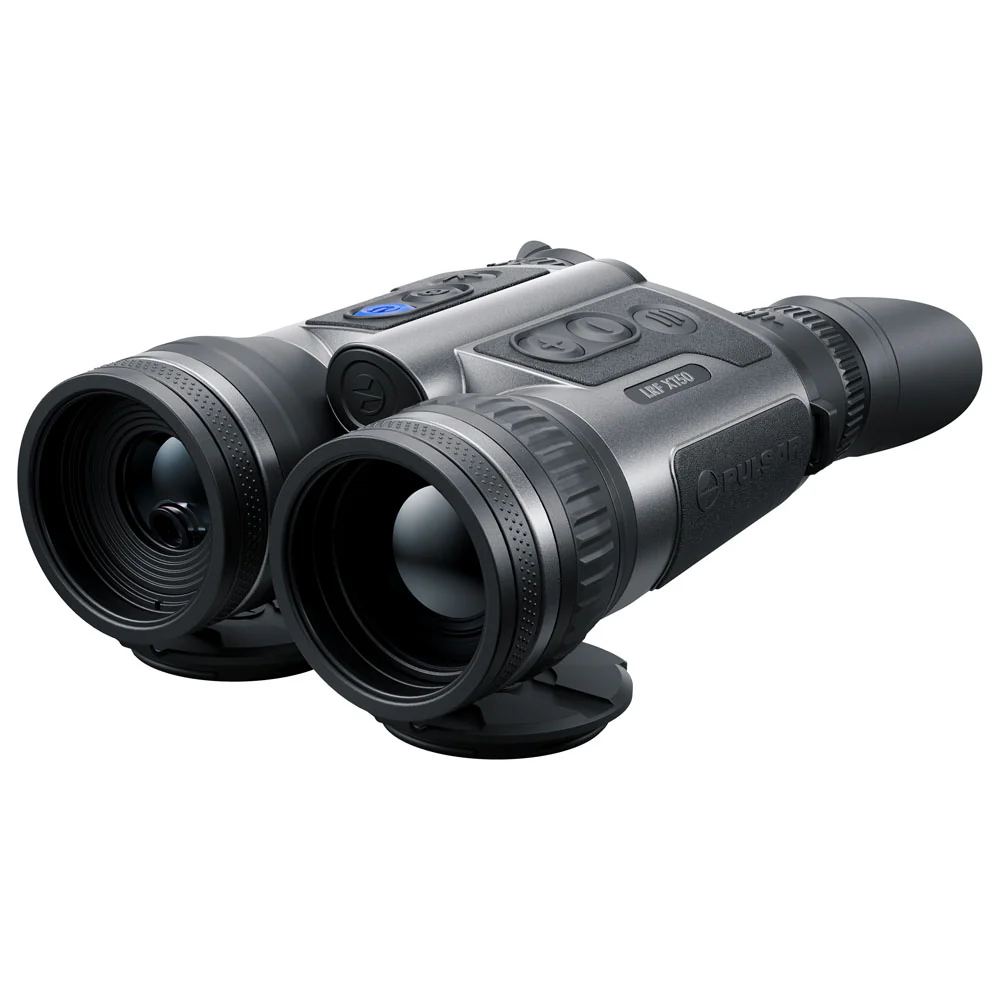
Pulsar Symbion LRF DXR50 Multispectral Thermal Binocular
-
Pulsar Symbion LRF DXT50 Multispectral Thermal Binocular
What Makes a Binocular Different From a Goggle
Three night vision formats, and the distinction is mechanical rather than a matter of taste.
A monocular has one tube and one eyepiece. It is versatile and light, leaving your other eye naturally dark-adapted. No depth perception, and normally no magnification.
A goggle is a headwear with two eyepieces and runs at 1x. The 1x is deliberate. Magnification destroys your ability to judge terrain and move, so goggles do not have it. Goggles split further into bi-ocular, where one tube feeds both eyes and there is no depth, and dual tube, where two independent tubes produce genuine stereoscopic depth. That distinction is covered in dual-tube night vision.
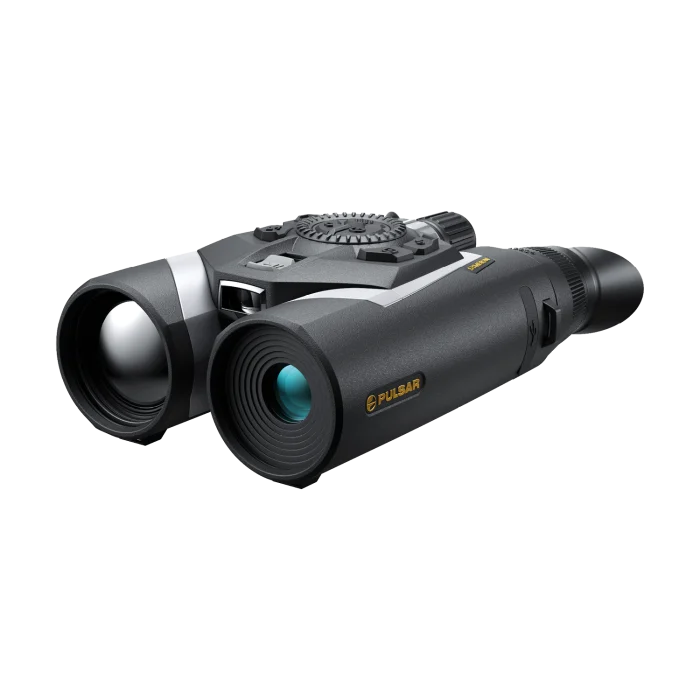
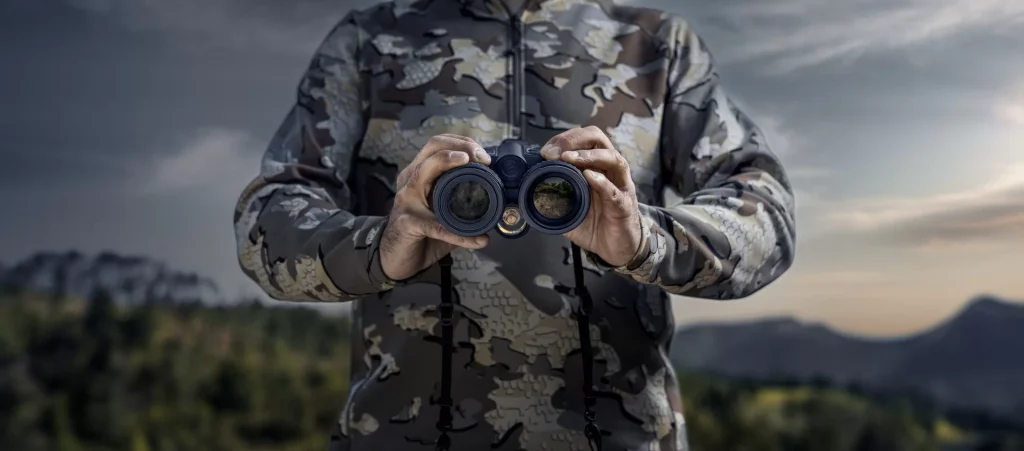
A binocular has two tubes, two eyepieces, depth perception, and magnification. It is handheld or tripod mounted, never head worn, because a magnified image on your face makes movement impossible.
| Monocular | Bifocal goggle | Dual-tube goggle | Binocular | |
|---|---|---|---|---|
| Tubes | 1 | 1 | 2 | 2 |
| Depth perception | No | No | Yes. | Yes. |
| Magnification | Rarely | No | No | 5x or 8x |
| Hands free | With mount | Yes. | Yes. | No |
| Preserves dark adaptation | Yes, one eye | No | No | No |
| Best for | Versatility | Entry hands-free | Moving in darkness | Identifying at a distance |
| Our range from | €2,100 | €2,900 | $7,150 | $3,520 |
The one-line summary: goggles are for moving, monoculars are for everything, and binoculars are for looking closely at something specific.
The Magnification Myth
This is the most important section on the page, and almost nothing written about night vision binoculars gets it right.
Magnification does not extend how far you can detect.
Detection range on an image intensifier device is set by how many photons the objective lens gathers and how efficiently the photocathode converts them into electrons. That is a light gathering problem. Magnification adds no light. It enlarges the image formed from light already collected.
What magnification genuinely extends is the identification range. At 1x you might perceive that something is standing in a field at 200 m. At 8x you can see it is a roe doe, judge her condition, and read the ground between you. Same detection distance, radically better identification.
| Threshold | What it means | Effect of magnification |
|---|---|---|
| Detection | Something is there | None |
| Recognition | What class of thing | Modest |
| Identification | Which animal, what angle | Large |
So the buying question is not how far you need to see. It is at what distance you need to know what you are looking at. If the answer is 80 m, you do not need 8x, and you will regret buying it. If the answer is 250 m, then magnification is the only reason to choose a binocular.
Optical Magnification Against Digital Zoom
The second thing the market muddles is this.
Optical magnification comes from the glass. It enlarges the image before it reaches the tube or sensor, so every bit of detail the optics resolved is preserved. Genuine tube binoculars have optical magnification ranging from 1x to 8x. Our Foxbat-5 is 5x, and the Foxbat-8 NW1 is 8x.
Digital zoom crops the image and enlarges the cropped area. No detail is added. Beyond about 2x it visibly degrades, which is why a digital device advertising 6x to 36x is quoting a number that stops meaning anything after the first few steps.
You will read advice recommending 10x or 12x night vision binoculars. That advice is written about digital devices where Zoom is free, and it is why buyers arrive expecting 12x and find real tube binoculars come in 5x and 8x. The tube devices are not underpowered. The digital numbers are not real.
Judge optical magnification only. If a listing quotes a range like 6x to 36x, the first number is the optical figure, and everything after it is cropping.
The Tremor Problem, Made Practical
Magnification amplifies hand movement at exactly the rate it magnifies the image. At 5x, a natural tremor becomes five times more visible. At 8x, eight times.
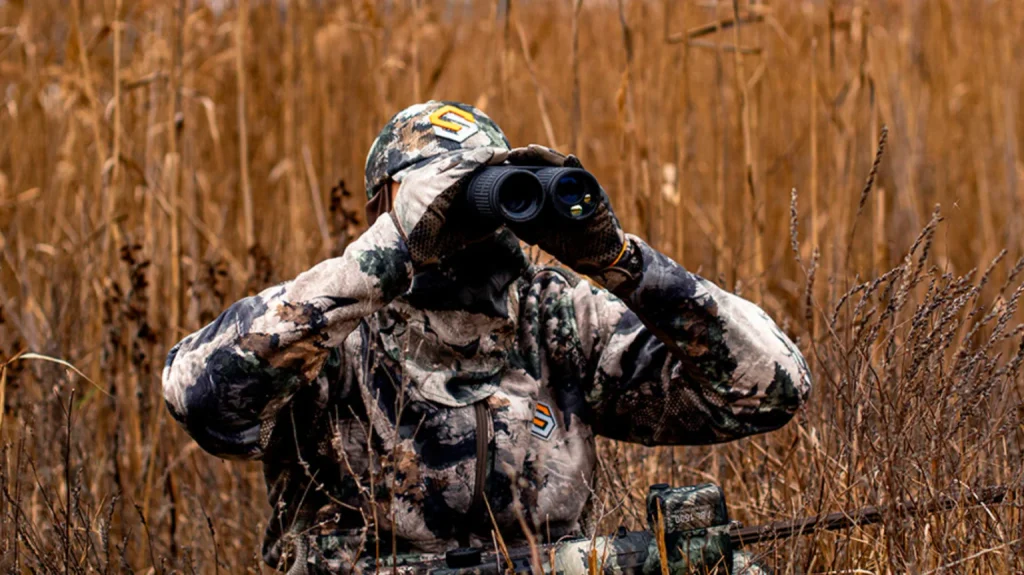
At 5x, hand-holding works for most people across short observations. Bracing against a tree, a post, or a vehicle improves it markedly.
At 8x, the image dances enough to cost you the detail you paid for. An 8x night vision binocular effectively requires a rest, a shooting stick, or a tripod to deliver its advantage.
This is not a fault in the device. It is physics, and it applies to daylight binoculars identically. But at night, working with an already grainy amplified image, tremor hurts more because you have less detail to spare.
The rule: if you cannot brace, buy 5x. If you will be glassing from a high seat, a hide, or a vehicle, 8x earns its place.
Field of View: The Cost of Magnification
Magnification and field of view trade against each other. Basic optical geometry, and there is no way around it.
A 1x goggle gives roughly 40 degrees. A 5x binocular gives considerably less, and an 8x less again. In practice a magnified binocular is slow to scan with and easy to lose a moving animal in.
The consequence for how you work: do not use a binocular as your primary search tool. Locate with something wide, whether that is the naked eye, a thermal monocular, or a 1x device, then bring the binocular up to examine what you found.
If searching ground is your main problem, a thermal monocular will find animals across a valley in seconds, while a magnified night vision binocular would take an hour to stumble on. The two are complementary rather than competing, and thermal vs. night vision sets out the division properly.
How to Spot a Fake Generation Label
You will encounter consumer digital binoculars advertised as Gen 3 at a few hundred pounds. They are not Gen 3, and here is how to tell.
Generation labels describe image intensifier tubes. Gen 1, Gen 2, Gen 2+, and Gen 3 refer to photocathode and microchannel plate technology inside a vacuum tube. A device with a CMOS sensor and a screen has no tube, so it has no generation. Applying one is marketing, not specification.
Four checks that resolve it in seconds:
Price. A genuine Gen 2+ tube costs the manufacturer several hundred euros before anything is built around it. A complete Gen 2+ binocular below about €2,000 does not exist. If a Gen 3 binocular costs €200, it contains no tube.
Illuminator prominence. If the infrared illuminator is the headline feature, with multiple brightness levels advertised, the device depends on it. Tube devices amplify ambient light and use an illuminator only as a fallback. Digital devices need one most nights.
Figure of merit. Any genuine tube device quotes an FOM, which multiplies resolution by signal to noise ratio. Every unit we ship carries an FOM of 1,400 to 1,800. A listing that cannot quote one has nothing to quote.
Daylight tolerance. If the listing says it can be used in daylight, it is digital. Bright light permanently destroys an image intensifier tube. This is the fastest single check.
None of that makes digital devices worthless. A €500 digital binocular is a real product that does a real job in moonlight, records video, and survives being switched on at dawn. It is simply not Gen 3, and it will not work under the cloud with no moon. The full comparison sits in analog night vision.
What the Tube Actually Costs
Genuine Gen 2+ image intensifier binoculars carry two complete tubes, which is why the price sits where it does. Two tubes, two photocathodes, two microchannel plates.
| Model | Magnification | Phosphor | Price |
|---|---|---|---|
| AGM Foxbat-5 NL1 | 5x | Green | $3,520 |
| AGM Foxbat-5 NW1 | 5x | White | $3,630 |
| AGM Foxbat-8 NW1 | 8x | White | $4,620 |
All three are Gen 2+ with a figure of merit of 1,400 to 1,800. Browse the full night vision binocular range.
Note the Foxbat-5 pair. Identical device, identical tube specification, one green and one white, $110 apart. That is the true cost of white phosphor on matched hardware, and it is worth knowing because the market implies a premium of thousands. Larger gaps elsewhere reflect tube grade, not phosphor. We cover the choice in white phosphor night vision; the short version is that white is less tiring across long sessions and green holds a slim edge on the finest detail.
The step from Foxbat-5 to Foxbat-8 costs roughly $990 and buys 8x instead of 5x. Only worth it if you can brace.
Realistic Ranges
For a Gen 2+ binocular at FOM 1,400 to 1,800 against a deer sized target. Detection figures assume you know roughly where to look, since the narrow field makes searching slow.
| Conditions | Detection | Identification at 5x | Identification at 8x |
|---|---|---|---|
| Full moon, clear | 350 to 400 m | 180 to 220 m | 250 to 300 m |
| Quarter moon | 250 to 300 m | 130 to 160 m | 180 to 220 m |
| Starlight, no moon | 150 to 200 m | 80 to 100 m | 110 to 140 m |
| Overcast, no moon | 80 to 120 m | 40 to 60 m | 55 to 75 m |
| Total darkness, no IR | 0 | 0 | 0 |
Two things worth reading twice. Detection does not change with magnification. And ambient light matters far more than magnification does. The gap between a full moon and an overcast is larger than the gap between 5x and 8x.
Should You Buy a Binocular at All?
Honest answers, including the ones that send you elsewhere.
Buy a binocular if you observe from a fixed position, need to identify animals at 150 m or beyond, run sessions long enough that two eyed viewing matters, and can brace or use a rest.
Buy a monocular instead if this is your first tube device. It has handholds, helmet mounts, and sits behind a day scope, covering every role while you learn which one you actually need. The AGM Wolf-14 NL1 at €2,100 is the affordable route in, and the monocular range covers the rest.
Buy a dual-tube goggle instead if you move through terrain rather than observing it. Depth perception at 1x is what makes walking, driving, and negotiating obstacles natural in darkness. See the goggle range.
Buy thermal instead if your problem is finding animals rather than examining them. Thermal sweeps ground in seconds regardless of moon, fog, or cover, whereas a magnified binocular is slow and narrow.
Buy a thermal or fusion binocular if you want binocular ergonomics with detection capability. The ThermTec Ventus is multispectral with an integrated rangefinder, and the AGM Voyage runs a thermal channel alongside a digital night vision channel. Both covered in fusion night vision.
Setup That Most Buyers Get Wrong
A binocular only delivers depth if it is adjusted properly, and this is where the benefit quietly gets lost.
Interpupillary distance. The hinge must be set so each tube sits centered on its eye. Wrong, and the images will not fuse cleanly. You get eye strain and no depth. Set it in the dark, on your own face, before you rely on the device.
Diopter, each eye separately. Both channels focus independently. Close one eye, focus the other on a distant object, then swap. Most people run one eye slightly out for months without noticing.
Dark adaptation. Both eyes sit behind tubes, so you have no naturally adapted eye to fall back on. Taking the binocular down leaves you effectively blind for several minutes. Plan for it. This is the one operational disadvantage a binocular carries against a monocular.
Never in daylight. Bright light destroys the tubes permanently. Two tubes means twice the replacement cost.
Export Control
Gen 2+ image intensifier devices are controlled goods in most jurisdictions, and a binocular carries two controlled tubes rather than one, which attracts more scrutiny.
We confirm we can lawfully ship to your destination before taking payment. If your country prohibits import, we tell you and do not process the order. Send us your country, and we will confirm within a working day: contact us.
Frequently Asked Questions
What is the difference between night vision binoculars and goggles?
Magnification and how they are worn. Goggles run at 1x and are head mounted for hands free movement, because magnification makes terrain unreadable. Binoculars carry 5x or 8x optical magnification, are handheld or tripod mounted, and are for identifying at a distance from a fixed position.
Does more magnification let me see further in the dark?
No. Detection range depends on light gathering, and magnification adds no light. What it extends is identification range, meaning the distance at which you can tell what you are looking at. Buy magnification for identification, not for reach.
What magnification should night vision binoculars have?
5x for handheld use, 8x if you can brace or use a tripod. You will read recommendations for 10x or 12x; those are written about digital devices, quoting digital zoom. Genuine tube binoculars have optical magnification ranging from 1x to 8x.
Are Gen 3 night vision binoculars available for a few hundred pounds?
No. Devices advertised that way are digital sensors carrying a label that describes image intensifier tubes. A genuine Gen 2+ binocular contains two tubes and does not exist below about €2,000. Check for a quoted figure of merit and whether the listing claims daylight use. Daylight destroys a real tube.
How much do real night vision binoculars cost?
Ours runs from $3,520 for a 5x Gen 2+ to $4,620 for an 8x. The price reflects two complete image intensifier tubes rather than one.
Green or white phosphor?
Preference rather than performance. White is less tiring over long sessions and faster to interpret. Green holds a slim edge on the finest detail. On our matched Foxbat-5 pair, the difference is $110, which tells you what the phosphor is actually worth on identical hardware.
Can I use night vision binoculars in daylight?
No. Bright light permanently damages image intensifier tubes, and a binocular has two of them. Digital devices are unaffected, which is one of their genuine advantages.
Do night vision binoculars work in complete darkness?
Not without help. They amplify existing light, so if none is available, there is nothing to amplify. An infrared illuminator supplies invisible light the tubes can use, at the cost of being visible to anyone else running night vision.
Binoculars or a monocular for a first purchase?
Monocular, in almost every case. It covers handheld, helmet mounted and weapon mounted roles for a third of the money, and it teaches you what you actually need before committing to a binocular.
Will you ship night vision binoculars to my country?
Sometimes. Gen 2+ is export controlled in many jurisdictions, and a binocular carries two controlled tubes. Send us your destination and we will confirm before you pay.
Where to Go From Here
- How the technology works: night vision systems explained
- Depth perception and goggles: dual tube night vision
- Green or white: white phosphor night vision
- Tube against digital: analog night vision
- Finding rather than identifying: thermal vs night vision
- Model recommendations: night vision buying guide
- Browse: binoculars · monoculars · goggles · full Gen 2+ range · AGM Global Vision
Unsure whether 5x or 8x suits your ground, or whether a binocular is the right format at all? Tell us how you observe and at what distance you need to identify, and we will tell you honestly, including when a cheaper monocular would serve you better. Talk to us.